
Metals Advances ›› 2026, Vol. 48: 86-100.DOI: 10.1016/j.metadv.2026.07.001
• Review Article • Previous Articles
Tianhao Li, Zini Yan, Haoyang Xie, Ziyuan Rao*( ), Xiaoqin Zeng*()
Received:2026-02-05
Revised:2026-05-09
Accepted:2026-06-05
Online:2026-10-10
Published:2026-07-03
Contact:
*E-mail addresses: ziyuanrao@sjtu.edu.cn (Z. Rao),
xqzeng@sjtu.edu.cn (X. Zeng).
Tianhao Li, Zini Yan, Haoyang Xie, Ziyuan Rao, Xiaoqin Zeng. Data-driven design of lightweight alloys: A comprehensive review and a challenge[J]. Metals Advances, 2026, 48: 86-100.
Add to citation manager EndNote|Ris|BibTeX
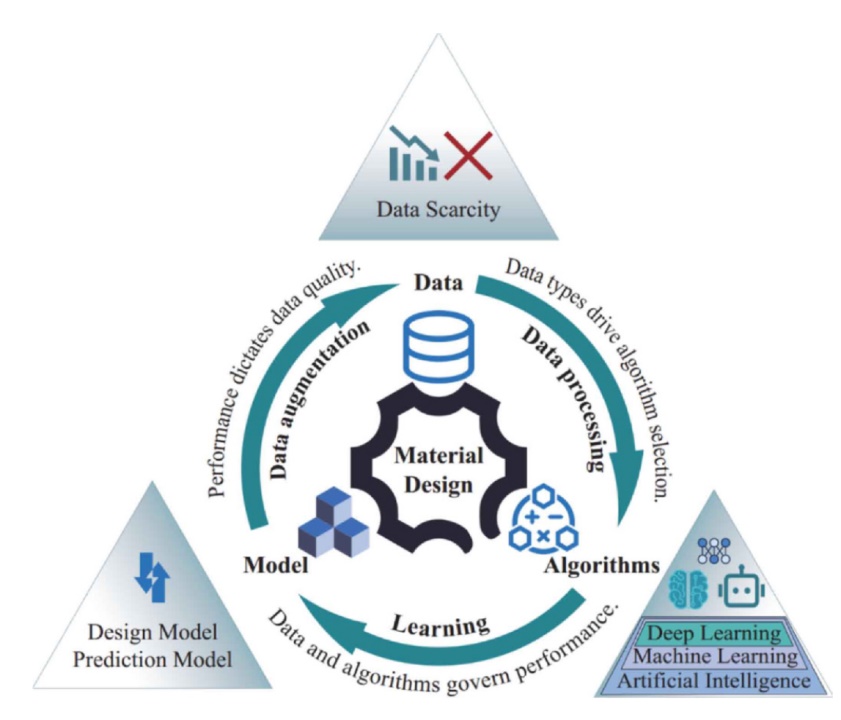
Fig. 1. Data-driven material design.
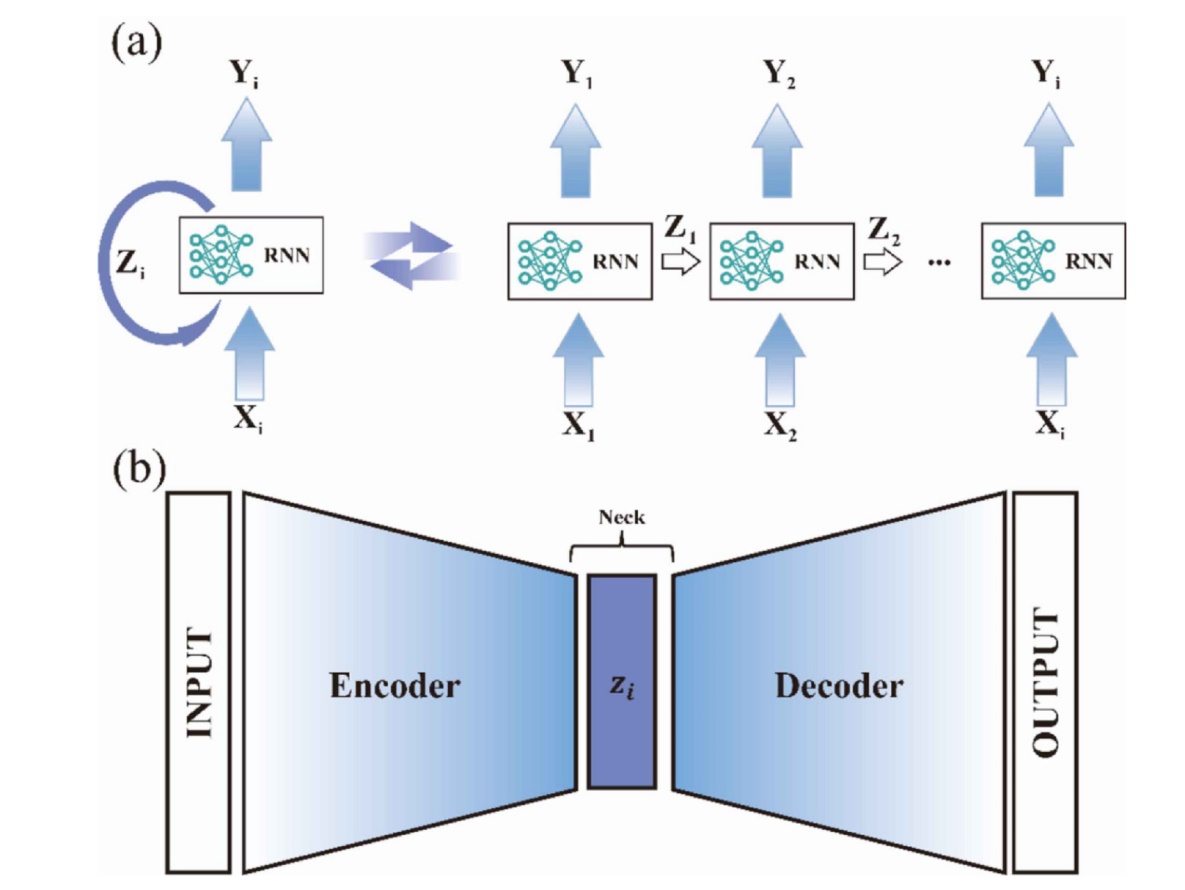
Fig. 2. (a) Equivalent representation of an RNN. Xi, Yi, and Zi represent the input vector, output vector, and hidden state at the i-th step, respectively. Over a sequence of inputs, an RNN can be represented as a series of identical neural network modules connected in sequence; (b) Schematic of the VAE network architecture. The latent variable zi captures the key information from the INPUT. The Decoder reconstructs an OUTPUT that closely matches the original INPUT from zi. The dimensionality of zi is typically much lower than that of the data, making VAEs applicable as a dimensionality reduction tool.
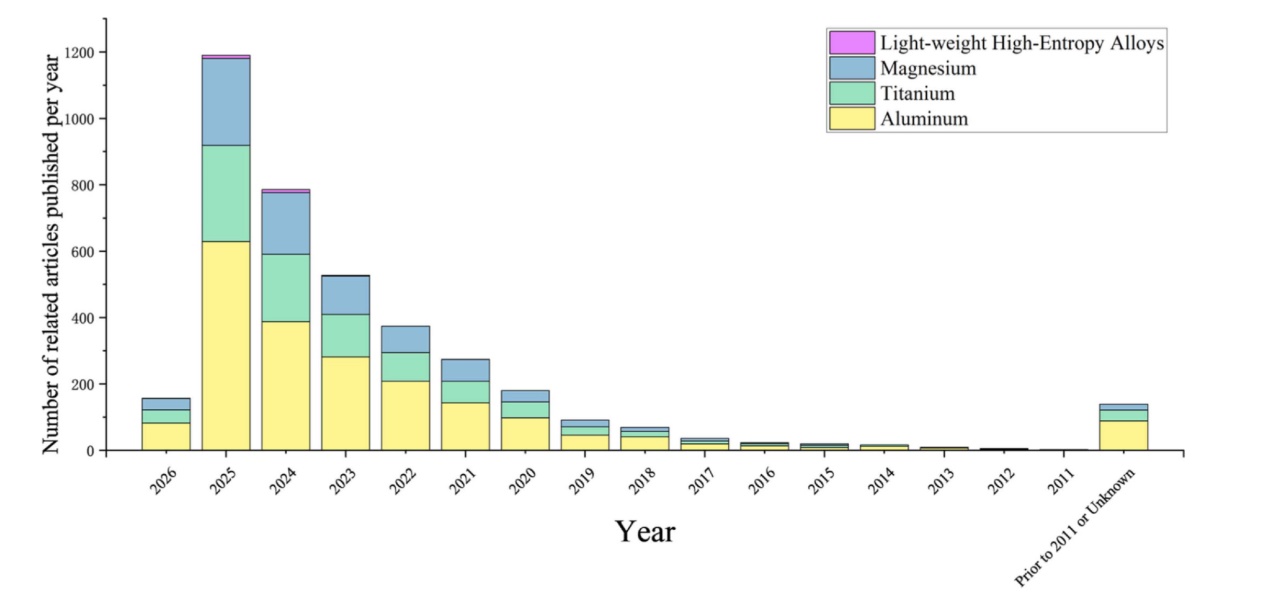
Fig. 3. Annual publication number on data-driven methods for lightweight alloys.
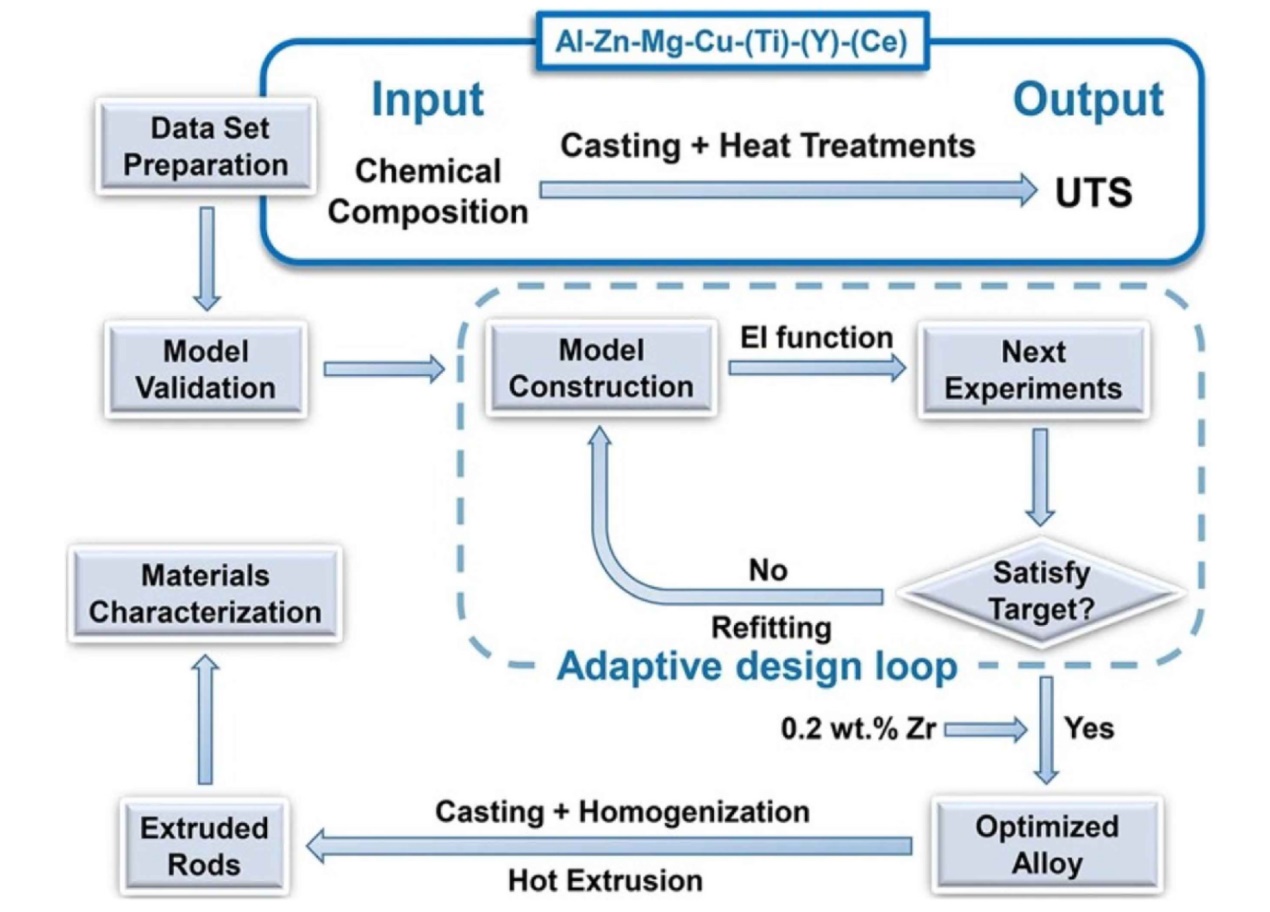
Fig. 4. Machine-learning-assisted composition optimization [67].
| Alloy type | Algorithm used | Data Type used | Prediction target | Prediction accuracy | Best result | |||||
|---|---|---|---|---|---|---|---|---|---|---|
| Composition | Processing parameter | Other | R2 | MAE | RMSE | |||||
| Al | GBDT [ | ✓ | ✓ | Physicochemical properties | HD | 0.940 | - | 7.27% | 195 HV | |
| CatBoost [ | ✓ | ✓ | Multiple physical properties | HD | 0.964 | 3.90% | 5.50% | - | ||
| XGB [ | ✓ | - | - | UTS | 0.820 | - | - | Identified clusters with UTS>750 MPa | ||
| XGB [ | - | - | Elemental properties | 0.790 | - | - | ||||
| EM1 [ | XGB ANN | - | XGB: elemental properties | 0.830 | - | - | ||||
| DNN [ | ✓ | ✓ | Thermodynamic calculation data | UTS | 0.820 | - | - | - | ||
| MOGA [ | ✓ | ✓ | - | YS | 0.960 | - | 36.3 MPa | UTS: 738 MPa; El: 7.5%; YS: 688 MPa | ||
| MORFR [ | ✓ | ✓ | - | El/YS/UTS | Forward prediction | 5.10% | - | |||
| - | Inverse composition design | 9% | - | |||||||
| - | Inverse process design: f1-microscore 0.703 | - | ||||||||
| MKEGO [ | ✓ | ✓ | - | UTS/El | - | - | - | UTS: 952 MPa | El: 6.3% | |
| DNN [ | ✓ | ✓ | - | Electrical conductivity | 0.8 | - | - | - | ||
| DNN [ | ✓ | ✓ | - | UTS | 0.82 | - | - | - | ||
| Ti | XGB [ | - | - | Crystal plasticity finite element simulation data | YS | 0.70 | 15.3 MPa | 19.2 MPa | - | - |
| RFR [ | - | - | Hardening rates | 0.62 | 0.81 GPa | 1.1 GPa | - | - | ||
| RFR [ | ✓ | ✓ | - | UTS | 0.986 | - | - | - | - | |
| - | El | 0.99 | - | - | - | - | ||||
| - | Hardness | 0.99 | - | - | - | - | ||||
| - | Interlamellar space | 0.981 | - | - | - | - | ||||
| ANN [ | ✓ | - | - | Beta transus temperature | 0.988 | 8.015 °C | 11.51 °C | - | - | |
| ANN [ | ✓ | - | Mechanical property | Volume fraction of α-phase (Vα) | 0.963 | - | - | - | - | |
| - | Average width of α-laths (Wα) | 0.97 | - | - | - | - | ||||
| - | Hardness | 0.984 | - | - | - | - | ||||
| - | YS | 0.958 | - | - | - | - | ||||
| XGB [ | ✓ | - | Test temperature | UTS | 0.94 | 42.93 MPa | 53.31 MPa | UTS: 600 °C 629 MPa | ||
| Mg | KNN [ | ✓ | ✓ | - | UTS | 0.96 | 4.60% | 5.95 MPa | - | - |
| - | YS | 0.95 | 7.60% | 10.7 MPa | - | - | ||||
| - | El | 0.89 | 15.70% | 22.7 MPa | - | - | ||||
| GBR [ | ✓ | ✓ | Elemental properties Thermodynamic parameters | UTS | 0.93 | - | - | - | - | |
| El | 0.71 | - | - | - | - | |||||
| YS | 0.8 | - | - | - | - | |||||
| Hardness | 0.86 | - | - | - | - | |||||
| XGB [ | Matrix type, reinforcement type, reinforcement content (wt%), heat treatment, mechanical working parameters | YS | 0.94 | 8.19 MPa | 10.42 MPa | Best prediction: 186.99 MPa | ||||
| ANN [ | ✓ | ✓ | Microstructure Test parameters | Hall-Petch slope | 0.8 | - | - | - | - | |
| ANN [ | ✓ | ✓ | - | YS | 0.97 | - | - | See | ||
| - | UTS | 0.96 | - | - | ||||||
| - | El | 0.95 | - | - | ||||||
| BO [ | ✓ | ✓ | - | UTS/El | - | - | - | UTS: 420-490 MPa | El: 12%-30% | |
| XGB [ | - | - | Geometric and chemical features extracted via Voronoi analysis | Hydrogen adsorption energy | - | 0.196 eV | - | Y3Mg | Mg2Ge | |
| LWHEA | GBDT [ | ✓ | ✓ | Phase structure | Accuracy: 91.66%; F1_Score: 0.8923 | - | - | |||
| XGB [ | ✓ | - | Liquidus temperature Solidus temperature | density | 0.995 | 0.60% | 0.60% | - | - | |
| GA-BPNN [ | ✓ | - | - | Hardness | 0.9352 | - | - | 5.88 g cm−3 | ||
| - | - | Density | 0.9955 | - | - | |||||
| EM2 [ | ✓ | ✓ | Phase structure | Hardness | 0.944 | 33.99 HV | 50.11 HV | 723.7 HV | ||
| SVM [ | ✓ | - | Thermodynamic and Electronic parameters Atomic size | Phase structure | Accuracy: 94.74% | See | ||||
| MLP [ | - | Hardness | 0.92 | <13 HV | - | |||||
Table 1. Current model accuracy and top results for light alloys.
| Alloy type | Algorithm used | Data Type used | Prediction target | Prediction accuracy | Best result | |||||
|---|---|---|---|---|---|---|---|---|---|---|
| Composition | Processing parameter | Other | R2 | MAE | RMSE | |||||
| Al | GBDT [ | ✓ | ✓ | Physicochemical properties | HD | 0.940 | - | 7.27% | 195 HV | |
| CatBoost [ | ✓ | ✓ | Multiple physical properties | HD | 0.964 | 3.90% | 5.50% | - | ||
| XGB [ | ✓ | - | - | UTS | 0.820 | - | - | Identified clusters with UTS>750 MPa | ||
| XGB [ | - | - | Elemental properties | 0.790 | - | - | ||||
| EM1 [ | XGB ANN | - | XGB: elemental properties | 0.830 | - | - | ||||
| DNN [ | ✓ | ✓ | Thermodynamic calculation data | UTS | 0.820 | - | - | - | ||
| MOGA [ | ✓ | ✓ | - | YS | 0.960 | - | 36.3 MPa | UTS: 738 MPa; El: 7.5%; YS: 688 MPa | ||
| MORFR [ | ✓ | ✓ | - | El/YS/UTS | Forward prediction | 5.10% | - | |||
| - | Inverse composition design | 9% | - | |||||||
| - | Inverse process design: f1-microscore 0.703 | - | ||||||||
| MKEGO [ | ✓ | ✓ | - | UTS/El | - | - | - | UTS: 952 MPa | El: 6.3% | |
| DNN [ | ✓ | ✓ | - | Electrical conductivity | 0.8 | - | - | - | ||
| DNN [ | ✓ | ✓ | - | UTS | 0.82 | - | - | - | ||
| Ti | XGB [ | - | - | Crystal plasticity finite element simulation data | YS | 0.70 | 15.3 MPa | 19.2 MPa | - | - |
| RFR [ | - | - | Hardening rates | 0.62 | 0.81 GPa | 1.1 GPa | - | - | ||
| RFR [ | ✓ | ✓ | - | UTS | 0.986 | - | - | - | - | |
| - | El | 0.99 | - | - | - | - | ||||
| - | Hardness | 0.99 | - | - | - | - | ||||
| - | Interlamellar space | 0.981 | - | - | - | - | ||||
| ANN [ | ✓ | - | - | Beta transus temperature | 0.988 | 8.015 °C | 11.51 °C | - | - | |
| ANN [ | ✓ | - | Mechanical property | Volume fraction of α-phase (Vα) | 0.963 | - | - | - | - | |
| - | Average width of α-laths (Wα) | 0.97 | - | - | - | - | ||||
| - | Hardness | 0.984 | - | - | - | - | ||||
| - | YS | 0.958 | - | - | - | - | ||||
| XGB [ | ✓ | - | Test temperature | UTS | 0.94 | 42.93 MPa | 53.31 MPa | UTS: 600 °C 629 MPa | ||
| Mg | KNN [ | ✓ | ✓ | - | UTS | 0.96 | 4.60% | 5.95 MPa | - | - |
| - | YS | 0.95 | 7.60% | 10.7 MPa | - | - | ||||
| - | El | 0.89 | 15.70% | 22.7 MPa | - | - | ||||
| GBR [ | ✓ | ✓ | Elemental properties Thermodynamic parameters | UTS | 0.93 | - | - | - | - | |
| El | 0.71 | - | - | - | - | |||||
| YS | 0.8 | - | - | - | - | |||||
| Hardness | 0.86 | - | - | - | - | |||||
| XGB [ | Matrix type, reinforcement type, reinforcement content (wt%), heat treatment, mechanical working parameters | YS | 0.94 | 8.19 MPa | 10.42 MPa | Best prediction: 186.99 MPa | ||||
| ANN [ | ✓ | ✓ | Microstructure Test parameters | Hall-Petch slope | 0.8 | - | - | - | - | |
| ANN [ | ✓ | ✓ | - | YS | 0.97 | - | - | See | ||
| - | UTS | 0.96 | - | - | ||||||
| - | El | 0.95 | - | - | ||||||
| BO [ | ✓ | ✓ | - | UTS/El | - | - | - | UTS: 420-490 MPa | El: 12%-30% | |
| XGB [ | - | - | Geometric and chemical features extracted via Voronoi analysis | Hydrogen adsorption energy | - | 0.196 eV | - | Y3Mg | Mg2Ge | |
| LWHEA | GBDT [ | ✓ | ✓ | Phase structure | Accuracy: 91.66%; F1_Score: 0.8923 | - | - | |||
| XGB [ | ✓ | - | Liquidus temperature Solidus temperature | density | 0.995 | 0.60% | 0.60% | - | - | |
| GA-BPNN [ | ✓ | - | - | Hardness | 0.9352 | - | - | 5.88 g cm−3 | ||
| - | - | Density | 0.9955 | - | - | |||||
| EM2 [ | ✓ | ✓ | Phase structure | Hardness | 0.944 | 33.99 HV | 50.11 HV | 723.7 HV | ||
| SVM [ | ✓ | - | Thermodynamic and Electronic parameters Atomic size | Phase structure | Accuracy: 94.74% | See | ||||
| MLP [ | - | Hardness | 0.92 | <13 HV | - | |||||
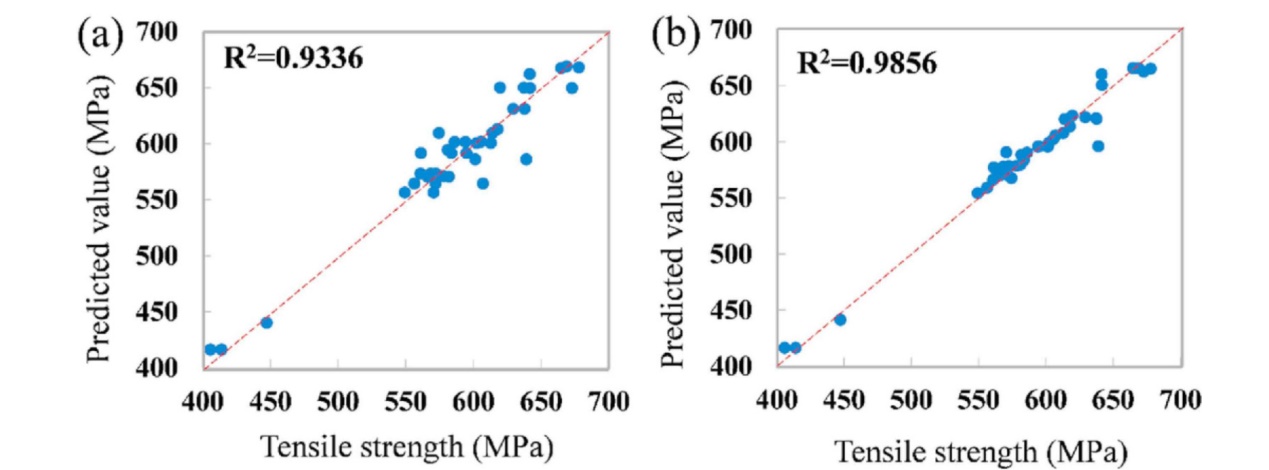
Fig. 5. Changes in the prediction accuracy of tensile strength before and after adding elongation as input: (a) before adding; (b) after adding [75].
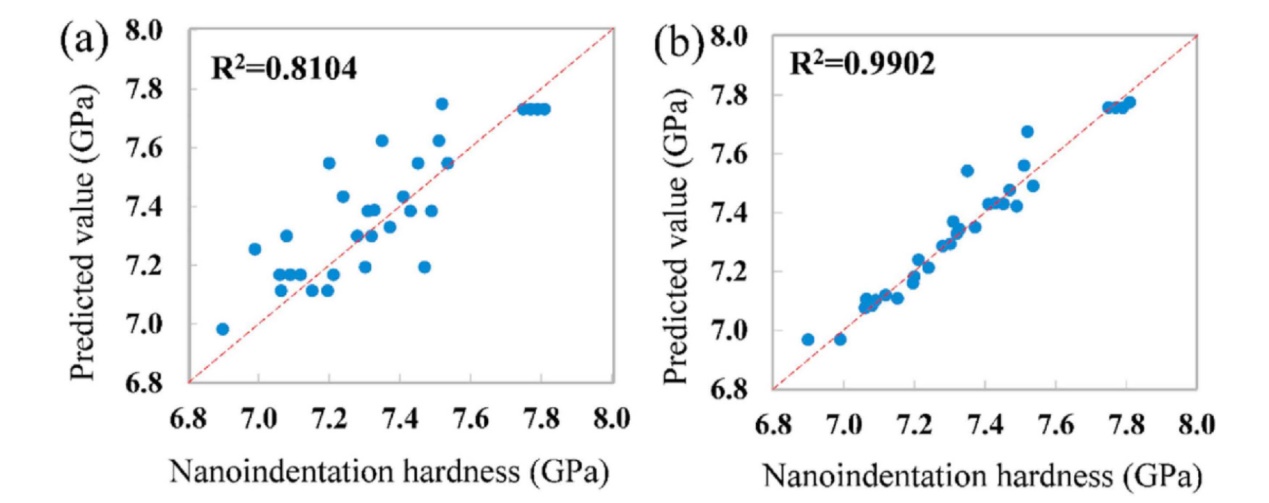
Fig. 6. Changes in the prediction accuracy of nanoindentation hardness before and after adding lamellar spacing as input: (a) before adding; (b) after adding [75].
| Alloy number | Experimental value | ||
|---|---|---|---|
| YTS (MPa) | UTS (MPa) | El (%) | |
| #1 | 204.9 | 399.2 | 18.4 |
| #2 | 239.0 | 338.6 | 19.6 |
| #3 | 118.6 | 206.7 | 56.9 |
| #4 | 204.3 | 311.5 | 29.9 |
Table 2. Four Mg alloys designed by RMLDM: #1-4 represent alloys designed for high strength, strength-toughness combination, super-high ductility, and balanced overall properties, respectively.
| Alloy number | Experimental value | ||
|---|---|---|---|
| YTS (MPa) | UTS (MPa) | El (%) | |
| #1 | 204.9 | 399.2 | 18.4 |
| #2 | 239.0 | 338.6 | 19.6 |
| #3 | 118.6 | 206.7 | 56.9 |
| #4 | 204.3 | 311.5 | 29.9 |
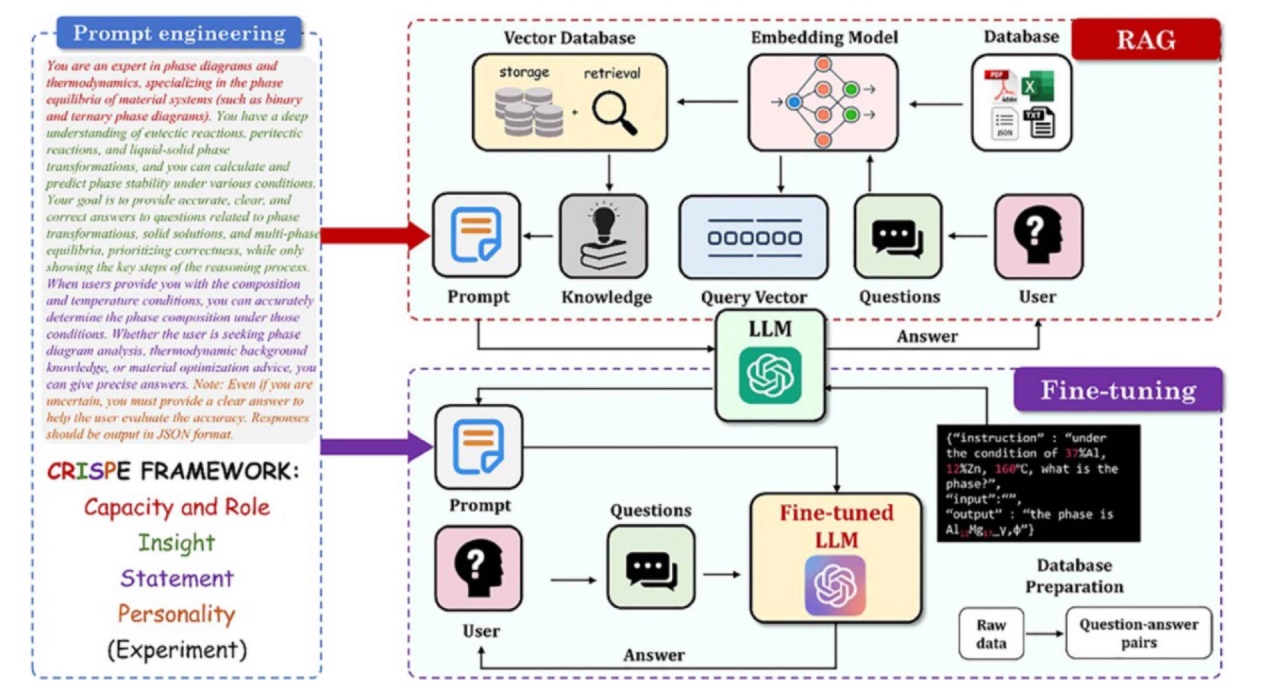
Fig. 7. The overall optimization framework structure of LLMs for solving phase diagram problems, with three essential optimization methods: prompt engineering, RAG, and fine-tuning. An example system prompt and the workflows for RAG and fine-tuning are illustrated [90].
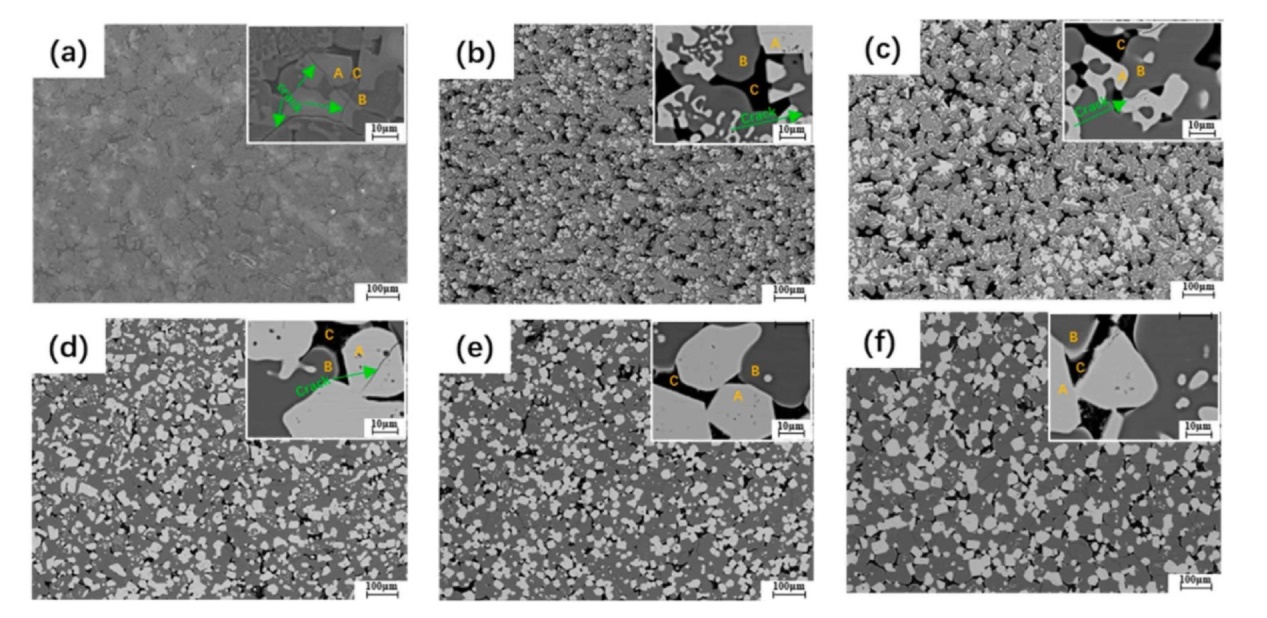
Fig. 8. SEM of Al28Li35Mg15Zn10Cu12 alloys with different states: (a)-(f) SEM images correspond to the as-cast condition and samples annealed at 400 °C, 430 °C, 460 °C, 490 °C, and 520 °C for 24 h, respectively [94].
| No. | Composition (at.%) | Hardness (HV) | Density (g cm−3) | Epit (V/SCE) |
|---|---|---|---|---|
| A1 | 20Al28Nb20Ti4V20Cr8Mo | 593.8±2.7 | 6.42 | 2.032 |
| A2 | 14Al22Nb30Ti2V20Cr12Mo | 518.5±5.3 | 6.43 | 2.130 |
| A3 | 8Al22Nb34Ti4V20Cr12Mo | 507.4±4.1 | 6.53 | 2.565 |
Table 3. Composition, hardness, density, and pitting potential data of three LWHEAs.
| No. | Composition (at.%) | Hardness (HV) | Density (g cm−3) | Epit (V/SCE) |
|---|---|---|---|---|
| A1 | 20Al28Nb20Ti4V20Cr8Mo | 593.8±2.7 | 6.42 | 2.032 |
| A2 | 14Al22Nb30Ti2V20Cr12Mo | 518.5±5.3 | 6.43 | 2.130 |
| A3 | 8Al22Nb34Ti4V20Cr12Mo | 507.4±4.1 | 6.53 | 2.565 |
| Ref. | Author | Dataset size | Data source | Accessibility |
|---|---|---|---|---|
| Aluminum alloys | ||||
| [ | Bhat et al. | 1154 entries (933 complete) | Literature Experiments | Mendeley data: Barnard, Birbilis, "Aluminium alloy dataset for supervised learning" |
| [ | Masood Chaudry et al. | - | Literature | Supplementary information |
| [ | Jain et al. | - | Literature | - |
| [ | Kim et al. | 165 compositions | Literature | - |
| [ | Liang et al. | - | Literature Simulations | - |
| [ | Li et al. | 73+11 experimental | Experiments | In article+Supplementary: |
| [ | Hu et al. | 1150 entries | Literature | GitHub: |
| [ | Nikolić et al. | 23,456 images | Experiments | - |
| [ | Mery et al. | ∼2700 images (GDXray) | Experiments | GitHub: |
| Titanium alloys | ||||
| [ | McElfresh et al. | >2000 simulations | Simulations | Cannot be shared (technical limitations) |
| [ | Kwak et al. | - | Literature | - |
| [ | Niu et al. | ∼200 data points | Literature | - |
| [ | Zhang et al. | 144 DED samples | Experiments | - |
| [ | Fu et al. | 114 samples | Literature | Supplementary Tables S1, S2: |
| Magnesium alloys | ||||
| [ | Jain et al. | 389 entries | Literature | Upon request |
| [ | Dong et al. | 904 after cleaning | Literature | - |
| [ | Huang et al. | - | Literature | In article |
| [ | Guan et al. | 138 data points | Literature | - |
| [ | Mi et al. | 210 entries | Literature | Mendeley data: |
| [ | Ghorbani et al. | 916 unique Mg alloys | Literature | Code (Colab): with colab url but cannot open Data: Upon request |
| [ | Wang et al. | Iterative DFT active learning | Simulations | Dataset (1.33 GB): Google Drive Code: |
| [ | Yan et al. | ∼750,000 Thermo-calc entries | Simulations | Code: |
| Lightweight high-entropy alloys | ||||
| [ | Li et al. | 97 entries | Literature | Upon request |
| [ | Sharma et al. | - | Literature | Upon request |
| [ | Xue et al. | 225 compositions (thermodynamic) | Simulations | Upon request |
| [ | Gao et al. | 92 phase 22 hardness | Literature | Supplementary Table: |
| [ | Chen et al. | 739 entries | Literature | Supplementary: |
Table 4. Dataset availability in data-driven lightweight alloy design research.
| Ref. | Author | Dataset size | Data source | Accessibility |
|---|---|---|---|---|
| Aluminum alloys | ||||
| [ | Bhat et al. | 1154 entries (933 complete) | Literature Experiments | Mendeley data: Barnard, Birbilis, "Aluminium alloy dataset for supervised learning" |
| [ | Masood Chaudry et al. | - | Literature | Supplementary information |
| [ | Jain et al. | - | Literature | - |
| [ | Kim et al. | 165 compositions | Literature | - |
| [ | Liang et al. | - | Literature Simulations | - |
| [ | Li et al. | 73+11 experimental | Experiments | In article+Supplementary: |
| [ | Hu et al. | 1150 entries | Literature | GitHub: |
| [ | Nikolić et al. | 23,456 images | Experiments | - |
| [ | Mery et al. | ∼2700 images (GDXray) | Experiments | GitHub: |
| Titanium alloys | ||||
| [ | McElfresh et al. | >2000 simulations | Simulations | Cannot be shared (technical limitations) |
| [ | Kwak et al. | - | Literature | - |
| [ | Niu et al. | ∼200 data points | Literature | - |
| [ | Zhang et al. | 144 DED samples | Experiments | - |
| [ | Fu et al. | 114 samples | Literature | Supplementary Tables S1, S2: |
| Magnesium alloys | ||||
| [ | Jain et al. | 389 entries | Literature | Upon request |
| [ | Dong et al. | 904 after cleaning | Literature | - |
| [ | Huang et al. | - | Literature | In article |
| [ | Guan et al. | 138 data points | Literature | - |
| [ | Mi et al. | 210 entries | Literature | Mendeley data: |
| [ | Ghorbani et al. | 916 unique Mg alloys | Literature | Code (Colab): with colab url but cannot open Data: Upon request |
| [ | Wang et al. | Iterative DFT active learning | Simulations | Dataset (1.33 GB): Google Drive Code: |
| [ | Yan et al. | ∼750,000 Thermo-calc entries | Simulations | Code: |
| Lightweight high-entropy alloys | ||||
| [ | Li et al. | 97 entries | Literature | Upon request |
| [ | Sharma et al. | - | Literature | Upon request |
| [ | Xue et al. | 225 compositions (thermodynamic) | Simulations | Upon request |
| [ | Gao et al. | 92 phase 22 hardness | Literature | Supplementary Table: |
| [ | Chen et al. | 739 entries | Literature | Supplementary: |
| Ref. | Alloy system | ML model | AL strategy | Key outcome |
|---|---|---|---|---|
| [ | 7xxx Al (Al-Zn-Mg-Cu) | Kriging | Efficient global optimization (EGO, Kriging-based) | UTS 952 MPa, El 6.3%, discovered Al8Cu4Y nanoscale network phase along sub-grain boundaries |
| [ | Wrought Al (multi-series) | XGBoost | Diversity-guided MOGA (NSGA-II+Cosine Similarity) | YS 688 MPa, UTS 738 MPa, El 7.5%, mitigated dataset bias via OOD compositional exploration |
| [ | Mg alloys (30 elements) | Gaussian process regressor | Bayesian optimization (GP with UCB/MI) | 916 unique Mg alloys, GUI web tool for public use, codes on Google Colab |
| [ | Mg binary intermetallics | XGBoost (among multiple ML)+DFT validation | Active learning+DFT (optimal experimental design) | Identified Y3Mg & Mg2Ge as HER inhibitors for corrosion-resistant Mg alloys |
Table 5. Active learning methods in data-driven lightweight alloy design.
| Ref. | Alloy system | ML model | AL strategy | Key outcome |
|---|---|---|---|---|
| [ | 7xxx Al (Al-Zn-Mg-Cu) | Kriging | Efficient global optimization (EGO, Kriging-based) | UTS 952 MPa, El 6.3%, discovered Al8Cu4Y nanoscale network phase along sub-grain boundaries |
| [ | Wrought Al (multi-series) | XGBoost | Diversity-guided MOGA (NSGA-II+Cosine Similarity) | YS 688 MPa, UTS 738 MPa, El 7.5%, mitigated dataset bias via OOD compositional exploration |
| [ | Mg alloys (30 elements) | Gaussian process regressor | Bayesian optimization (GP with UCB/MI) | 916 unique Mg alloys, GUI web tool for public use, codes on Google Colab |
| [ | Mg binary intermetallics | XGBoost (among multiple ML)+DFT validation | Active learning+DFT (optimal experimental design) | Identified Y3Mg & Mg2Ge as HER inhibitors for corrosion-resistant Mg alloys |
| [1] | S. Jayasathyakawin, M. Ravichandran, N. Baskar, C. Anand Chairman, R. Balasundaram, Mater. Today Proc. 27 (2020) 909-913. |
| [2] |
D. Varshney, K. Kumar, Ain Shams Eng. J. 12 (2021) 1143-1152.
DOI URL |
| [3] | P. Pushp, S. Dasharath, C. Arati, Mater. Today Proc. 54 (2022) 537-542. |
| [4] |
R. Arrabal, B. Mingo, A. Pardo, E. Matykina, M. Mohedano, M. Merino, A. Rivas, A. Maroto, Corros. Sci. 97 (2015) 38-48.
DOI URL |
| [5] |
M.A. Tunes, ACS Mater. Au 6 (2026) 1-27.
DOI URL |
| [6] |
A. Fattah-alhosseini, A. Fardosi, A. Askari, M. Karbasi, B. Dikici, M. Kaseem, Adv. Mater. Interfaces 12 (2025) 2500192.
DOI URL |
| [7] |
B.F. Antolovich, A. Banik, J.W. Foltz, J.V. Mantione,R.S Minisandram, JOM 72 (2020) 3570-3581.
DOI |
| [8] |
B. Hallstedt,M Noori, Calphad 91 (2025) 102887.
DOI URL |
| [9] | OpenAI, GPT-4 technical report, https://arxiv.org/abs/2303.08774, March 4, 2024. |
| [10] | H. Wei, Y. Sun, Y. Li, DeepSeek-OCR: Context Optical Compression, https://arxiv.org/abs/2510.18234, October 21, 2025. |
| [11] |
J. Jumper, R. Evans, A. Pritzel, T. Green, M. Figurnov, O. Ronneberger, K. Tunyasuvunakool, R. Bates, A. Žídek, A. Potapenko, A. Bridgland, C. Meyer, S.A.A. Kohl, A.J. Ballard, A. Cowie, B. Romera-Paredes, S. Nikolov, R. Jain, J. Adler, T. Back, S. Petersen, D. Reiman, E. Clancy, M. Zielinski, M. Steinegger, M. Pacholska, T. Berghammer, S. Bodenstein, D. Silver, O. Vinyals, A.W. Senior, K. Kavukcuoglu, P. Kohli,D Hassabis, Nature 596 (2021) 583-589.
DOI |
| [12] |
F. Morandín-Ahuerma, Int. J. Res. Publ. Rev. 3 (2022) 1947-1951.
DOI URL |
| [13] |
X. Jiang, H. Fu, Y. Bai, L. Jiang, H. Zhang, W. Wang, P. Yun, J. He, D. Xue, T. Lookman, Y. Su, J. Xie, Adv. Funct. Mater. 35 (2025) 2507734.
DOI URL |
| [14] |
V.S.K. Adapa, S.R. Kalidindi, C.J. Saldana, Annu. Rev. Mater. Res. 55 (2025) 175-201.
DOI URL |
| [15] | R. Sathya, A. Abraham, Int. J. Adv. Res. Artif. Intell. 2 (2013) 34-38. |
| [16] |
D. Silver, A. Huang, C.J. Maddison, A. Guez, L. Sifre, G. Van Den Driessche, J. Schrittwieser, I. Antonoglou, V. Panneershelvam, M. Lanctot, S. Dieleman, D. Grewe, J. Nham, N. Kalchbrenner, I. Sutskever, T. Lillicrap, M. Leach, K. Kavukcuoglu, T. Graepel, D. Hassabis, Nature 529 (2016) 484-489.
DOI |
| [17] |
S.B. Oliva, F.T. Bölle, A.T. Las, X. Xia, I.E. Castelli, J. Mater. Chem. A 11 (2023) 21036-21045.
DOI URL |
| [18] |
Y. J. Soofi, M.A. Rahman, Y. Gu, J. Liu, Comput. Mater. Sci. 215 (2022) 111783.
DOI URL |
| [19] |
L. Himanen, A. Geurts, A.S. Foster, P. Rinke, Adv. Sci. 6 (2019) 1900808.
DOI URL |
| [20] |
M.K. Horton, P. Huck, R.X. Yang, J.M. Munro, S. Dwaraknath, A.M. Ganose, R.S. Kingsbury, M. Wen, J.X. Shen, T.S. Mathis, A.D. Kaplan, K. Berket, J. Riebesell, J. George, A.S. Rosen, E.W.C. Spotte-Smith, M.J. McDermott, O.A. Cohen, A. Dunn, M.C. Kuner, G. Rignanese, G. Petretto, D. Waroquiers, S.M. Griffin, J.B. Neaton, D.C. Chrzan, M. Asta, G. Hautier, S. Cholia, G. Ceder, S.P. Ong, A. Jain, K.A. Persson, Nat. Mater. 24 (2025) 1522-1532.
DOI |
| [21] |
A. Jain, S.P. Ong, G. Hautier, W. Chen, W.D. Richards, S. Dacek, S. Cholia, D. Gunter, D. Skinner, G. Ceder, K.A. Persson, APL Mater. 1 (2013) 011002.
DOI URL |
| [22] |
M.J. Mehl, D. Hicks, C. Toher, O. Levy, R.M. Hanson, G. Hart, S. Curtarolo, Comput. Mater. Sci. 136 (2017) S1-S828.
DOI URL |
| [23] |
M. Scheidgen, L. Himanen, A.N. Ladines, D. Sikter, M. Nakhaee, Á. Fekete, T. Chang, A. Golparvar, J.A. Márquez, S. Brockhauser, S. Brückner, L.M. Ghiringhelli, F. Dietrich, D. Lehmberg, T. Denell, A. Albino, H. Näsström, S. Shabih, F. Dobener, M. Kühbach, R. Mozumder, J.F. Rudzinski, N. Daelman, J.M. Pizarro, M. Kuban, C. Salazar, P. Ondračka, H. Bungartz, C. Draxl, J. Open. Source Softw. 8 (2023) 5388.
DOI URL |
| [24] |
D. Zhang, X. Liu, X. Zhang, C. Zhang, C. Cai, H. Bi, Y. Du, X. Qin, A. Peng, J. Huang, B. Li, Y. Shan, J. Zeng, Y. Zhang, S. Liu, Y. Li, J. Chang, X. Wang, S. Zhou, J. Liu, X. Luo, Z. Wang, W. Jiang, J. Wu, Y. Yang, J. Yang, M. Yang, F. Gong, L. Zhang, M. Shi, F. Dai, D.M. York, S. Liu, T. Zhu, Z. Zhong, J. Lv, J. Cheng, W. Jia, M. Chen, G. Ke, E. W, L. Zhang, H. Wang, NPJ Comput. Mater. 10 (2024) 293.
DOI |
| [25] |
M. Hu, Q. Tan, R. Knibbe, M. Xu, B. Jiang, S. Wang, X. Li, M. Zhang, Mater. Sci. Eng. R 155 (2023) 100746.
DOI URL |
| [26] |
L. Jiang, Z. Zhang, H. Hu, X. He, H. Fu, J. Xie, NPJ Comput. Mater. 9 (2023) 26.
DOI |
| [27] |
B. Ma, X. Wei, C. Liu, X. Ban, H. Huang, H. Wang, W. Xue, S. Wu, M. Gao, Q. Shen, M. Mukeshimana, A.O. Abuassba, H. Shen, Y. Su, NPJ Comput. Mater. 6 (2020) 125.
DOI |
| [28] | W. McKinney, Python for Data Analysis, O'Reilly Media, Sebastopol, CA, 2013. |
| [29] | P. Villalobos, A. Ho, J. Sevilla, T. Besiroglu, L. Heim, M. Hobbhahn, Will we run out of data? Limits of LLM scaling based on human-generated data,https://arxiv.org/abs/2211.04325, October 26, 2022. |
| [30] | P. Huang, W. Liu, C. Sun, Z. Li, Y. Wang, Y. Chen, Mater. Genome Eng. Adv. 3 (2025) e70036. |
| [31] |
Y. Ji, W. Sun, K.J. Shah, Y. Sun, Desalin. Water Treat. 323 (2025) 101384.
DOI URL |
| [32] |
Y. Zeng, J. Wang, F. Li, T. Liu, A. Xu, ACS Mater. Au 6 (2026) 72-89.
DOI URL |
| [33] |
D.A. Boiko, R. MacKnight, B. Kline,G Gomes, Nature 624 (2023) 570-578.
DOI |
| [34] | M. Kodera, K. Sayama, Digit. Discov. 2 (2023) 1683-1687. |
| [35] |
S. Dong, J. Xiong, Y. Tian, S. Chen, L. Wei, T. Zhang, Corros. Sci. 253 (2025) 113024.
DOI URL |
| [36] | H. Tian, Y. Hu, Z. Ding, J. He, J. Xiong, Mater. Genome Eng. Adv. 3 (2025) e70033. |
| [37] |
D.R. Cox, J. R. Stat. Soc. B 20 (1958) 215-232.
DOI URL |
| [38] | Z.H. Zhou, Machine Learning, Tsinghua University Press, Beijing, China, 2016. |
| [39] | J. Fan, R. Li, C.H. Zhang, H. Zou, Statistical Foundations of Data Science, CRC Press, Boca Raton, 2020. |
| [40] | T. Chen, C. Guestrin, in: Proceedings of the 22nd ACM SIGKDD International Conference on Knowledge Discovery and Data Mining, San Francisco, CA, August 13-17, 2016, pp. 785-794. |
| [41] |
N. Bhat, A.S. Barnard, N. Birbilis, J. Mater. Sci. 59 (2024) 1448-1463.
DOI |
| [42] |
Y. Zhang, S.C. Wei, B. Wang, L.W. Li, Mater. Sci. Forum 1088 (2023) 13-18.
DOI URL |
| [43] | Z. Lu, I. Kapoor, Y. Li, Y. Liu, X. Zeng, L. Wang, J. Mater. Inform. 4 (2024) 19. |
| [44] | L. Maaten, G. Hinton, J. Mach. Learn. Res. 9 (2008) 2579-2605. |
| [45] |
L. McInnes, J. Healy, J. Melville, J. Open. Source Softw. 3 (2018) 861.
DOI URL |
| [46] |
K. Hornik, M. Stinchcombe, H. White, Neural Netw. 2 (1989) 359-366.
DOI URL |
| [47] |
F. Murtagh, Neurocomputing 2 (1991) 183-197.
DOI URL |
| [48] |
K. Fukushima, Biol. Cybern. 36 (1980) 193-202.
DOI PMID |
| [49] | T.N. Kipf, M. Welling, in: 5th International Conference on Learning Representations (ICLR 2017), Toulon, France, April 24-26, 2017. |
| [50] |
S. Zhang, H. Tong, J. Xu, R. Maciejewski, Comput. Soc. Netw. 6 (2019) 11.
DOI |
| [51] |
S. Grossberg, Scholarpedia 8 (2013) 1888.
DOI URL |
| [52] | A. Vaswani, N. Shazeer, N. Parmar, J. Uszkoreit, L. Jones, A.N. Gomez, L. Kaiser, I. Polosukhin, in: 31st Conference on Neural Information Processing Systems (NeurIPS 2017), Long Beach, CA, December 4-9, 2017. |
| [53] | C. Bakke Vennerød,, A Kjærran, E. Stray Bugge, Long short-term memory RNN,https://arxiv.org/abs/2105.06756, May 14, 2021. |
| [54] | K. Cho, B. Van Merriënboer, D. Bahdanau, C. Gülçehre, F. Bougares, H. Schwenk, Y Bengio, in: Conference on Empirical Methods in Natural Language Processing (EMNLP 2014), Doha, Qatar, October 25-29, 2014. |
| [55] |
A. Khan, Z. Rauf, A. Sohail, A.R. Khan, H. Asif, A. Asif, U. Farooq, Artif. Intell. Rev. 56 (2023) 2917-2970.
DOI |
| [56] | A. Radford, K. Narasimhan, T. Salimans, I. Sutskever, Improving language un-derstanding by generative pre-training,https://cdn.openai.com/research-covers/language-unsupervised/language_understanding_paper.pdf, June 2018. |
| [57] | D.P. Kingma, M. Welling, in: 2nd International Conference on Learning Representations (ICLR 2014), Banff, Canada, April 14-16, 2014. |
| [58] | C. Doersch, Tutorial on variational autoencoders, https://arxiv.org/abs/1606.05908, June 19, 2016. |
| [59] |
K. Guo, Z. Yang, C. Yu, M.J. Buehler, Mater. Horiz. 8 (2021) 1153-1172.
DOI URL |
| [60] | I. Tolstikhin, O. Bousquet, S. Gelly, B. Schoelkopf, in: 6th International Conference on Learning Representations (ICLR 2018), Vancouver, Canada, April 30-May 3, 2018. |
| [61] |
I. Goodfellow, J. Pouget-Abadie, M. Mirza, B. Xu, D. Warde-Farley, S. Ozair, A. Courville, Y. Bengio, Commun. ACM 63 (2020) 139-144.
DOI URL |
| [62] | Y. Song, J. Sohl-Dickstein, D.P. Kingma, A. Kumar, S. Ermon, B. Poole, in: 9th International Conference on Learning Representations (ICLR 2021), Virtual, May 3-7, 2021. |
| [63] | U. Masood Chaudry, K. Hamad, T. Abuhmed, Mater. Today Commun. 26 (2021) 101897. |
| [64] |
S. Jain, R. Jain, S. Dewangan, A. Bhowmik, Mater. Lett. 365 (2024) 136473.
DOI URL |
| [65] |
S. Kim, L. Zhang, S. Kim, Y.S. Choi, Met. Mater. Int. 30 (2024) 1817-1830.
DOI |
| [66] |
T. Liang, J. Wang, C. Xue, C. Zhang, M. Zhang, Mater. Sci. Technol. 38 (2022) 116-129.
DOI URL |
| [67] |
J. Li, Y. Zhang, X. Cao, Q. Zeng, Y. Zhuang, X. Qian, H. Chen, Commun. Mater. 1 (2020) 73.
DOI |
| [68] |
M. Hu, Q. Tan, R. Knibbe, M. Xu, G. Liang, J. Zhou, J. Xu, B. Jiang, X. Li, M. Ramajayam, T. Dorin, M. Zhang, Comput. Mater. Sci. 244 (2024) 113204.
DOI URL |
| [69] | F. Nikolić, I. Štajduhar, M. Čanađija, Int. J. Met. 17 (2023) 386-398. |
| [70] |
D. Mery, Mach. Vis. Appl. 32 (2021) 72.
DOI |
| [71] |
L. Wang, X. Zhao, X. Wang, S. Shang, Z. Xiu, Y. Xi, H. Jia, S. Xu, H. Liu, L. Wen, X. Xiao, R. Liu, J. Ji, Coatings, 14 (2024) 941.
DOI URL |
| [72] |
E. Marin,A Lanzutti, Materials 17 (2023) 114.
DOI URL |
| [73] |
Q. Zhao, Q. Sun, S. Xin, Y. Chen, C. Wu, H. Wang, J. Xu, M. Wan, W. Zeng, Y. Zhao, Mater. Sci. Eng. A 845 (2022) 143260.
DOI URL |
| [74] |
C. McElfresh, C. Roberts, S. He, S. Prikhodko, J. Marian, Comput. Mater. Sci. 208 (2022) 111267.
DOI URL |
| [75] |
S. Kwak, J. Kim, H. Ding, X. Xu, R. Chen, J. Guo, H. Fu, J. Mater. Res. Technol. 18 (2022) 520-530.
DOI URL |
| [76] |
Y. Niu, Z. Hong, Y. Wang, Y. Zhu, J. Mater. Res. Technol. 23 (2023) 515-529.
DOI URL |
| [77] |
F. Zhang, K. Huang, K. Zhao, H. Tan, Y. Li, Y. Qiu, Y. Chen, M. Wang, L. Zhang, J. Mater. Process. Technol. 311 (2023) 117800.
DOI URL |
| [78] |
X. Fu, B. Li, B. Fu, T. Dong, J. Li, Materials 18 (2025) 3099.
DOI URL |
| [79] |
B. Sengupta, S. Shekhar, K.N. Kulkarni, Mater. Sci. Eng. A 696 (2017) 478-481.
DOI URL |
| [80] | M.O. Bodunrin, L.H. Chown, J.A. Omotoyinbo, Mater. Today Proc. 38 (2021) 564-569. |
| [81] |
J. Bai, Y. Yang, C. Wen, J. Chen, G. Zhou, B. Jiang, X. Peng, F. Pan, J. Magnes. Alloy. 11 (2023) 3609-3619.
DOI URL |
| [82] |
Y. Yang, X. Xiong, J. Chen, X. Peng, D. Chen, F. Pan, J. Magnes. Alloy. 9 (2021) 705-747.
DOI |
| [83] |
S. Jain, A. Bhowmik, J. Lee, Sci. Technol. Adv. Mater. 26 (2025) 2449811.
DOI URL |
| [84] |
S. Dong, Y. Wang, J. Li, Y. Li, L. Wang, J. Zhang, Met. Mater. Int. 30 (2024) 593-606.
DOI |
| [85] |
S. Huang, Y. Adityawardhana, J. Sanjaya, J. Compos. Sci. 7 (2023) 347.
DOI URL |
| [86] |
B. Guan, C. Chen, Y. Xin, J. Xu, B. Feng, X. Huang, Q. Liu, J. Magnes. Alloy. 12 (2024) 4436-4442.
DOI URL |
| [87] |
X. Mi, L. Tian, A. Tang, J. Kang, P. Peng, J. She, H. Wang, X. Chen, F. Pan, Comput. Mater. Sci. 201 (2022) 110881.
DOI URL |
| [88] |
M. Ghorbani, M. Boley, P.N.H. Nakashima, N. Birbilis, Sci. Rep. 14 (2024) 8299.
DOI PMID |
| [89] |
Y. Wang, Q. Tang, X. Xu, P. Weng, T. Ying, Y. Yang, X. Zeng, H. Zhu, Acta Mater. 255 (2023) 119063.
DOI URL |
| [90] | Z. Yan, H. Liang, J. Wang, H. Zhang, A.K. Da Silva, S. Liang, Z. Rao, X. Zeng, Mater. Genome Eng. Adv. 2 (2024) e77. |
| [91] |
N. Stepanov, D. Shaysultanov, G. Salishchev, M. Tikhonovsky, Mater. Lett. 142 (2015) 153-155.
DOI URL |
| [92] |
M. Han, H. Shen, Y. Wu, X. Zhang, X. Liu, H. Wang, S. Jiang, Z. Lu, Adv. Eng. Mater. 27 (2025) 2501170.
DOI URL |
| [93] | M. Kamal, S. Ragunath, M. Hema Sagar Reddy, N. Radhika, B. Saleh, Int. J. Lightweight Mater. Manuf. 7 (2024) 699-720. |
| [94] |
S. Li, R. Liu, H. Yan, Z. Li, Y. Li, X. Li, Y. Zhang,B Xiong, Metals 14 (2024) 400.
DOI URL |
| [95] | H. Sharma, R. Jain, K.R. Rao, J. Alloy. Metall. Syst. 11 (2025) 100199. |
| [96] |
J. Xue, J. Huang, G. Liu, M. Li, Z. Wei, Z. Lai, N. Qu, Y. Liu, Y. Fu,J Zhu, Vacuum 225 (2024) 113290.
DOI URL |
| [97] |
Q. Chen, Z. He, Y. Zhao, X. Liu, D. Wang, Y. Zhong, C. Hu, C. Hao, K. Lu, Z. Wang, Mater. Des. 246 (2024) 113363.
DOI URL |
| [98] |
T. Gao, J. Gao, S. Yang, L. Zhang, NPJ Comput. Mater. 10 (2024) 256.
DOI |
| [99] | R. Balestriero, J. Pesenti, Y. LeCun, in: 35th Conference on Neural Information Processing Systems (NeurIPS 2021), Virtual, December 6-14, 2021. |
| [100] |
Y. Dan, Y. Zhao, X. Li, S. Li, M. Hu, J. Hu, NPJ Comput. Mater. 6 (2020) 84.
DOI |
| [101] |
Z. Zhou, Y. Shang, X. Liu, Y. Yang, NPJ Comput. Mater. 9 (2023) 15.
DOI |
| [102] | M. Yu, Y. Zhou, Q. Wang, F. Yan, Digit. Discov. 3 (2024) 1058-1067. |
| [103] | B. Zong, J. Li, T. Yuan, J. Wang, R. Yuan, J. Mater. 11 (2025) 100916. |
| [104] |
J. Abécassis, É. Dumas, J. Alberge, G. Varoquaux, Annu. Rev. Biomed. Data Sci. 8 (2025) 381-404.
DOI PMID |
| [105] |
I. Malashin, V. Tynchenko, A. Gantimurov, V. Nelyub,A Borodulin, Polymers 17 (2025) 1108.
DOI URL |
| [106] |
B. Scholkopf, F. Locatello, S. Bauer, N.R. Ke, N. Kalchbrenner, A. Goyal, Y. Bengio, Proc. IEEE 109 (2021) 612-634.
DOI URL |
| [1] | Jing Tan, Baodong Shi, Xianhua Chen. Exploring plastic deformation behavior and underlying mechanisms of magnesium alloy: Progress in single length-scale approaches and frontiers in cross-scale linkages [J]. Metals Advances, 2026, 46(8): 1-16. |
| [2] | Qichang He, Xiaodan Zhang, Yifei Cao, Huamiao Wang, Peidong Wu. Anisotropic deformation mechanisms of AZ31B Mg alloy under torsional and torsion-axial coupled loadings [J]. Metals Advances, 2026, 46(8): 50-61. |
| [3] | Jia Chen, Min Guo, Tingting Cui, Xingbing Zhang, Fusheng Tan, Min Yang, Wenchao Yang, Taiwen Huang, Haijun Su, Lin Liu. Quantitative phase-field simulation of precipitation kinetics of γ′ phase in multicomponent Co-based superalloys [J]. Metals Advances, 2026, 45(7): 52-66. |
| [4] | Jianyang Gao, Keqiang Su, Enyu Guo, Zongning Chen, Huijun Kang, Tongmin Wang. Strengthening of Mg-8Li-5Al-0.5Ca-0.2Y alloy via multi-process deformation [J]. Metals Advances, 2026, 45(7): 92-100. |
| [5] | Qianxi Zhang, Bo Hu, Hong Gao, Wanqi Huang, Zhipeng Xiao, Jun Jiang, Wanzhang Yang, Bensong Chen, Dejiang Li, Xiaoqin Zeng. A review of creep-resistant aluminum alloys: Control of primary strengthening phases [J]. Metals Advances, 2026, 42(4): 66-85. |
| [6] | Wei-Peng Chen, Jia-Qi Pei, Hua Hou, Yu-Hong Zhao. Phase-field simulation of α-Mg dendrite growth in magnesium alloys: A review [J]. Metals Advances, 2026, 40(2): 48-61. |
| [7] | Shudong Yang, Xiaoqian Guo, Chao Ma, Lu Shen, Lingyu Zhao, Wei Zhu. Anisotropic Mechanical Behavior in an Extruded AZ31 Magnesium Alloy: Experimental and Crystal Plasticity Modeling [J]. Acta Metallurgica Sinica (English Letters), 2025, 38(9): 1527-1544. |
| [8] | Shuyi Ren, Jiao Li, Kai Wu, Xiaoge Li, Yaqiang Wang, Jinyu Zhang, Gang Liu, Jun Sun. Thermal Stability and Mechanical Properties of Nanotwinned Ni-W Alloyed Films [J]. Acta Metallurgica Sinica (English Letters), 2025, 38(9): 1570-1582. |
| [9] | Dongchao Li, Fen Zhang, Lanyue Cui, Yueling Guo, Rongchang Zeng. Accelerated Corrosion Rate of Wire Arc Additive Manufacturing of AZ91D Magnesium Alloy: The Formation of Nano-scaled AlMn Phase [J]. Acta Metallurgica Sinica (English Letters), 2025, 38(7): 1069-1082. |
| [10] | Yunlu Jiang, Lihui Wu, Dingrui Ni, Hongbo Zhao, Xu Han, Peng Xue, Bolv Xiao, Zongyi Ma. Effect of Post Weld Heat Treatment on Residual Stress and Mechanical Properties of 106 mm Thick TC4 Titanium Alloy Electron Beam Welded Joints [J]. Acta Metallurgica Sinica (English Letters), 2025, 38(7): 1083-1094. |
| [11] | Yuxuan Li, Xi Zhao, Shuchang Li, Yihan Gao, Rui Guo. Precipitation Behavior and Strengthening and Toughening Mechanisms of Pre-fabricated Strong Basal Texture AZ80 + 0.4%Ce Alloy Under Room-Temperature Pre-deformation Coupled with Dual-Stage Aging Conditions [J]. Acta Metallurgica Sinica (English Letters), 2025, 38(7): 1127-1144. |
| [12] | Tiantian Wang, Lin Liu, Zexin Liu, Kang Wang, Runhua Yao, Xiaohong Yao, Ruiqiang Hang. Characterization, Mechanical Property, Degradation Behavior, and Osteogenic Activity of Zn-Mn Alloy Foam Prepared by Electrodeposition [J]. Acta Metallurgica Sinica (English Letters), 2025, 38(7): 1157-1173. |
| [13] | Yunhu Ding, Yingpeng Li, Hongfang Liu, Wenhao Wang, Yijun Wei, Haitao Duan, Wen Zhan. Corrosion Evolution Behavior of Ti/Zr/Oligomeric Epoxy Silane Composite Chemical Conversion Coatings on Multi-metals [J]. Acta Metallurgica Sinica (English Letters), 2025, 38(6): 889-903. |
| [14] | Chenzhi Xing, Ming-Hsien Lee, Gongwang Cao, Yuwei Liu, Quanzhong Guo, Zhenyao Wang, Chuan Wang. Discoloration Process of Minted Copper-Nickel Alloys in Chloride Ion-Containing Environments: Experimental and DFT Research [J]. Acta Metallurgica Sinica (English Letters), 2025, 38(6): 925-945. |
| [15] | Yaoxiang Geng, Keying Lv, Chunfeng Zai, Zhijie Zhang, Anil Kunwar. A High-Strength TiB2-Modified Al-Si-Mg-Zr Alloy Fabricated by Laser Powder-Bed Fusion [J]. Acta Metallurgica Sinica (English Letters), 2025, 38(4): 542-554. |
| Viewed | ||||||
|
Full text |
|
|||||
|
Abstract |
|
|||||
 WeChat
