
Metals Advances ›› 2026, Vol. 48: 59-85.DOI: 10.1016/j.metadv.2026.07.003
• Review Article • Previous Articles Next Articles
Wenhao Lina,b,1, Bangfei Zhoua,b,1, Zhe Shena,b, Biao Dinga,b, Qiang Lia,b, Zhongze Lina,b, Weili Rena,b, Tianxiang Zhenga,b,*( ), Yunbo Zhonga,b,*()
Received:2025-12-29
Revised:2026-05-19
Accepted:2026-06-05
Online:2026-10-10
Published:2026-07-24
Contact:
*State Key Laboratory of Materials for Advanced Nuclear Energy, Shanghai University, Shanghai 200444, China. E-mail addresses: ztx@shu.edu.cn (T. Zheng),
yunboz@shu.edu.cn (Y. Zhong).
About author:1These authors contributed equally to this work.
Wenhao Lin, Bangfei Zhou, Zhe Shen, Biao Ding, Qiang Li, Zhongze Lin, Weili Ren, Tianxiang Zheng, Yunbo Zhong. Application of electromagnetic fields in separation, purification, refining, and crystal growth processes of metallic materials: A review[J]. Metals Advances, 2026, 48: 59-85.
Add to citation manager EndNote|Ris|BibTeX
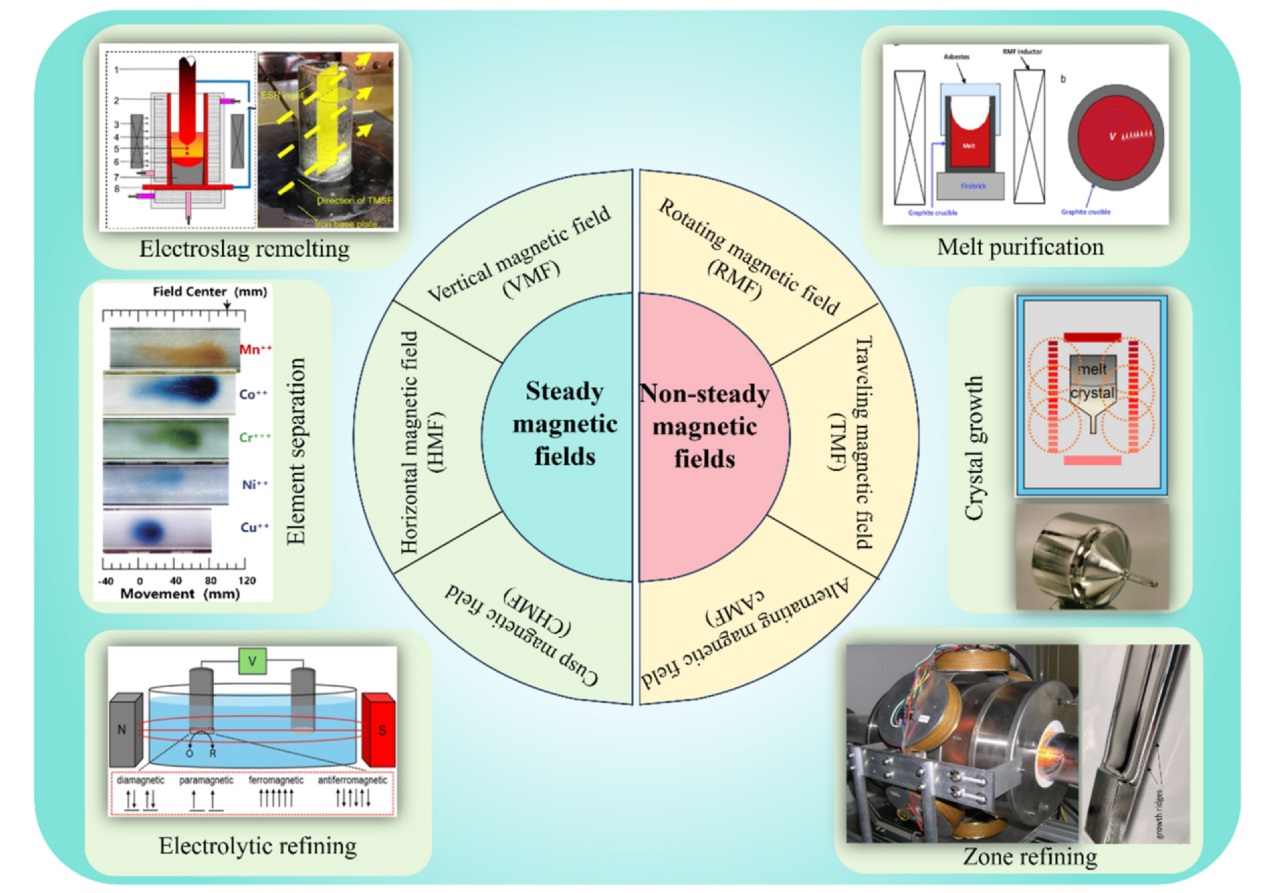
Fig. 1. Diagram of the outline in this review [30], [31], [32], [33], [34], [35], [36].
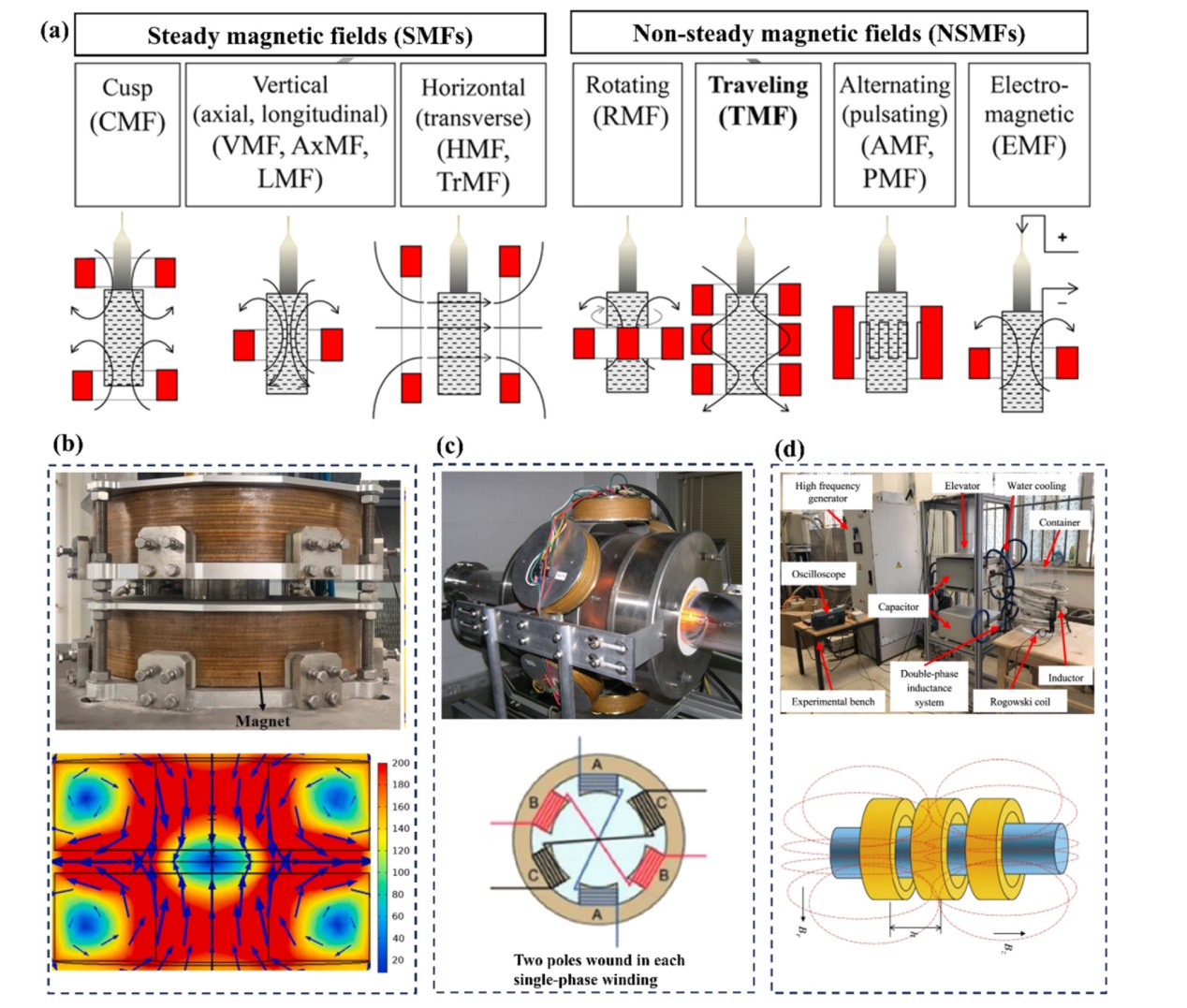
Fig. 2. Classification and introduction of magnetic fields: (a) Various types of magnetic field arrangements in materials separation, refining and purification processes [30]; (b) CMF magnet (upper) and the distribution of magnetic field (lower) [42]; (c) RMF magnet (upper) [35] and the principle of RMF (lower) [43]; (d) TMF magnet (upper) [44] and the principle of TMF (lower) [41].
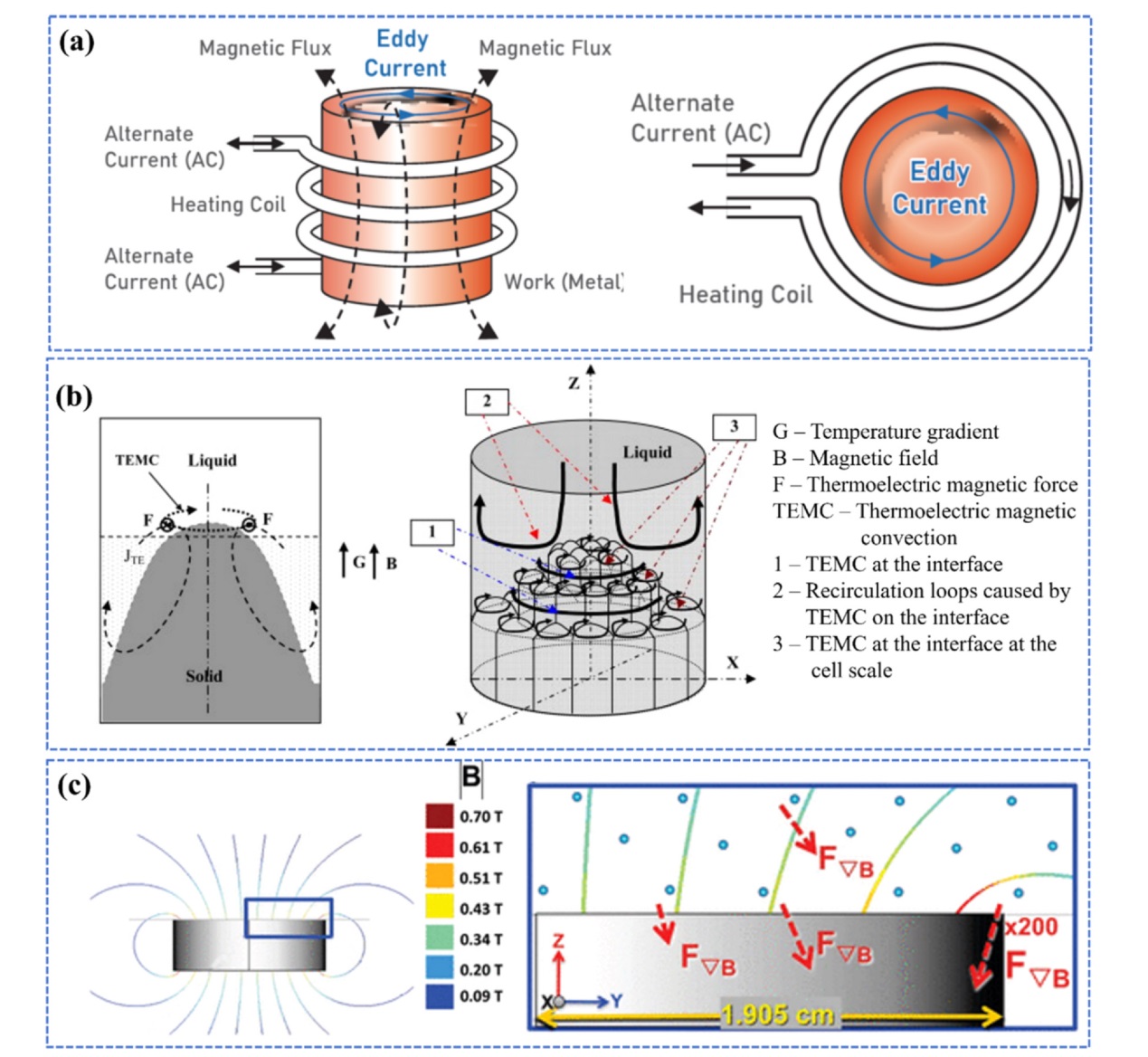
Fig. 3. Various types of magnetic field effects: (a) Principle of high-frequency induction heating [45]; (b) Illustration of the TEMF effects [51]; (c) Illustration of the KF [55].
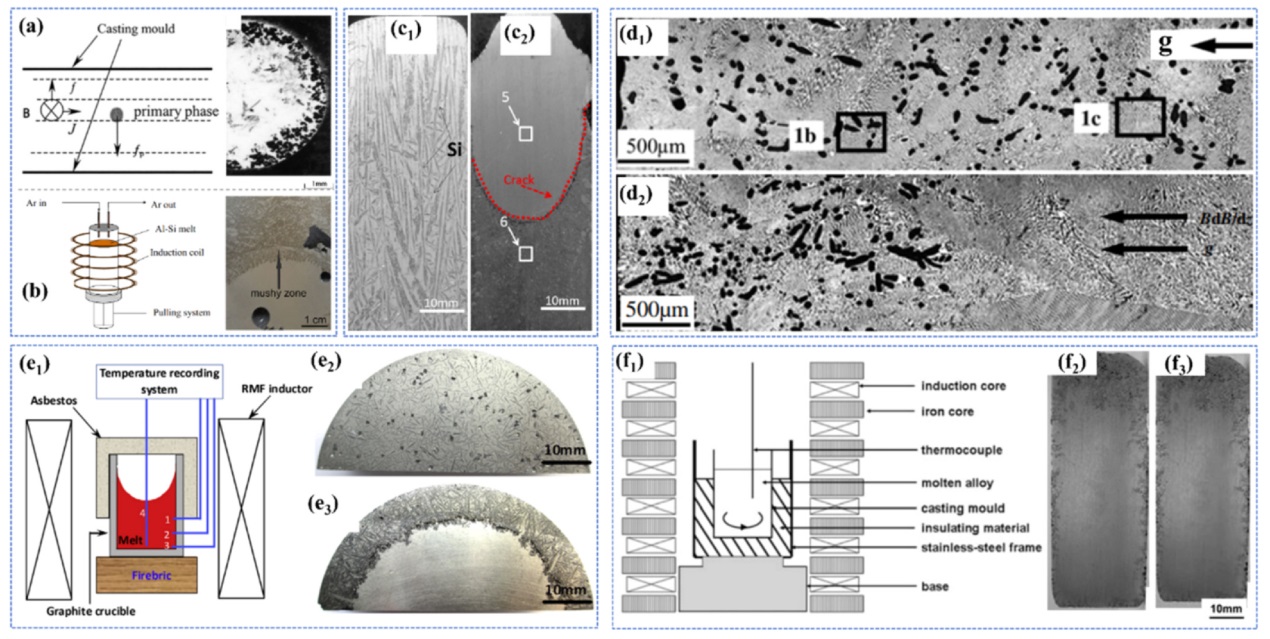
Fig. 4. Principle and schematic of phase separation under different magnetic field: (a) Forces exerted on primary phase under a combined static magnetic field and DC and macrostructure of the casting section [56]. (b) Schematic diagram of the experimental setup and cross section of a typical sample (Al-45wt%Si alloy at a pulling rate of 7 µm/s) [57]. (c1) Sample in the resistance furnace [58]; (c2) Sample in the induction furnace (with 3 kHz magnetic field) [58]. (d1) Mn-89.7wt%Sb, 0 T; (d2) Mn-89.7wt%Sb, BdB/dz=282 T2/m and a holding time of 30 min [62]. (e1) Schematic illustration of Al-30wt%Si alloy solidified under an RMF; (e2) 0 mT;(e3) 25 mT RMF [63]. (f1) Configuration of the combined magnetic system; (f2) Macrostructure of the longitudinal sections of the solidified samples under 0 T; (f3) Macrostructure of the longitudinal sections of the solidified samples under TMF (110 A, 50 Hz) and RMF (25 A, 40 Hz) [68].
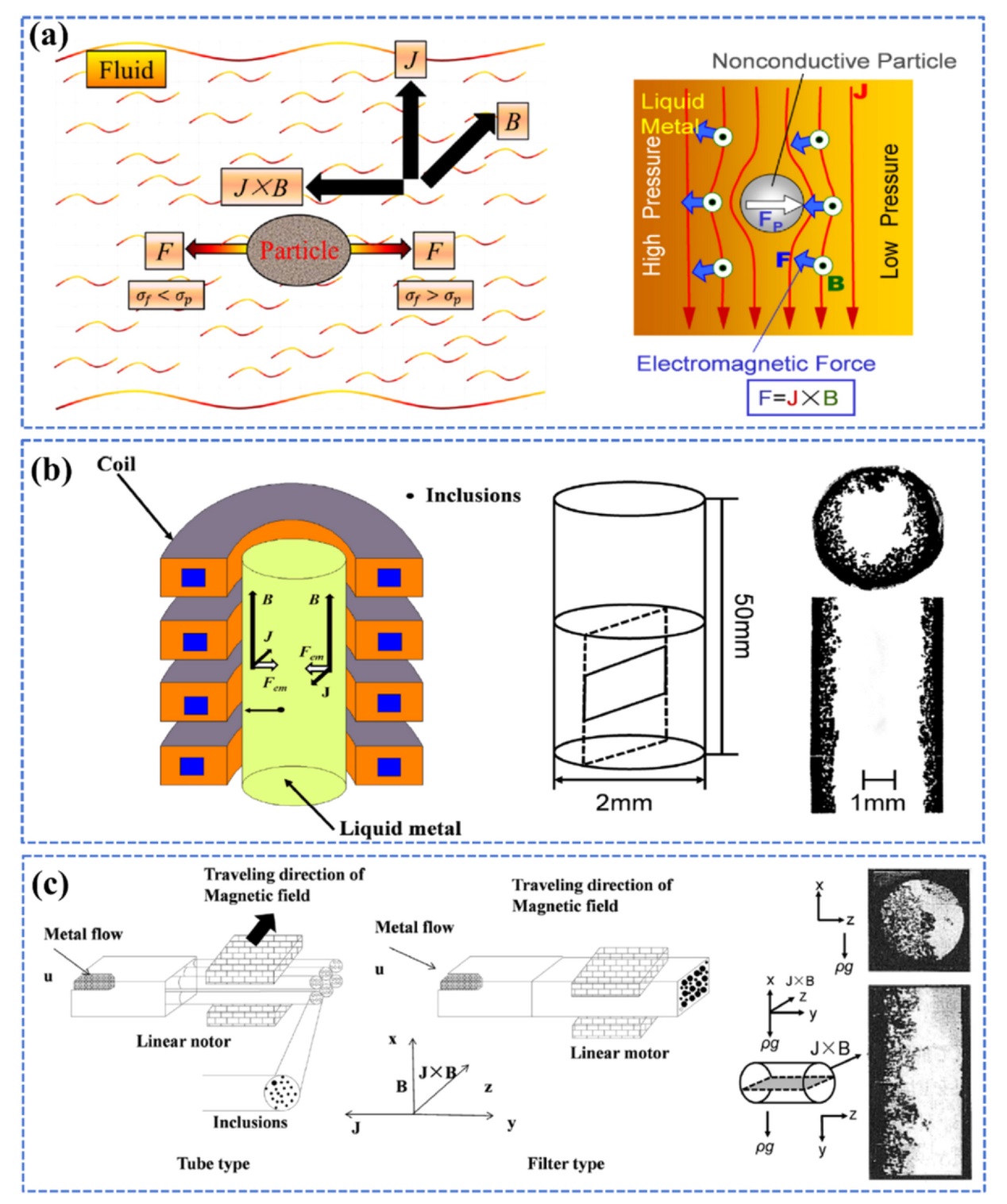
Fig. 5. Principles and schematic diagrams of melt purification under different magnetic fields: (a) Principle of EM separation of inclusions from the melt [71], [89]; (b) Removal inclusions from liquid metal using a fixed AMF [81]; (c) Separating inclusions from molten metal using a TMF [86].
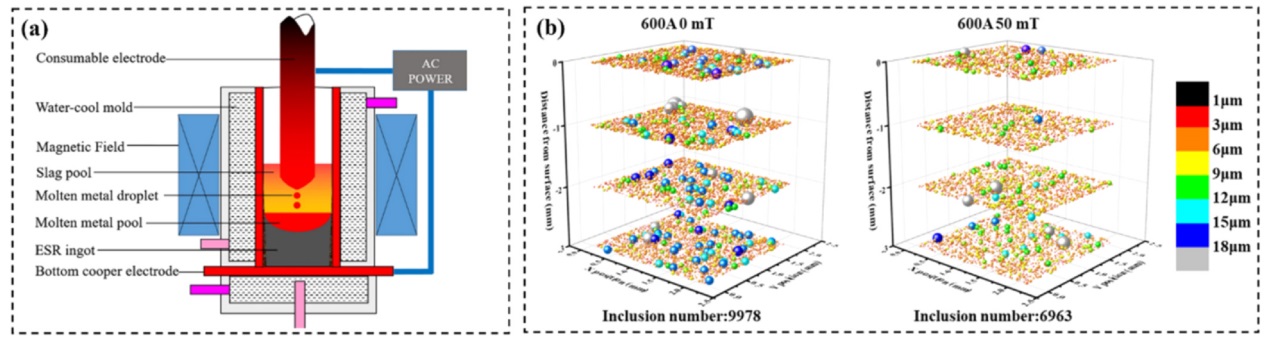
Fig. 6. (a) Schematic diagram of MC-ESR process [105] and (b) purification comparison. Spatial distribution results of the number and size of the four-layer inclusions detected in ESR ingots under different experimental parameters: 600 A‐0 mT (left) and 600 A‐50 mT (right), respectively [107].
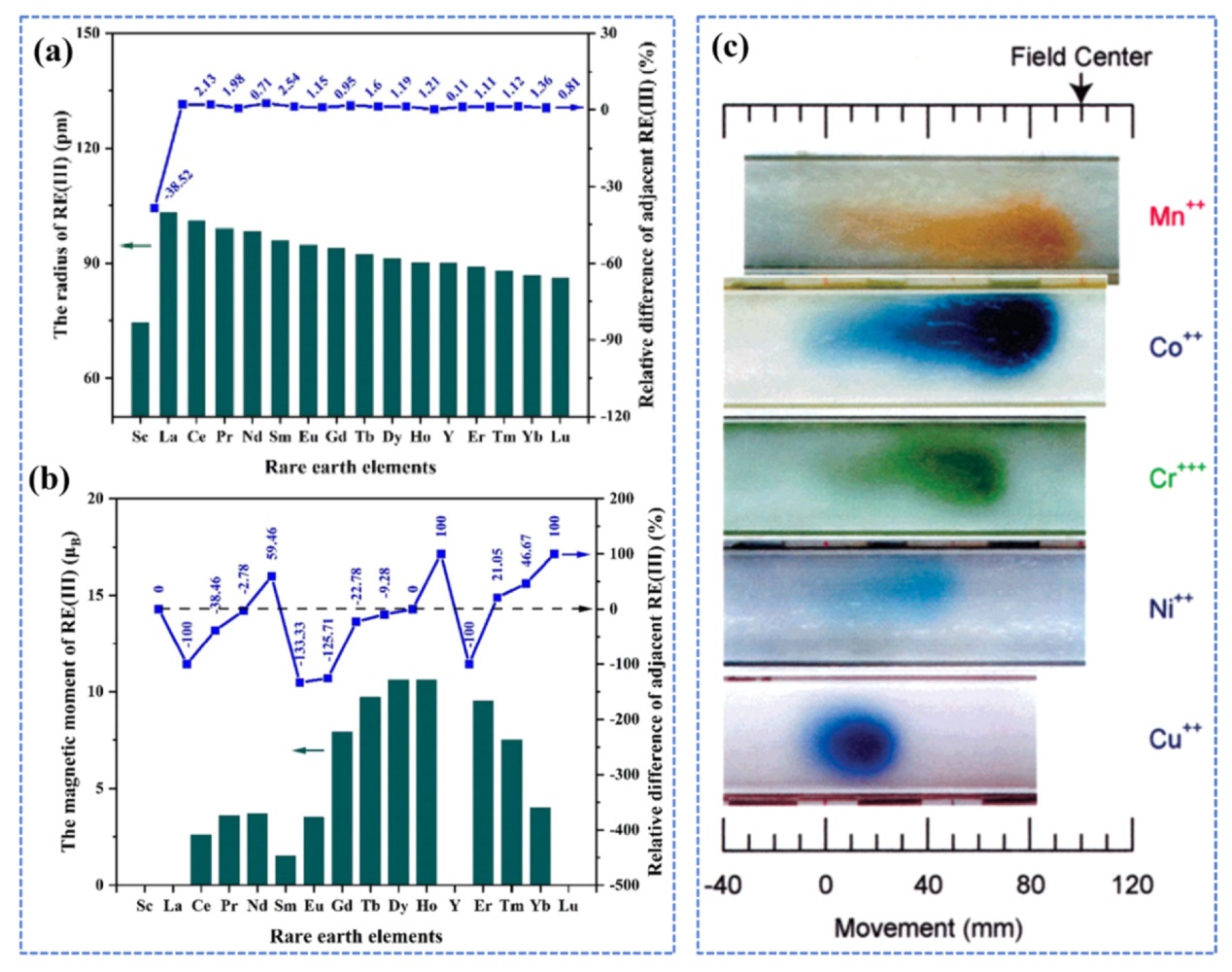
Fig. 7. (a) The radius of RE(III). (b) The magnetic moment of RE(III) [114]. (c) Movement of transition-metal ions on silica gel support [116]. The metal ion solutions were spotted at the 0-mm position that was 100 mm from the field center.
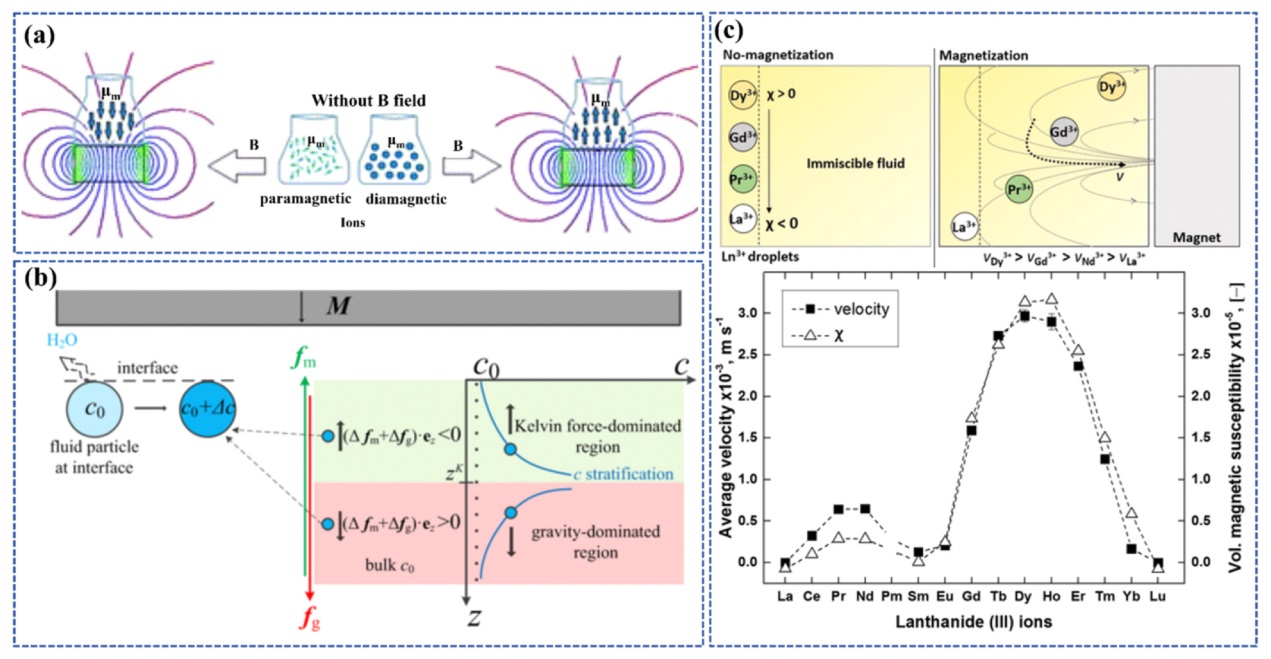
Fig. 8. Magnetic separation of RE elements: (a) Magnetic migration of Dy(III), Gd(III) and Y(III) with GMF [125]; (b) Sketch of the magnetic separation principle [126]; (c) The correspondence between average velocity and magnetic susceptibility [127].
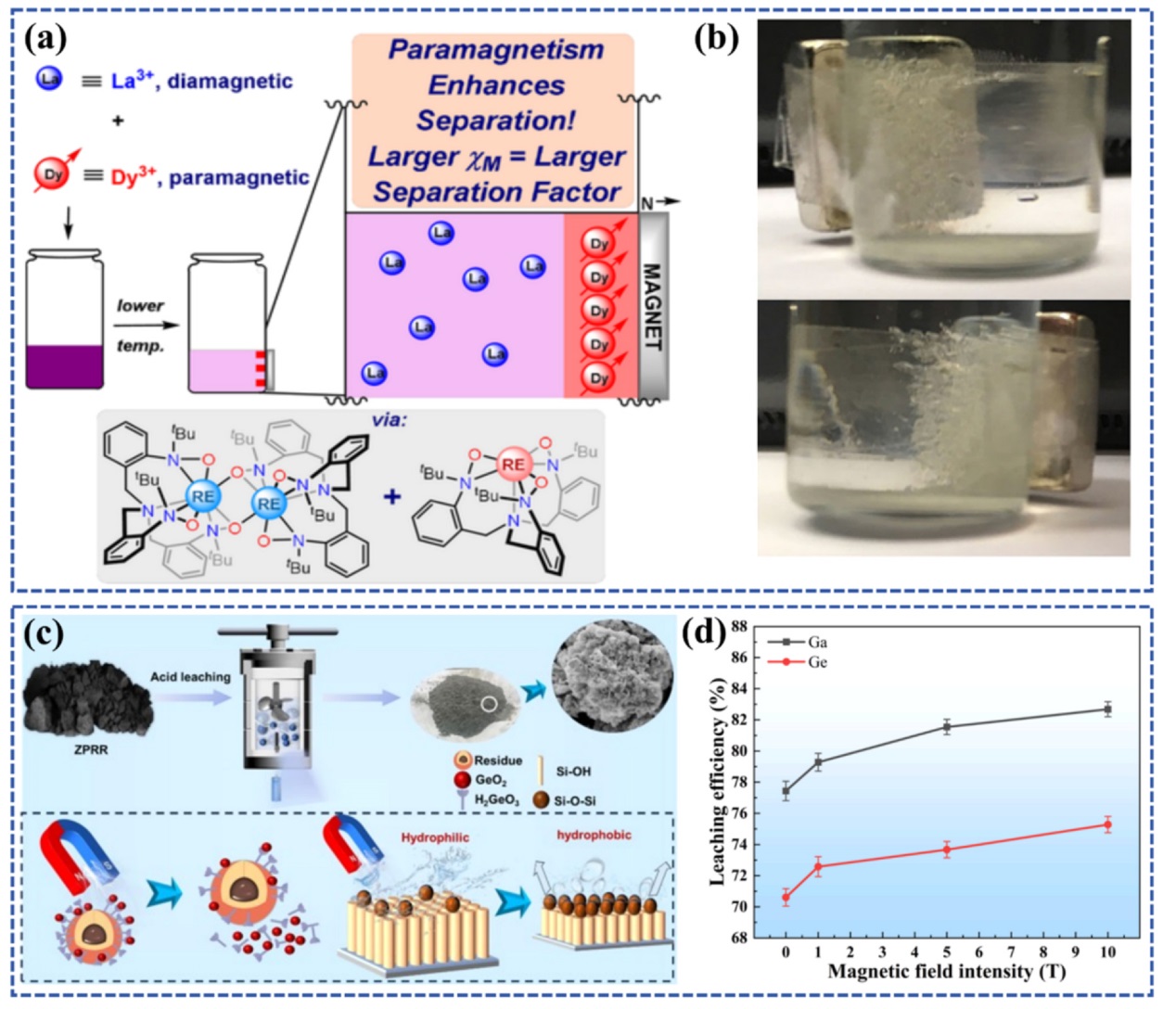
Fig. 9. The mechanisms and effects of magnetic fields in the separation of elements: (a) The mechanism of magnetic fields in the separation of Re elements (b) Photographs of [Tm(TriNOx)] crystals forming in the presence of a magnetic field [131]; (c) Schematic diagram of the extraction mechanism for Ga and Ge under a magnetic field [133]; (d) Effect of different magnetic flux densities on the enrichment of Ga and Ge [133].
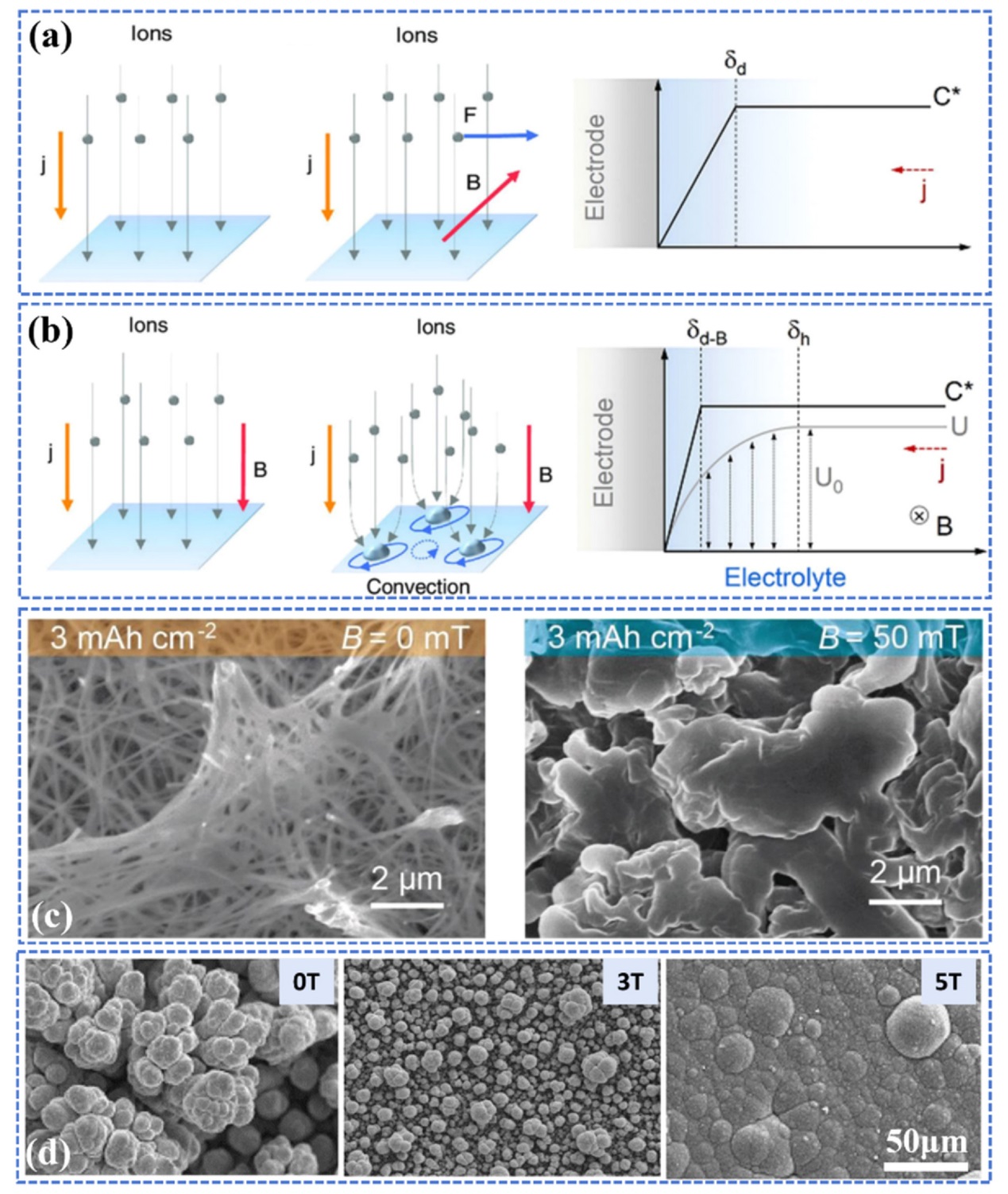
Fig. 10. The influence of a uniform magnetic field on electrochemical deposition: (a) Schematic of convection of electrolyte without a magnetic field [135]; (b) Schematic of convection of electrolyte with a magnetic field [135]; (c) The electrode surface after depositing 3 mAh cm−2 Li at a current density of 15 cm−2 with or without a 50 mT magnetic field [144]; (d) The copper films electrodeposited at the cathode potential of −400 mV vs. Cu reference electrode in various magnetic field intensities [160].
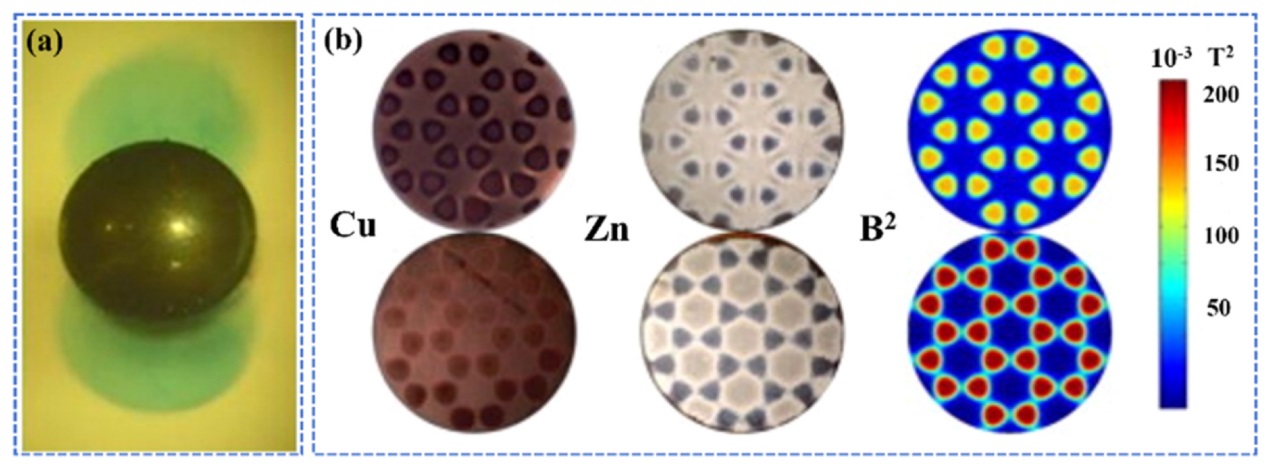
Fig. 11. The influence of GMF on electrochemical reaction: (a) Pattern of concentration of dissolved iron ions around a small iron sphere corroding in 5% HNO3 in an imposed magnetic field and the iron concentration profile follows a contour of magnetic field [162]; (b) Patterned electrodeposits on copper or silver cathodes above hexagonal arrays of 2 mm cylindrical magnets and the calculated stray field pattern at the cathode is shown on the right [141].
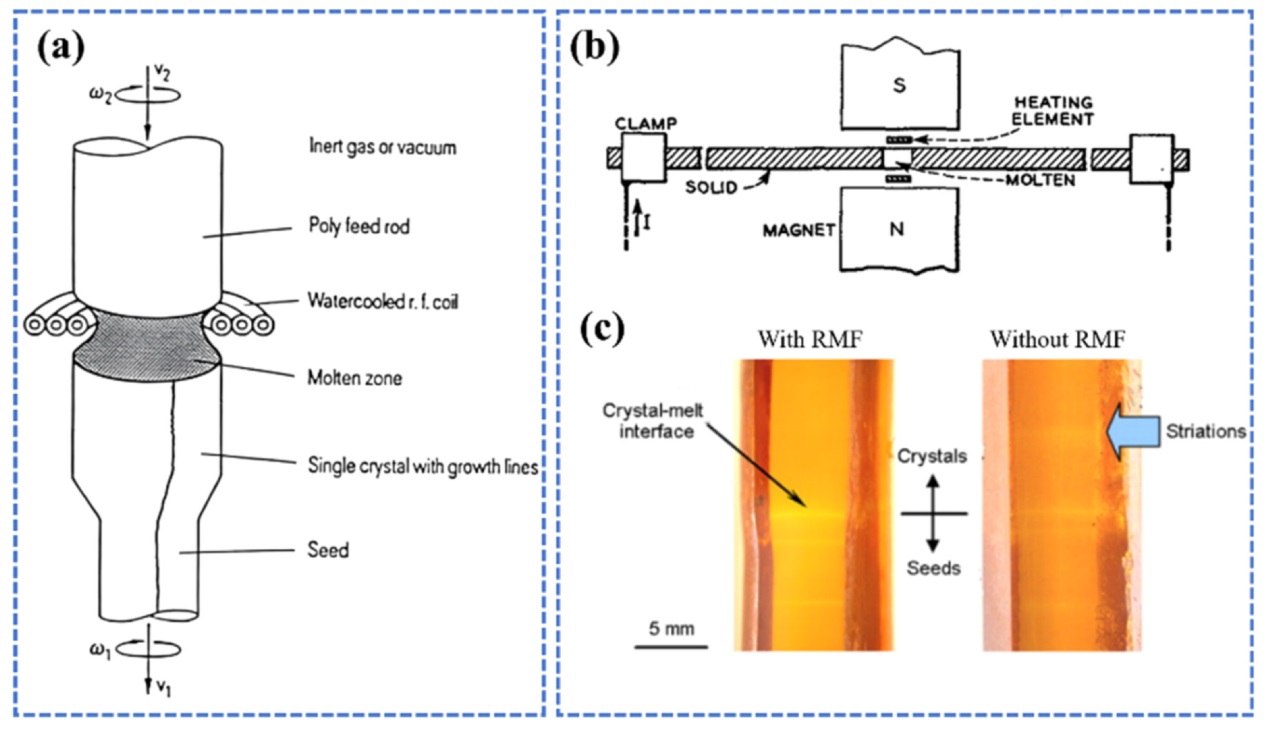
Fig. 12. (a) Schematic of floating-zone processes used for silicon single-crystal growth [21]; (b) Setup for electromagnetic suspension of a molten zone [186]. (c) Optical micrographs of crystals grown with and without RMF [187].
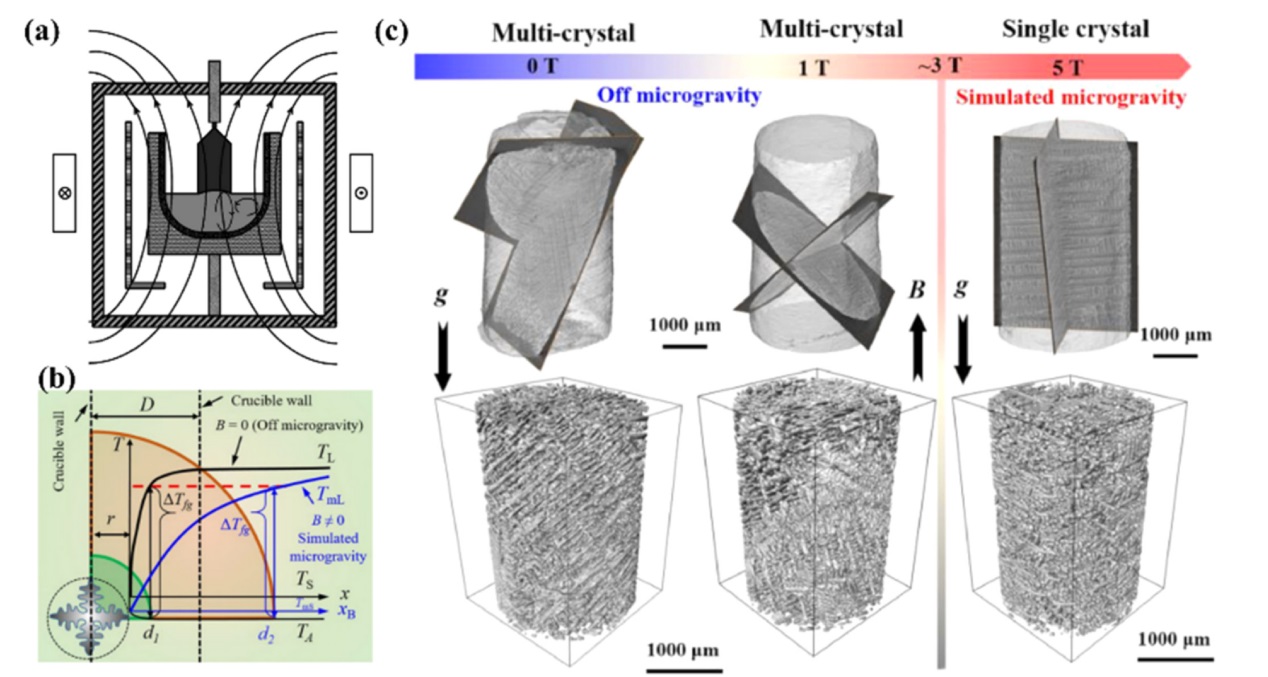
Fig. 13. Crystal preparation under VMF: (a) Schematic representation of a VMF configuration; (b) Schematic depiction of the solute suppression nucleation caused by the solute diffusion boundary created by growing grains [206]; (c) 3D reconstructions of Al‐12.4at.%Cu alloys solidified with a constant cooling rate of 5 K/min under various MFDs [206].
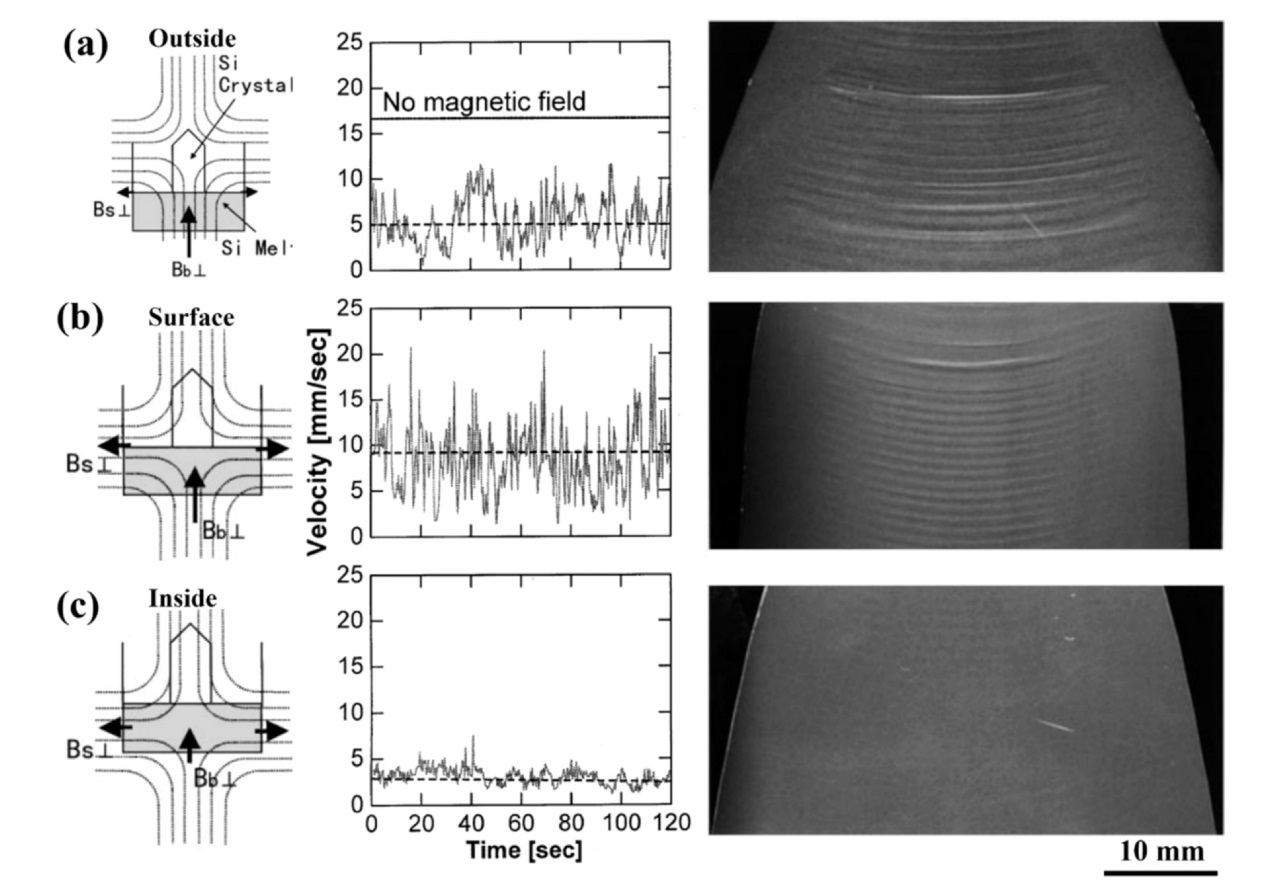
Fig. 14. The effect of CMF configurations on flow velocities and growth striations: (a) the center of the CMF positioned 20 mm above the melt-free surface (outside); (b) Center of the CMF positioned at the melt-free surface (surface); (c) Center of the CMF positioned 20 mm below the melt-free surface [221].
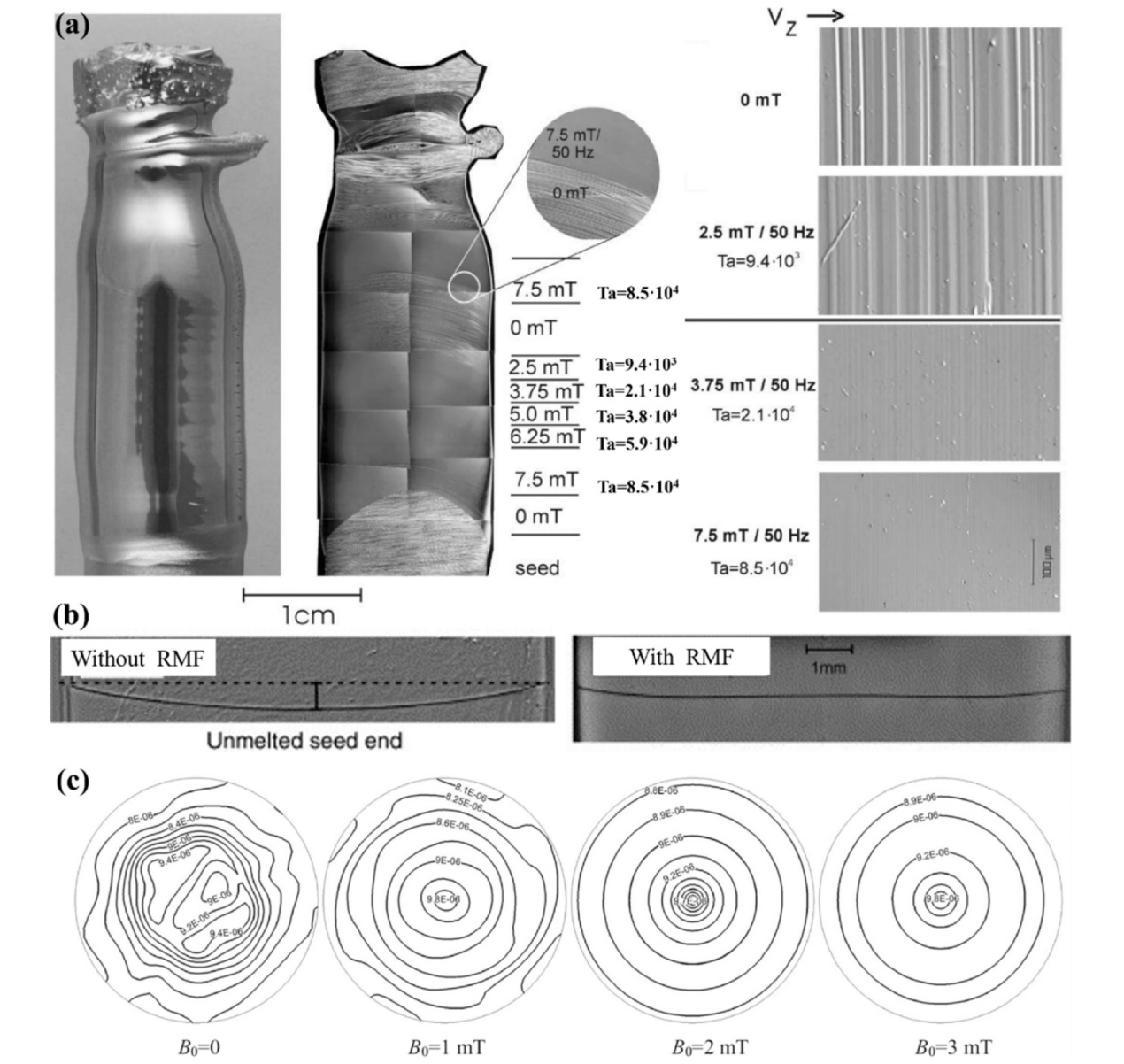
Fig. 15. Crystal preparation under RMF: (a) Si-Sb crystal: “as grown’’ (left) and a composite NDIC micrograph after cutting, polishing and etching (middle); The micro-segregation (striation pattern) changes significantly upon application of the RMF (right) [235]; (b) The impurity concentration distribution on the growth interface at t=1060 s under different magnetic flux densities [236]; (c) Influence of an RMF on the growth interface shape. The RMF decreases the concavity and induces a w-shape [230].
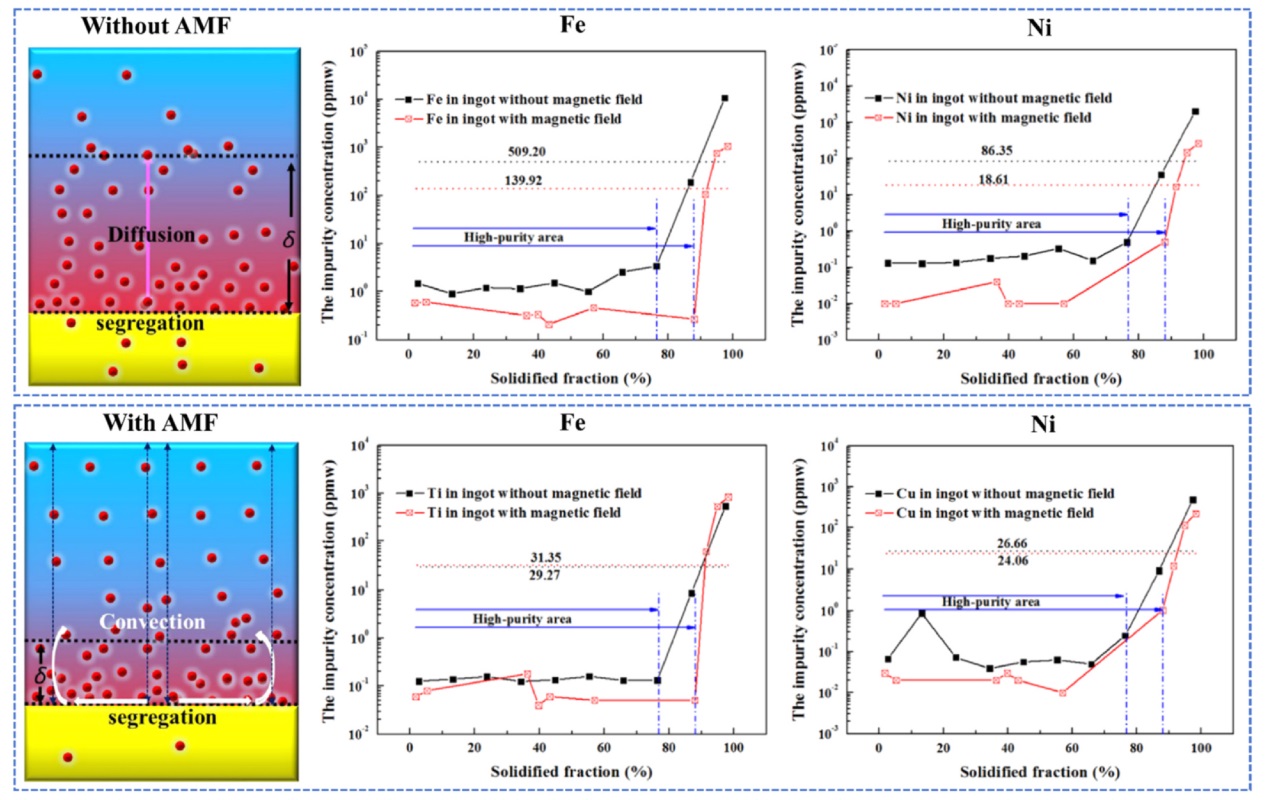
Fig. 16. Schematic diagram of the effect of AMF on the molten silicon and the concentration distributions of Fe, Ni, Ti and Cu in different positions of the two silicon ingots [242].
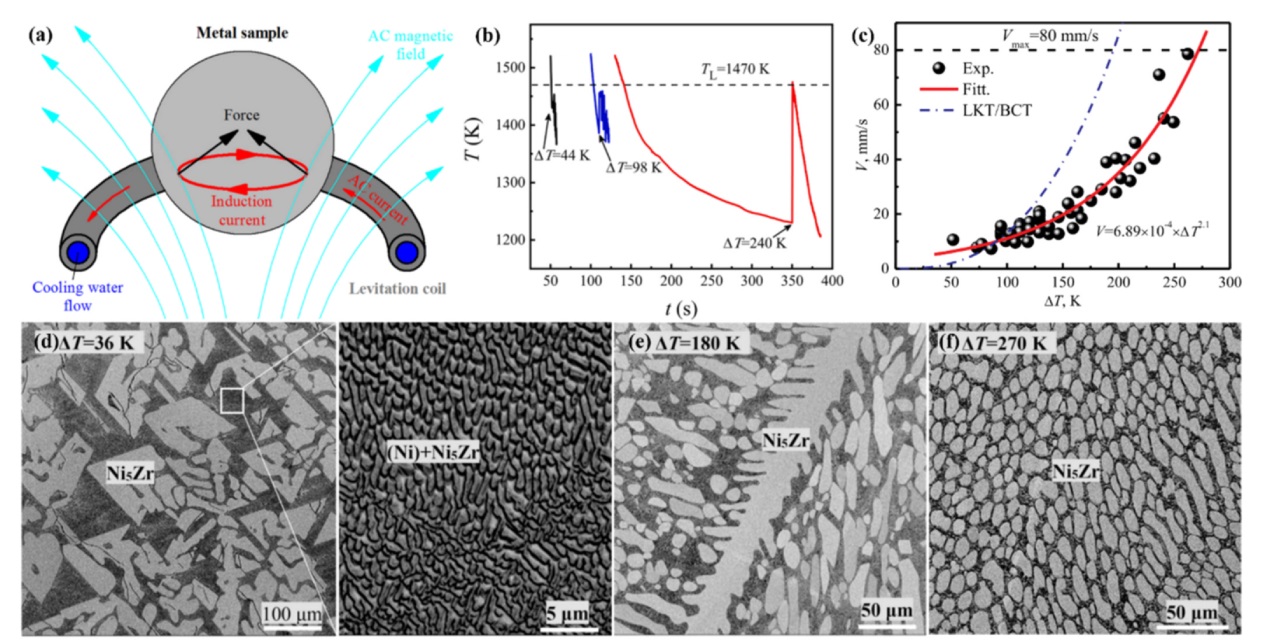
Fig. 17. (a) Principle of electromagnetic levitation [243]; (b) Typical cooling curves [244]; (c) Measured growth velocity of primary phase versus undercooling [249]. Microstructures of hypereutectic Ni-13at.%Zr alloy solidified at different undercoolings: (d) ΔT=36 K; (e) ΔT=180 K; (f) ΔT=270 K [249].
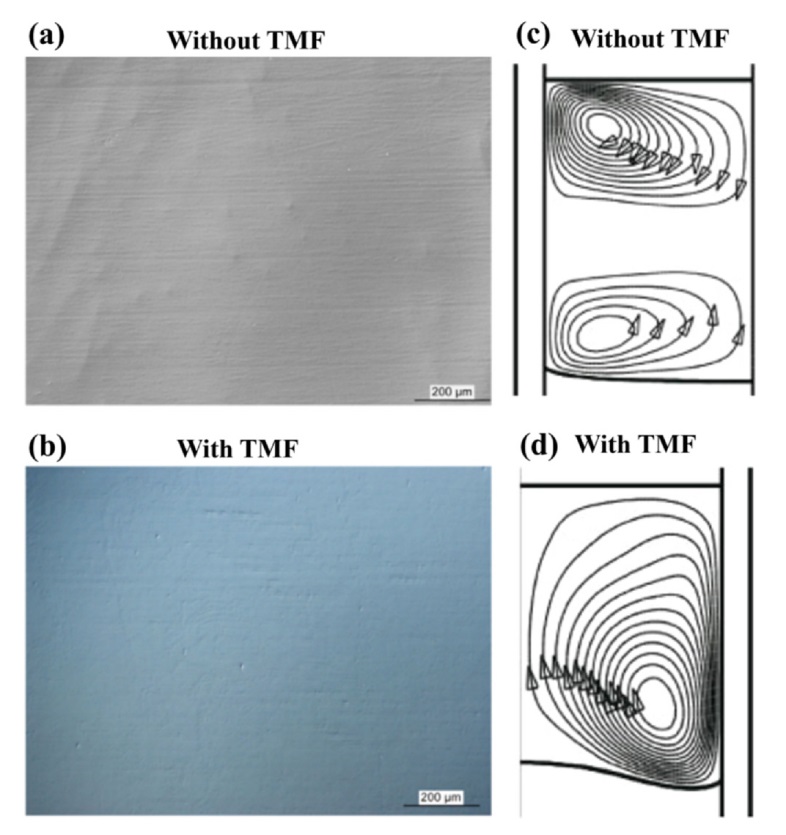
Fig. 18. Striation analysis on microscopic scale taken from longitudinal cuts of different as-grown 4-inch VGF Ge crystals grown: (a) without magnetic field, (b) under nearly optimized TMF parameters [30]. Global numeric simulation of the TMF effect in a Ge melt with diameter of 100 mm in the VGF equipment: (c) Stream lines of buoyancy flow without TMF and interface shape within the left half cylinder, causing an undesirable concave interface curvature; (d) stream contour in a downward translating TMF and interface shape within the right half cylinder produced by the heater-magnet at f=20 Hz and φ=60°. A favourable convex interface is obtained [41].
| Types | Applications | Examples | Key findings | References |
|---|---|---|---|---|
| SMF | Electroslag remelting; Crystal growth; Zone refining | GCr15 bearing steel; Si; InSb; Ge; Al-Cu alloy; GaAs; Cu, Co, Ni (electrodeposition) | Droplet refinement, structure homogenization, purification; Stabilize interfaces, improve crystalline uniformity; Suppress thermocapillary convection. | [ |
| GMF | Phase separation; Element enrichment; Electrolytic refining | Mn-Sb alloy; RE Ions; Oxygen; Ga and Ge (enrichment) | Enabling direct control based on magnetic susceptibility. | [ |
| RMF | Phase separation; Melt purification; Crystal growth; Zone refining | Al-Si alloy, Al-Si-Cu alloy, Si (purification); Al and Mg (inclusion removal); Cu, Ge, Si, GaAs, SiSb (crystal growth) | Suppressing temperature fluctuations and enhancing mixing; Provide a versatile and energy-efficient means to tailor melt convection, suppress defects, and improve crystal homogeneity across various growth techniques. | [ |
| TMF | Melt purification; Crystal growth | Al-Si-Cu alloy, Al and Mg melt (purification); Si, Ge, InP (Crystal growth) | Separating inclusions from molten metal; Precisely control melt convection and enhance crystal quality. | [ |
| CMF | Crystal growth | Si, Ge (Cz growth); Si-Ge crystal | Suppressing thermal instabilities; Enhancing field strength near the solid-liquid interface and improving dopant uniformity. | [ |
| LF | Induction heating; Melt purification; Electrolytic refining | Al-Si alloys; Si; Al and Mg melts (purification); Cu, Co, Ni (electrodeposition); Si, InSb, Ge (crystal growth) | Allowing turbulence suppression, interface stabilization, and melt stirring to refine solidification structures. | [ |
| KF | Electrolytic refining; Element enrichment | Rare earth ions; Oxygen; Cu, Co, Ni (electrodeposition); | Acting on magnetic susceptibility differences, enabling selective separation of particles and solutes. | [ |
| TEMF | Microstructure evolution; Electroslag remelting | GCr15 bearing steel; Metals/semiconductors under thermal gradients | Inducing localized fluid flow in molten metals or semiconductors, influencing dendrite morphology, promoting grain refinement, and facilitating the migration of secondary phases and impurities. | [ |
Table 1. Summary of magnetic field applications for separation, purification, refining, and crystal growth processes.
| Types | Applications | Examples | Key findings | References |
|---|---|---|---|---|
| SMF | Electroslag remelting; Crystal growth; Zone refining | GCr15 bearing steel; Si; InSb; Ge; Al-Cu alloy; GaAs; Cu, Co, Ni (electrodeposition) | Droplet refinement, structure homogenization, purification; Stabilize interfaces, improve crystalline uniformity; Suppress thermocapillary convection. | [ |
| GMF | Phase separation; Element enrichment; Electrolytic refining | Mn-Sb alloy; RE Ions; Oxygen; Ga and Ge (enrichment) | Enabling direct control based on magnetic susceptibility. | [ |
| RMF | Phase separation; Melt purification; Crystal growth; Zone refining | Al-Si alloy, Al-Si-Cu alloy, Si (purification); Al and Mg (inclusion removal); Cu, Ge, Si, GaAs, SiSb (crystal growth) | Suppressing temperature fluctuations and enhancing mixing; Provide a versatile and energy-efficient means to tailor melt convection, suppress defects, and improve crystal homogeneity across various growth techniques. | [ |
| TMF | Melt purification; Crystal growth | Al-Si-Cu alloy, Al and Mg melt (purification); Si, Ge, InP (Crystal growth) | Separating inclusions from molten metal; Precisely control melt convection and enhance crystal quality. | [ |
| CMF | Crystal growth | Si, Ge (Cz growth); Si-Ge crystal | Suppressing thermal instabilities; Enhancing field strength near the solid-liquid interface and improving dopant uniformity. | [ |
| LF | Induction heating; Melt purification; Electrolytic refining | Al-Si alloys; Si; Al and Mg melts (purification); Cu, Co, Ni (electrodeposition); Si, InSb, Ge (crystal growth) | Allowing turbulence suppression, interface stabilization, and melt stirring to refine solidification structures. | [ |
| KF | Electrolytic refining; Element enrichment | Rare earth ions; Oxygen; Cu, Co, Ni (electrodeposition); | Acting on magnetic susceptibility differences, enabling selective separation of particles and solutes. | [ |
| TEMF | Microstructure evolution; Electroslag remelting | GCr15 bearing steel; Metals/semiconductors under thermal gradients | Inducing localized fluid flow in molten metals or semiconductors, influencing dendrite morphology, promoting grain refinement, and facilitating the migration of secondary phases and impurities. | [ |
| [1] |
M. Adnan, V. Tung, P.V. Pham, R. Sankar, Mater. Today 90 (2025) 647-680.
DOI URL |
| [2] | L. Kong, C. Tang, H.J. Peng, J.Q. Huang,Q Zhang, SmartMat 1 (2020) e1007. |
| [3] | R. Soni, R. Verma, R.K. Garg, V. Sharma, Mater. Today. Proc. 113 (2024) 180-184. |
| [4] |
G. Purcek, G.G. Yapici, I. Karaman, H.J. Maier, Mater. Sci. Eng. A 528 (2011) 2303-2308.
DOI URL |
| [5] |
J. Lefebvre, J. Ding, Z. Li, P. Finnie, G. Lopinski, R.L. Malenfant, Acc. Chem. Res. 50 (2017) 2479-2486.
DOI URL |
| [6] | W. Tang, T. Wang, X. Zhang, R.Q. Cheng, X.Z. Tan, Y.T. Cui, J. Zhang, C.P. Fu, Mater. Today Commun. 47 (2025) 112910. |
| [7] |
X. Yuan, L. Guo, Q. Lv, D. Zhao, H. Liao, W. Ma, Q. Jiang, G. Xie, Y. Hou, J. Shen, Renew. Sust. Energ. Rev. 214 (2025) 115569.
DOI URL |
| [8] | J. Linke, J. Du, T. Loewenhoff, G. Pintsuk, B. Spilker, I. Steudel,M Wirtz, Extremes 4 (2019) 056201. |
| [9] |
P. Lecoq, Nucl. Instrum. Meth. A 809 (2016) 130-139.
DOI URL |
| [10] |
P. Zhao, J. Qiu, H. Lian, Y.J. Jian, F.D. Huang, N.N. Wang,Y.Q Zhu, ACS Omega 10 (2025) 36804-36823.
DOI URL |
| [11] | Y. Waseda, urification Process and Characterization of Ultra-high Purity Metals: Application of Basic Science to Metallurgical Processing, Springer, Berlin, Heidelberg, 2002, pp. 39-177. |
| [12] |
J. Wen, M. Wu, J. Peng,H.X Zheng, Separations 10 (2023) 380.
DOI URL |
| [13] |
J.M. Oh, K.M. Roh, J.W. Lim, Int. J. Hydrog. Energy 41 (2016) 23033-23041.
DOI URL |
| [14] |
R. Guschlbauer, S. Momeni, F. Osmanlic, C. Körner, Mater. Charact. 143 (2018) 163-170.
DOI URL |
| [15] |
Z.Q. Wang, Z.A. Li, J.M. Zhong, D.H. Chen, X.W. Zhang, L. Zhou, Rare Met. 40 (2021) 2307-2312.
DOI URL |
| [16] |
Y. Tan, H. Yang, G. Tian, X.H. Yu, J.C. Hu, X. Wang, J.X. Cheng, H.Q. Song, Ind. Eng. Chem. Res. 62 (2023) 4817-4830.
DOI URL |
| [17] |
X. Xue, Z. Zhou, B. Peng, M.M. Zhu, Y.J. Zhang, W. Ren, Z.G. Ye, X. Chen, M. Liu, RSC Adv. 5 (2015) 79249-79263.
DOI URL |
| [18] |
Z. Zhu,C.Y Cheng, Hydrometallurgy 107 (2011) 1-12.
DOI URL |
| [19] |
L. Guo, J. Chen, L. Shen, J.P. Zhang, D.L. Zhang, Y.F. Deng, ACS Sustain. Chem. Eng. 2 (2014) 1968-1975.
DOI URL |
| [20] |
B. Zeng, C.K. Chen, H.L. Zhao, C. Zhang, P.F. Liu, G.B. Wang, A.R. He, F.Q. Liu, J. Mater. Res. Technol. 34 (2025) 987-1009.
DOI URL |
| [21] | B.Q. Li, J. Oper. Manag. 50 (1998) 1-13. |
| [22] | E. Beaugnon, D. Bourgault, D. Braithwaite, P. Rango, L. Perrier, R. Bathie, A. Sulpice, R. Tournier, J. Phys. I 3 (1993) 399-421. |
| [23] |
Y. Wu, X. Zhang, X. Xu, X.W. Liu, L. Liu, J. Energy Storage 31 (2020) 101567.
DOI URL |
| [24] |
Q. Wang, T. Liu, K. Wang, P. Gao, Y. Liu, J. He, ISIJ Int. 54 (2014) 516-525.
DOI URL |
| [25] |
Y. Hou, Z. Gao, C. Li, Metals 12 (2022) 1778.
DOI URL |
| [26] |
Z. Sun, M. Guo, J. Vleugels, O. Van Der Biest, B. Blanpain, Curr. Opin. Solid. State Mater. Sci. 16 (2012) 254-267.
DOI URL |
| [27] |
T. Liu, Q. Wang, Y. Yuan, K. Wang, G. Li, Chin. Phys. B 27 (2018) 118103.
DOI URL |
| [28] |
Z. Hu, D. Lu, X. Zheng, Y. Wang, Z. Xue, S. Xu, Powder Technol. 421 (2023) 118435.
DOI URL |
| [29] |
L.M.A. Monzon, J.M.D. Coey, Electrochem. Commun. 42 (2014) 42-45.
DOI URL |
| [30] |
C. Frank-Rotsch, N. Dropka, F.M. Kießling, P. Rudolph, Cryst. Res. Technol. 55 (2020) 1900115.
DOI URL |
| [31] |
J.C. Jie, Q.C. Zou, H.W. Wang, J.L. Sun, Y.P. Lu, T.M. Wang, T.J. Li, J. Cryst. Growth 399 (2014) 43-48.
DOI URL |
| [32] |
M. Fujiwara, K. Chie, J. Sawai, D. Shimizu, Y. Tanimoto, J. Phys. Chem. B 108 (2004) 3531-3534.
DOI URL |
| [33] | Q. Li, Y.B. Zhong, C.X. Sun, H. Wang, T.X. Zheng, W.L. Ren, Z.M. Ren, Acta Metall. Sin.-Engl. Lett. 31 (2018) 1311-1316. |
| [34] |
N. Karki, F.L. Mufoyongo, A.J. Wilson, Inorg. Chem. Front. 11 (2024) 5414-5434.
DOI URL |
| [35] | J. Roszmann, Y.C. Liu, S. Dost, B. Lent, S. Grenier, N. Audet, Fluid. Dyn. Mater. Process. 5 (2009) 231-244. |
| [36] |
K. Gradwohl, A. Gybin, C. Guguschev, A. Kwasniewski, M. Pietsch, U. Juda, C. Richter, R.R. Sumathi, J. Cryst. Growth 632 (2024) 127645.
DOI URL |
| [37] | W.R. Wilcox, L.L. Regel, Found. Crystallogr. 50 (1994) 652-653. |
| [38] | H.P. Utech, M.C. Flemings, J. Appl. Phys. 37 (1966) 2021-2024. |
| [39] |
H.A. Chedzeyh,D.T.J Hurle, Nature 210 (1966) 933-934.
DOI |
| [40] | . P Rudolph, second ed, Handbook of Crystal Growth: Bulk Crystal Growth, Elsevier, North Holland, 2015, pp. 909-950. |
| [41] |
P. Rudolph, J. Cryst. Growth 310 (2008) 1298-1306.
DOI URL |
| [42] |
C. Zhang, X. Hu, X. Yuan, W.L. Ren, H.B. Lu, B. Ding, Q. Li, T.X. Zheng, Z.S. Lei, Y.B. Zhong, A. Zhang, P.K. Liaw, J. Mater. Res. Technol. 29 (2024) 1025-1039.
DOI URL |
| [43] | P. Thirugnanam, Induction Motors-Recent Advances, New Perspectives and Applications, IntechOpen, United Kingdom, 2023, pp. 61-62. |
| [44] |
S. Guo, X. Cui, X. Wang, X.Z. Na, R. Ernst, Y. Fautrelle, Metall. Mater. Trans. B 56 (2025) 1-13.
DOI |
| [45] | Nippon Avionics Co., Ltd., Principle of High Frequency Induction Heating, https://avioweld.com/highfrequency/principle/. |
| [46] |
T. Bayerl, M. Duhovic, P. Mitschang, D. Bhattacharyya, Compos. Part. A-Appl. S 57 (2014) 27-40.
DOI URL |
| [47] |
O. Lucia, P. Maussion, E.J. Dede, J.M. Burdío, IEEE Trans. Ind. Electron. 61 (2013) 2509-2520.
DOI URL |
| [48] |
L. Zhang, S. Wang, A. Dong, J. Gao, L.N.W. Damoah, Metall. Mater. Trans. B 45 (2014) 2153-2185.
DOI URL |
| [49] |
J.A. Shercliff, J. Fluid. Mech. 91 (1979) 231-251.
DOI URL |
| [50] |
P. Lehmann, R. Moreau, D. Camel, R. Bolcato, Acta Mater. 46 (1998) 4067-4079.
DOI URL |
| [51] |
X. Li, A. Gagnoud, Z. Ren, Y. Fautrelle, R. Moreau, Acta Mater. 57 (2009) 2180-2197.
DOI URL |
| [52] |
D. Du, J.C. Haley, A. Dong, Y. Fautrelle, D. Shu, G. Zhu, X. Li, B. Sun, E.J. Lavernia, Mater. Des. 181 (2019) 107923.
DOI URL |
| [53] |
J. Wang, Y. Fautrelle, Z.M. Ren, X. Li, H. Nguyen-thi, N. Mangelinck-noel, G.S.A. Jaoude, Y.B. Zhong, I. Kaldre, Appl. Phys. Lett. 101 (2012) 251904.
DOI URL |
| [54] |
B. Zhou, W. Lin, Y. Guo, T.X. Zheng, Y.B. Zhong, L. Zhang, Q.J. Zhang, Scr. Mater. 226 (2023) 115268.
DOI URL |
| [55] | M.C. Weston, M.D. Gerner,I Fritsch, ACS 82 (2010) 3411-3418. |
| [56] |
Z.M. Xu, T.X. Li, Y.H. Zhou, Metall. Mater. Trans. A 34 (2003) 1719-1725.
DOI URL |
| [57] |
W.Z. Yu, W.H. Ma, Z. Zheng, Y. Lei, W.Y. Jiang, J. Li, Metall. Mater. Trans. B 48 (2017) 2804-2811.
DOI |
| [58] |
Y.F. He, X. Yang, L.F. Duan, S.Y. Li, Z.J. Chen, W.H. Ma, G.Q. Lv, A.M. Xing, Mater. Sci. Semicond. Process. 121 (2021) 105333.
DOI URL |
| [59] |
K.S. Zhu, L. Cao, J. Wang, W.H. Ma, K.X. Wei, L. Zhou, J. Alloy. Compd. 906 (2022) 163989.
DOI URL |
| [60] |
T. Tamura, M.J. Li, J. Alloy. Compd. 979 (2024) 173528.
DOI URL |
| [61] |
T. Liu, Q. Wang, A. Gao, C. Zhang, C.J. Wang, J.C. He, Scr. Mater. 57 (2007) 992-995.
DOI URL |
| [62] |
T. Liu, Q. Wang, N. Hirota, Y. Liu, S. Chen, J.C. He, J. Cryst. Growth 335 (2011) 121-126.
DOI URL |
| [63] |
J.C. Jie, Q.C. Zou, J.L. Sun, Y.P. Lu, T.M. Wang, T.J. Li, Acta Mater. 72 (2014) 57-66.
DOI URL |
| [64] |
Q.C. Zou, J.C. Jie, J.L. Sun, T.M. Wang, Z.Q. Cao, T.J. Li, Sep. Purif. Technol. 142 (2015) 101-107.
DOI URL |
| [65] |
B.Y. Ban, T.T. Zhang, J.W. Li, X.L. Bai, X. Pan, J. Chen, S.H. Tabaian, Sep. Purif. Technol. 202 (2018) 266-274.
DOI URL |
| [66] |
Q.C. Zou, Z.H. Dong, X.H. Yang, J.C. Jie, X.Z. An, N. Han, T.J. Li, Chem. Eng. J. 425 (2021) 131664.
DOI URL |
| [67] |
K. Shiga, T. Fujiwrar, Y. Murakami, N. Omura, J. Alloy. Compd. 1004 (2024) 175866.
DOI URL |
| [68] |
Y. He, Q. Li, W. Liu, Metall. Mater. Trans. B 43 (2012) 1149-1155.
DOI URL |
| [69] |
A. Kolin, Science 117 (1953) 134-137.
PMID |
| [70] |
D. Leenov, A. Kolin, J. Chem. Phys. 22 (1954) 683-688.
DOI URL |
| [71] | N. El-Kaddah, A.D. Patel,T.T. Natarajan, JOM 47 (1995) 46-49. |
| [72] | O.R. Singleton, G.C. Robinson, J. Inst. Met. 99 (1971) 155. |
| [73] |
T.J. Lewis, A.J. Wright, J. Phys. D Appl. Phys. 1 (1968) 441.
DOI URL |
| [74] |
N.A. Surplice, Br. J. Appl. Phys. 17 (1966) 175.
DOI URL |
| [75] | P. Marty, A. Alemany, Metall. Appl. Magnetohydrodyn. (1982) 245-259. |
| [76] | T. Li, M. Xu, B. Sun, D. Shu, Y. Zhou, Trans. Nonferrous Met. Soc. China 13 (2003) 121-125. |
| [77] |
K. Li, J. Wang, D. Shu, T.X. Li, B.D. Sun, Y.H. Zhou, Mater. Lett. 56 (2002) 215-220.
DOI URL |
| [78] |
S. Taniguchi, J.K. Brimacombe, ISIJ Int. 34 (1994) 722-731.
DOI URL |
| [79] |
A.P. Dong, S. Da, J. Wang, B.D. Sun, J.G. Shen, Y.S. Ren, Y.L. Lu, X.D. Yin, Ironmak. Steelmak. 36 (2009) 316-320.
DOI URL |
| [80] |
L. Zhang, S. Wang, A. Dong, J.W. Gao, L.N.W. Damoah, Metall. Mater. Trans. B 45 (2014) 2153-2185.
DOI URL |
| [81] | F. Yaniao, K. Sassa, K. Iwa,S Asai, Tetsu Hagane 83 (1997) 30-35. |
| [82] |
E.P. Yoon, J.P. Choi, J.H. Kim, T.W. Nam, S. Kitaoka, Mater. Sci. Technol. 18 (2002) 1027-1035.
DOI URL |
| [83] | J.P. Park, A. Morihira, K. Sassa,A Asai, Tetsu Hagane 80 (1994) 389-394. |
| [84] |
Y. He, Q. Li, W. Liu, Mater. Lett. 65 (2011) 1226-1228.
DOI URL |
| [85] | Z. Ren, Z. Lei, C. Li, W. Xuan, Y. Zhong, X. Li, Acta Metall. Sin. 56 (2020) 583-600. |
| [86] |
S. Asai, Sci. Technol. Adv. Mater. 1 (2000) 191-200.
DOI URL |
| [87] |
S. Yesilyur, S. Motakef, R. Grugel, K. Mazuru, J. Cryst. Growth 263 (2004) 80-89.
DOI URL |
| [88] | Y.B. Zhong, Metalloid Particles’ Migration in Molten Metals in an Electromagnetic Force Field and It’s Application, Ph.D, Thesis, Shanghai University, 2002 (in Chinese). |
| [89] |
K. Takahashi, S. Taniguchi, ISIJ Int. 43 (2003) 820-827.
DOI URL |
| [90] |
J. Campbell, J.W. Bannister, Met. Technol. 2 (1975) 409-415.
DOI URL |
| [91] |
A.H. Dilawari, J. Szekely, T.W. Eagar, Metall. Trans. B 9 (1978) 371-381.
DOI URL |
| [92] |
A. Jardy, D. Ablitzer, J.F. Wadier, Metall. Trans. B 22 (1991) 111-120.
DOI URL |
| [93] | C.B. Shi, S.J. Wang, L. Jing, J.W. Cho, Iron Steel Res. Int. 28 (2021) 1483-1503. |
| [94] | R. Krishnamurthy, M. Fahrmann, M. Detrois,P Jablonski, BHM 170 (2025) 12-18. |
| [95] |
F.L. Li, R. Fu, D. Feng, F.J. Yin, Z.L. Tian, Rare Metal. Mat. Eng. 45 (2016) 1437-1442.
DOI URL |
| [96] |
L. Rao, J.H. Zhao, Z.X. Zhao, G. Ding, M.P. Geng, J. Iron Steel Res. Int. 21 (2014) 644-652.
DOI URL |
| [97] |
T. Weier, D. Baczyzmalski, J. Massing, S. Landgraf, C. Cierpka, Int. J. Hydrog. Energy 42 (2017) 20923-20933.
DOI URL |
| [98] | D.A. Musaeva, V.K. Ilyin, V. Geža, E. Baake, Phys. Math. 2 (2016) 193-200. |
| [99] |
L.M.A. Monzon, J.M.D. Coey, Electrochem. Commun. 42 (2014) 38-41.
DOI URL |
| [100] |
K. Miyazawa, T. Fukaya, S. Aaai, I. Muchi, M. Choudhary, J. Szekely, Trans. Iron Steel Inst. Jpn. 25 (1985) 386-393.
DOI URL |
| [101] |
Q. Wang, H.G. Yan, F. Wang, B.K. Li, JOM 67 (2015) 1821-1829.
DOI URL |
| [102] |
H. Wang, Y.B. Zhong, Q. Li, Y.P. Fang, W.L. Ren, Z.S. Lei, Z.M. Ren, ISIJ Int. 56 (2016) 255-263.
DOI URL |
| [103] | Y.B. Zhong, Q. Li, Y.P. Fang, H. Wang, M.H. Peng, L.C. Dong, T.X. Zheng, Z.S. Lei, W. L. Ren, Z.M. Ren, Mater. Sci. Eng. Proc. Conf. 660 (2016) 118-126. |
| [104] |
H. Wang, Y.B. Zhong, Q. Li, Y.P. Fang, W.L. Ren, Z.S. Lei, Z.M. Ren, Metall. Mater. Trans. B 48 (2017) 655-663.
DOI |
| [105] |
Q. Li, Z. Xia, Y. Guo, Z. Shen, T.X. Zheng, B. Ding, Y.B. Zhong, Metall. Mater. Trans. B 52 (2021) 1495-1507.
DOI |
| [106] |
C.K. Ma, Z.B. Xia, Y.F. Guo, W.F. Liu, X.H. Zhao, Q. Li, W.T. Qi, Y.B. Zhong, J. Mater. Res. Technol. 19 (2022) 3272-3286.
DOI URL |
| [107] | M.L. Feng, Y.B. Zhong, Q.F. Wu, G. Chen, Z.S. Lei, W.L. Ren, Z.M. Ren, J. Iron Steel Res. Int. 1 (2012) 363-368. |
| [108] |
F. Li, J. Zeng, X. Sun, RSC Adv. 10 (2020) 26671-26674.
DOI URL |
| [109] |
Z. Hammache, S. Bensaadi, Y. Berbar, N. Audebrand, A. Szymczyk, M. Amara, Sep. Purif. Technol. 254 (2021) 117641.
DOI URL |
| [110] |
T. Uda, K.T. Jacob,M Hirasawa, Science 289 (2000) 2326-2329.
PMID |
| [111] |
J.A. Cotruvo, E.R. Featherston, J.A. Mattocks, J.V. Ho, T.N. Laremore, J. Am. Chem. Soc. 140 (2018) 15056-15061.
DOI PMID |
| [112] |
J.A. Bogart, C.A. Lippincott, P.J. Carroll, E.J. Schelter, Angew. Chem. 127 (2015) 8340-8343.
DOI URL |
| [113] |
T. Cheisson,E.J Schelter, Science 363 (2019) 489-493.
DOI URL |
| [114] |
B. Fan, F. Li, Y. Cheng, Y. Cheng, Z. Wang, N. Zhang, Q. Wu, L. Bai, X. Zhang, Sep. Purif. Technol. 301 (2022) 122025.
DOI URL |
| [115] | J.M.D. Coey, Magnetism and Magnetic Materials, Cambridge University Press, Cambridge, 2010, pp. 204-210. |
| [116] |
M. Fujiwara, K. Chie, J. Sawai, D. Shimizu, Y. Tanimoto, J. Phys. Chem. B 108 (2004) 3531-3534.
DOI URL |
| [117] |
M. Fujiwara, K. Mitsuda, Y. Tanimoto, J. Phys. Chem. B 110 (2006) 13965-13969.
DOI URL |
| [118] |
K. Chie, M. Fujiwara, Y. Fujiwar, Y. Tanimoto, J. Phys. Chem. B 107 (2009) 14374-14377.
DOI URL |
| [119] | W. Noddack, I. Noddack, E. Wicht, Z. Elektrochem. 62 (1958) 77-85. |
| [120] |
H.G. Mukherjee, S.K. Datta, Microchim. Acta 79 (1983) 431-436.
DOI URL |
| [121] |
I.R. Rodrigues, L. Lukina, S. Dehaeck, P. Conlinet, K. Binnemans, J. Fransaer, J. Phys. Chem. Lett. 8 (2017) 5301-5305.
DOI PMID |
| [122] |
A. Habenschuss, F.H. Spedding, J. Chem. Phys. 70 (1979) 2797-2806.
DOI URL |
| [123] |
D. Schröder, L. Duchackova, J. Tarabek, M. Karwowska, K.J. Fijalkowski, M Ončák,, P. Slavíček, J. Am. Chem. Soc. 133 (2011) 2444-2451.
DOI PMID |
| [124] |
B. Pulko, X. Yang, Z. Lei, S. Odenbach, K. Ecket, Appl. Phys. Lett. 105 (2014) 232407.
DOI URL |
| [125] |
A. Franczak, K. Binnemans, J. Fransaer, Phys. Chem. Chem. Phys. 18 (2016) 27342-27350.
DOI URL |
| [126] |
Z. Lei, B. Fritzsche, K. Eckert, Phys. Rev. E 101 (2020) 013109.
DOI URL |
| [127] |
I.R. Rodrigues, L. Lukina, S. Dehaeck, P. Colinet, K. Binnemans, J. Fransaer, J. Phys. Chem. C 122 (2018) 23675-23682.
DOI URL |
| [128] |
H. Yang, F. Peng, D.E. Schier, S.A. Markotic, X. Zhao, A.N. Hong, Y.X. Wang, P.Y. Feng, X.H. Bu, Angew. Chem. Int. Ed. 60 (2021) 11148-11152.
DOI URL |
| [129] |
X. Zhao, Y. Wang, D.S. Li, X. Bu, P. Feng, Adv. Mater. 30 (2018) 1705189.
DOI URL |
| [130] |
K.R. Meihaus, J.F. Corbey, M. Fang, J.W. Ziller, J.R. Long, W.J. Evans, Inorg. Chem. 53 (2014) 3099-3107.
DOI PMID |
| [131] |
R.F. Higgins, T. Cheisson, B.E. Cole, B.C. Manor, P.J. Carroll, E.J. Schelter, Angew. Chem. 132 (2020) 1867-1872.
DOI URL |
| [132] |
T.X. Zheng, Y.X. Liang, D.W. Xun, M. Sun, B. Ding, Z. Shen, Q. Li, P.J. Shi, B.F. Zhou, C.M. Liu, C.G. Wu, W.L. Ren, Y.B. Zhong, Miner. Eng. 224 (2025) 109196.
DOI URL |
| [133] |
Y.X. Liang, B.Y. Luo, L. Zhao, L.G. Chen, B. Ding, S. Shen, T.X. Zheng, Y.F. Guo, Q. Li, B.F. Zhou, C.M. Liu, J. Brnic, W.L. Ren, Y.B. Zhong, Sep. Purif. Technol. 330 (2024) 125572.
DOI URL |
| [134] | P. Dunne, Electrode Eff. Magn. -Electrochem. Ph. D. Thesis Trinity Coll. Dublin, (2011) (in Ireland). |
| [135] |
S. Luo, K. Elouarzaki, Z.J. Xu, Angew. Chem. Int. Ed. 61 (2022) e202203564.
DOI URL |
| [136] | A. Yu, Y. Zhang, S. Zhu, T. Wu, Z.J. Xu, Nat. Energy 10 (2025) 1-13. |
| [137] | R.A. Tacken, L.J.J. Janssen, J. Appl. Electrochem. 25 (1995) 1-5. |
| [138] |
K. Kołodziejczyk, E. Miękoś, M. Zieliński, M. Jaksender, D. Szczukocki, K. Czarny, B. Krawczyk, J. Solid. State Electrochem. 22 (2018) 1629-1647.
DOI |
| [139] |
L.M.A. Monzon, J.M.D. Coey, Electrochem. Commun. 42 (2014) 38-41.
DOI URL |
| [140] |
T. Wang, W. Chen, ECS Electrochem. Lett. 4 (2015) D14.
DOI URL |
| [141] |
P. Dunne, L. Mazza, Phys. Rev. Lett. 107 (2011) 024501.
DOI URL |
| [142] | K. Ota, Encyclopedia of Applied Electrochemistry, Springer, New York, 2014, pp. 1-11. |
| [143] |
L.M.A. Monzon, J.M.D. Coey, Electrochem. Commun. 42 (2014) 38-41.
DOI URL |
| [144] |
A. Wang, Q. Deng, L. Deng, X.Z. Guan, J.Y. Luo, Adv. Funct. Mater. 29 (2019) 1902630.
DOI URL |
| [145] |
K. Nishikawa, T. Saito, H. Matsushima, M. Ueda, Electrochim. Acta 297 (2019) 1104-1108.
DOI |
| [146] |
L.L. Yang, C. Chen, J. Yuan, L.Y. Gao, Z.A. Shang, Z.Q. Liu, J. Magn. Magn. Mater. 495 (2020) 165872.
DOI URL |
| [147] |
A. Franczak, A. Levesque, F. Bohr, J. Douglade, J.P. Chopart, Appl. Surf. Sci. 258 (2012) 8683-8688.
DOI URL |
| [148] |
A. Kumar, P.C. Mondal,C Fontanesi, Magnetochemistry 4 (2018) 36.
DOI URL |
| [149] |
J. Romero, H Prima‐garcia, M. Varela, S.G. Miralles, V. Oestreicher, G. Abellán, E Coronado, Adv. Mater. 31 (2019) 1900189.
DOI URL |
| [150] |
W. Kiciński, J.P. Sek, E. Matysiak-brynda, K. Miecznikowski, M. Donten, B. Budner, A.M. Nowicka, Appl. Catal. B 258 (2019) 117955.
DOI URL |
| [151] |
Z. Zeng, W. Zhang, Z. Ji, Z. Yin, J. Wei, Electrochem. Commun. 99 (2019) 36-40.
DOI URL |
| [152] |
Y. Li, L. Zhang, J. Peng, W. Zhang, K. Peng, J. Power Sources 433 (2019) 226704.
DOI URL |
| [153] |
K. Scott, Renew. Sust. Energ. Rev. 81 (2018) 1406-1426.
DOI URL |
| [154] |
H. Liu, H. Xu, L. Pan, D. Zhong, Y. Liu, Int. J. Hydrog. Energy 44 (2019) 22780-22786.
DOI URL |
| [155] |
H. Liu, L. Pan, Q. Qin, P. Li, J. Electroanal. Chem. 832 (2019) 293-302.
DOI URL |
| [156] |
H. Liu, Q. Hu, L. Pan, R. Wu, Y. Liu, D. Zhong, Electrochim. Acta 306 (2019) 350-359.
DOI URL |
| [157] |
E. Katz, O. Lioubashevsk, I. Willne, J. Am. Chem. Soc. 127 (2005) 3979-3988.
DOI URL |
| [158] |
O. Lioubashevski, E. Katz, I. Willner, J. Phys. Chem. B 108 (2004) 5778-5784.
DOI URL |
| [159] |
G. Hinds, F.E. Spada, J.M.D. Coey, T.R. Ní Mhíocháin, M.E.G. Lyons, J. Phys. Chem. B 105 (2001) 9487-9502.
DOI URL |
| [160] |
H. Matsushima, Bund, W. Plieth, S. Kikuchi, Y. Fukunaka, Electrochim. Acta 53 (2007) 161-166.
DOI URL |
| [161] |
J.M.D. Coey, G. Hinds, M.E.G. Lyons, Europhys. Lett. 47 (1999) 267.
DOI URL |
| [162] |
O.Y. Gorobetsa, Y.I. Gorobetsb, I.A. Bondara, Y.A. Legenkiy, J. Magn. Magn. Mater. 330 (2013) 76-80.
DOI URL |
| [163] |
L.B. Wang, N.I. Wakayama, T. Okada, ISIJ Int. 45 (2005) 1005-1013.
DOI URL |
| [164] |
K. Tschulik, C. Cierpka, A. Gebert, L. Schultz, C.J. Kähler, M. Uhlemann, Anal. Chem. 83 (2011) 3275-3281.
DOI URL |
| [165] |
J. König, K. Tschulik, L. Büttner, M. Uhlemann, J. Czarske, Anal. Chem. 85 (2013) 3087-3094.
DOI PMID |
| [166] |
N.B. Chaure, J.M.D. Coey, J. Electrochem. Soc. 156 (2009) F39.
DOI URL |
| [167] |
N.B. Chaure, F.M.F. Rhen, J. Hilton, J.M.D. Coey, Electrochem. Commun. 9 (2007) 155-158.
DOI URL |
| [168] |
L.M.A. Monzon, K. Rode, M. Venkatesan, J.M.D. Coey, Chem. Mater. 24 (2012) 3878-3885.
DOI URL |
| [169] |
H.A. Murdoch, D. Yin, E. Hernández-rivera, A.K. Giri, Electrochem. Commun. 97 (2018) 11-15.
DOI URL |
| [170] |
W.G. Pfann, JOM 4 (1952) 747-753.
DOI URL |
| [171] |
L. Yu, X. Kang, L. Chen, K. Luo, Y. Jiang,X Cao, Materials 14 (2021) 2064.
DOI URL |
| [172] |
K. Ghosh, V.N. Mani, Cryst. Res. Technol. 59 (2024) 2300347.
DOI URL |
| [173] | X. Zhang, S. Friedrich, B. Friedrich, J. Cryst. Process. Technol. 8 (2018) 33. |
| [174] | E. Hashimoto, Y. Ueda, T. Kino, J. De. Phys. IV C 5 (1995) 153-157. |
| [175] |
Y. Zhu, K. Mimura, Y. Ishikawa, M. Isshiki, Mater. Trans. 43 (2002) 2802-2807.
DOI URL |
| [176] |
G. Wang, Y. Sun, G. Yang, W.C. Xiang, Y.T. Guan, D.M. Mei, C. Keller, Y.D. Chan, J. Cryst. Growth 352 (2012) 27-30.
DOI URL |
| [177] |
P. Dold, A. Cröll, K.W. Benz, J. Cryst. Growth 183 (1998) 545-553.
DOI URL |
| [178] |
A. Cröll, F.R. Szofran, P. Dold, K.W. Benz, S.L. Lehoczky, J. Cryst. Growth 183 (1998) 554-563.
DOI URL |
| [179] |
H. Kimura, M.F. Harvey, D.J O’connor, G.D. Robertson, G.C. Valley, J. Cryst. Growth 62 (1983) 523-531.
DOI URL |
| [180] |
J.G.D. Robertson, D.J. O’connor, J. Cryst. Growth 76 (1986) 100-110.
DOI URL |
| [181] |
F.M. Herrmann, G. Müller, J. Cryst. Growth 156 (1995) 350-360.
DOI URL |
| [182] |
T.E. Morthland, J.S. Walker, J. Cryst. Growth 158 (1996) 471-479.
DOI URL |
| [183] |
C.W. Lan, J. Cryst. Growth 169 (1996) 269-278.
DOI URL |
| [184] |
X.F. Han, K. Kakimoto, S. Alradi, K. Zaidat, J. Cryst. Growth 546 (2020) 125773.
DOI URL |
| [185] |
I. Beaun, F.C. Frank, S. Marshall, G. Meyrick, Philos. Mag. 3 (1958) 208-209.
DOI URL |
| [186] | W.G. Pfann, D.W. Hagelbarger, J. Appl. Phys. 27 (1956) 12-18. |
| [187] |
Y. Liu, F. Ai, X.H. Pan, Y. Zhang, Y.F. Zhou, C.D. Feng, J. Cryst. Growth 312 (2010) 1622-1626.
DOI URL |
| [188] | W.G. Pfann, D. Dorsi, Rev. Sci. Instrum. 28 (1957) 720. |
| [189] |
H.J. Queisser,E.E Haller, Science 281 (1998) 945-950.
PMID |
| [190] | S.M. Sze, Y. Li, K.K. Ng, Physics of Semiconductor Devices, Wiley, Hoboken, 2021, pp. 5-75. |
| [191] |
M. Parker, Nat. Electron. 7 (2024) 938.
DOI |
| [192] | J. Shiyanbola, Int. J. Sci. Archit. Technol. Environ. 2 (2025) 541-555. |
| [193] |
R.S. Feigelson, J. Cryst. Growth 594 (2022) 126800.
DOI URL |
| [194] |
M. Saadatirad, M.H. Tavakoli, H. Khodamoradi,S.R Masharian, Crystengcomm 23 (2021) 6967-6976.
DOI |
| [195] |
J.R. Ristorcelli, J.L. Lumley, Instabilities , J. Cryst. Growth 116 (1992) 447-460.
DOI URL |
| [196] |
O. Gräbner, A. Mühe, G. Müller, E. Tomzig, J. Virbulis, W. von Ammon, Mater. Sci. Eng. B 73 (2000) 130-133.
DOI URL |
| [197] |
K.M. Kim, P. Smetana, J. Appl. Phys. 58 (1985) 2731-2735.
DOI URL |
| [198] |
R.W. Series, D.T.J. Hurle, K.G. Barraclough, IMA J. Appl. Math. 35 (1985) 195-203.
DOI URL |
| [199] |
P.S. Ravishankar, T.T. Braggins, R.N. Thomas, J. Cryst. Growth 104 (1990) 617-628.
DOI URL |
| [200] |
N. Kobayashi, J. Cryst. Growth 108 (1991) 240-246.
DOI URL |
| [201] |
D.T.J. Hurle, E. Jakeman, C.P. Johnson, J. Fluid. Mech. 64 (1974) 565-576.
DOI URL |
| [202] |
D.H. Matthiesen, M.J. Wargo, S. Motakef, D.J. Carlson, J.S. Nakos, A.F. Witt, J. Cryst. Growth 85 (1987) 557-560.
DOI URL |
| [203] |
J. Baumgartl, G. Müller, J. Cryst. Growth 169 (1996) 582-586.
DOI URL |
| [204] |
B.F. Zhou, W.H. Lin, Y. Liu, H. Cai, T.X. Zheng, C.M. Liu, Y.B. Zhong, J. Appl. Phys. 132 (2022) 165106.
DOI URL |
| [205] |
Y. Liu, W.H. Lin, B.F. Zhou, T.X. Zheng, Y.B. Zhong, L. Zhang, Rev. Sci. Instrum. 92 (2021) 094903.
DOI URL |
| [206] |
W.H. Lin, Y. Liu, B.F. Zhou, H. Cai, Z. Shen, W.L. Ren, Z.S. Lei, C.M. Liu, T.X. Zheng, Y.B. Zhong, B. Lu, L. Zhang, Q.L. Wang, Scr. Mater. 221 (2022) 114969.
DOI URL |
| [207] |
A.F. Witt, C.J. Herman, H.C. Gatos, J. Mater. Sci. 5 (1970) 822-824.
DOI URL |
| [208] |
M. Mihelčić, K. Wingerath, J. Cryst. Growth 82 (1987) 318-326.
DOI URL |
| [209] |
M. Oshima, N. Taniguchi, T. Kobayashi, J. Cryst. Growth 137 (1994) 48-53.
DOI URL |
| [210] |
H. Ozoe, M. Iwamoto, J. Cryst. Growth 142 (1994) 236-244.
DOI URL |
| [211] |
E. Iino, K. Takano, M. Kimura, H. Yamagishi, Mater. Sci. Eng. B 36 (1996) 142-145.
DOI URL |
| [212] |
K.M. Kim, J. Electrochem. Soc. 129 (1982) 427.
DOI |
| [213] |
S. Sen, R.A. Lefever, W.R. Wilcox, J. Cryst. Growth 43 (1978) 526-530.
DOI URL |
| [214] |
S. Chen, W. Liu, Z. Wen, Y. Liu, F. Jiang, Z. Xue, X. Wei, W. Li, Cryst. Growth Des. 23 (2023) 4480-4490.
DOI URL |
| [215] |
Y. Li, Z. Shan, R. Qin, J. Cryst. Growth 614 (2023) 127212.
DOI URL |
| [216] |
H. Hirata, K. Hoshikawa, J. Cryst. Growth 96 (1989) 747-755.
DOI URL |
| [217] |
R.W. Series, J. Cryst. Growth 97 (1989) 92-98.
DOI URL |
| [218] |
H. Hirata, K. Hoshikawa, J. Cryst. Growth 125 (1992) 181-207.
DOI URL |
| [219] |
V. Savolainen, J. Heikonen, J. Ruokolainen, O. Anttila, M. Laakso, J. Paloheimo, J. Cryst. Growth 243 (2002) 243-260.
DOI URL |
| [220] |
X. Liu, L. Liu, Z. Li, Y. Wang, J. Cryst. Growth 360 (2012) 38-42.
DOI URL |
| [221] |
M. Watanabe, M. Eguchi, T. Hibiya, J. Cryst. Growth 193 (1998) 402-412.
DOI URL |
| [222] |
H. Hirata, K. Hoshikawa, J. Cryst. Growth 98 (1989) 777-781.
DOI URL |
| [223] |
B.C. Sim, I.K. Lee, K.H. Kim, H.K. Lee, J. Cryst. Growth 275 (2005) 455-459.
DOI URL |
| [224] |
Y.C. Won, K. Kakimoto, H. Ozoe, J. Cryst. Growth 233 (2001) 622-630.
DOI URL |
| [225] |
P. Daggolu, J.W. Ryu, A. Galyukov, A. Kondratyev, J. Cryst. Growth 452 (2016) 22-26.
DOI URL |
| [226] |
P. Rudolph, K. Kakimoto, MRS Bull. 34 (2009) 251-258.
DOI URL |
| [227] | Y.M. Shaskow, N.Y. Shushlebina, Fiz. Khim. Obrab. Mater. 1 (1972) 34-36. |
| [228] |
K. Hoshikawa, H. Kohda, H. Hirata, H. Nakanishi, Jpn. J. Appl. Phys. 19 (1980) L33.
DOI URL |
| [229] |
F.U. Brückner, K. Schwerdtfeger, J. Cryst. Growth 139 (1994) 351-356.
DOI URL |
| [230] |
M.P. Volz, J.S. Walker, M. Schweizer, S.D. Cobb, F.R. Szofran, J. Cryst. Growth 282 (2005) 305-312.
DOI URL |
| [231] |
P. Dold, K.W. Benz, Cryst. Res. Technol. 32 (1997) 51-60.
DOI URL |
| [232] |
O. Pätzold, I. Grants, U. Wunderwald, K. Jenkner, A. Croll, G. Gerbeth, J. Cryst. Growth 245 (2002) 237-246.
DOI URL |
| [233] |
I. Grants, G. Gerbeth, J. Cryst. Growth 308 (2007) 290-296.
DOI URL |
| [234] |
P. Schwesig, M. Hainke, J. Friedrich, G. Mueller, J. Cryst. Growth 266 (2004) 224-228.
DOI URL |
| [235] |
P. Dold, A. Cröll, M. Lichtensteiger, T. Kaiser, K.W. Benz, J. Cryst. Growth 231 (2001) 95-106.
DOI URL |
| [236] |
Y. Zou, H. Huang, G. Zhu, X. Zhou, Microgravity Sci. Technol. 32 (2020) 349-361.
DOI |
| [237] |
T. Wetzel, A. Muiznieks, A. Mühlbauer, Y. Gelfgat, L. Gorbunov, J. Virbulis, E. Tomzig, W.V. Ammon, J. Cryst. Growth 230 (2001) 81-91.
DOI URL |
| [238] |
J. Virbulis, T. Wetzel, A. Muiznieks, B. Hanna, E. Dornberger, E. Tomzig, A Mühlbauer, W. Ammon, J. Cryst. Growth 230 (2001) 92-99.
DOI URL |
| [239] |
F. Mercier, S. Nishizawa, J. Cryst. Growth 318 (2011) 385-388.
DOI URL |
| [240] |
A. Mitric, T. Duffar, C. Diaz-Guerra, V. Corregidor, L.C. Alves, C. Garnier, G. Vian, J. Cryst. Growth 287 (2006) 224-229.
DOI URL |
| [241] |
A. Mitric, T. Duffar, J. Cryst. Growth 310 (2008) 1511-1517.
DOI URL |
| [242] |
P. Li, S. Ren, D. Jiang, J. Li, L. Zhang, Y. Tan, J. Cryst. Growth 437 (2016) 14-19.
DOI URL |
| [243] |
G. Lohöfer, M. Beckers, T. Blumberg, D. Bräuer, S. Schneider, T., Volkmann, A Meyer, Rev. Sci. Instrum. 95 (2024) 053903.
DOI URL |
| [244] |
Y. Zheng, L. Li, H. Li, Y. Ruan, B. Wei, J. Alloy. Compd. 1006 (2024) 176316.
DOI URL |
| [245] |
D.M. Herlach, R.F. Cochrane, I. Egry, H.J. Fecht, A.L Greer, Int. Mater. Rev. 38 (1993) 273-347.
DOI URL |
| [246] |
J. Gao, T. Volkmann, D.M. Herlach, Acta Mater. 50 (2002) 3003-3012.
DOI URL |
| [247] |
C. Kreischer,T Volkmann, Materialia 20 (2021) 101211.
DOI URL |
| [248] |
S. Liu, V. Kaban, O. Gutowski, T. Volkmann, K. Nielsch, I. Kaban, Acta Mater. 292 (2025) 121017.
DOI URL |
| [249] |
H.P. Wang, P. Li, X. Cai, B. Zhai, J.F. Zhao, B. Wei, Mater. Sci. Eng. A 772 (2020) 138660.
DOI URL |
| [250] |
D.M. Matson, L. Battezzati, P.K. Galenko, C.A. Gandin, A.K. Gangopadhyay, H. Henein, K.F. Kelton, M. Kolbe, J. Valloton, S.C. Vogel,T Volkmann, NPJ Microgravity 9 (2023) 65.
DOI PMID |
| [251] |
S. Xu, W. Wu, J. Chang, S. Sha, B. Wei, Metall. Mater. Trans. A 53 (2022) 762-772.
DOI |
| [252] |
Y.J. Jin, D.L. Geng, Q.C. Zhong, Z.X. Wan, B. Wei, Appl. Phys. Lett. 127 (2025) 061902.
DOI URL |
| [253] | Y. Zheng, C. Sun, Y. Ruan, B. Wei, Metall. Mater. Trans. A 56 (2025) 3984-3996. |
| [254] |
D. Tourret, C.A. Gandin, T. Volkmann, D.M. Herlach, Acta Mater. 59 (2011) 4665-4677.
DOI URL |
| [255] |
E. Tomzig, J. Virbulis, W.V. Ammon, Y. Gelfgat, L. Gorbunov, Mater. Sci. Semicond. Process. 5 (2002) 347-351.
DOI URL |
| [256] |
A. Krauze, A. Muižnieks, A. Mühlbauer, T.H. Wetzel, W.V. Ammon, J. Cryst. Growth 262 (2004) 157-167.
DOI URL |
| [257] |
P. Rudolph, M. Czupalla, B. Lux, F. Kirscht, C. Frank-Rotsch, W. Miller, M. Albrecht, J. Cryst. Growth 318 (2011) 249-254.
DOI URL |
| [258] |
W. Miller, C. Frank-Rotsch, P. Rudolph, J. Cryst. Growth 318 (2011) 244-248.
DOI URL |
| [259] |
N. Dropka, C. Frank-Rotsch, J. Cryst. Growth 386 (2014) 146-153.
DOI URL |
| [260] |
K. Dadzis, K. Niemietz, O. Pätzold, U. Wunderwald, J. Cryst. Growth 372 (2013) 145-156.
DOI URL |
| [261] |
C. Kudla, A.T. Blumenau, F. Büllesfeld, N. Dropka, C. Frank-Rotsch, F. Kiessling, O. Klein, P. Lange, W. Miller, U. Rehse, U. Sahr, M. Schellhorn, G. Weidemann, M. Ziem, G. Bethin, R. Fornari, M. Müller, J. Sprekels, V. Trautmann, P. Rudolph, J. Cryst. Growth 365 (2013) 54-58.
DOI URL |
| [262] | K. Yamashita, S. Kobayashi, T. Aoki, Y. Kawata, T. Shiraiwa, The Effect of a Rotational Magnetic Field on MCZ Crystal Growing, ASTM International, West Conshohocke, 1989, pp. 7-17. |
| [263] |
R. Mößner, G. Gerbeth, J. Cryst. Growth 197 (1999) 341-354.
DOI URL |
| [264] | E. Yildiz,S Dost, Growth 303 (2007) 279-283. |
| [265] |
V. Galindo, G. Gerbeth, W.V. Ammon, E. Tomzig, J. Virbulis, Energy Convers. Manag. 43 (2002) 309-316.
DOI URL |
| [266] |
E. Tomzig, J. Virbulis, W. von Ammon, Y. Gelfgat, L. Gorbunov, Mater. Sci. Semicond. Process. 5 (2002) 347-351.
DOI URL |
| [267] | M. Watanabe, M. Eguchi, T. Hibiya, Jpn. J. Appl. Phys. 38 (1999) L10-L13. |
| [268] | M. Watanabe, M. Eguchi, W. Wang, T. Hibiya, J. Cryst. Growth 237 (2002) 1657-1662. |
| [269] |
D. Vizman, M. Watanabe, J. Friedrich, G. Müller, J. Cryst. Growth 303 (2007) 221-225.
DOI URL |
| [1] | Yan-Yi Xu, Jing Zhao, Chun-Yang Ye, Yan-Ping Shen, Xin-Cheng Miao, Yun-Hu Zhang, Qi-Jie Zhai. Distributions of Electromagnetic Fields and Forced Flow and Their Relevance to the Grain Refinement in Al-Si Alloy Under the Application of Pulsed Magneto-Oscillation [J]. Acta Metallurgica Sinica (English Letters), 2022, 35(2): 254-274. |
| [2] | Zongye Ding, Qiaodan Hu, Fan Yang, Liao Yu, Tianxing Yang, Naifang Zhang, Wenquan Lu, Jingwei Yang, Jian Qiao, Jianguo Li. Unveiling the Growth Mechanism of Faceted Primary Al2Cu with Complex Morphologies During Solidification [J]. Acta Metallurgica Sinica (English Letters), 2022, 35(1): 124-132. |
| [3] | Sinan Liu, Jiacheng Ge, Huiqaing Ying, Chenyu Lu, Dong Ma, Xun-Li Wang, Xiaobing Zuo, Yang Ren, Tao Feng, Jun Shen, Horst Hahn, Si Lan. In Situ Scattering Studies of Crystallization Kinetics in a Phase-Separated Zr-Cu-Fe-Al Bulk Metallic Glass [J]. Acta Metallurgica Sinica (English Letters), 2022, 35(1): 103-114. |
| [4] | De-Xin Ma, Fu Wang, Jian-Zheng Guo, Wen-Liang Xu. Single Crystal Castability and Undercoolability of PWA1483 Superalloy [J]. Acta Metallurgica Sinica (English Letters), 2019, 32(11): 1415-1420. |
| [5] | Xiao-Yang Wei, Masoumeh Moradi, Li-Jing Yang, Zhen-Lun Song, Bi-Zhang Zheng, Zhan-Peng Lu. Influence of Static Low Electromagnetic Field on Copper Corrosion in the Presence of Multispecies Aerobic Bacteria [J]. Acta Metallurgica Sinica (English Letters), 2019, 32(10): 1287-1297. |
| [6] | Jing Zhao, Ji-Hao Yu, Ke Han, Hong-Gang Zhong, Ren-Xing Li, Qi-Jie Zhai. Improving the Solidified Structure by Optimization of Coil Configuration in Pulsed Magneto-Oscillation [J]. Acta Metallurgica Sinica (English Letters), 2018, 31(12): 1334-1344. |
| [7] | Yao-Yao Xi, Jie He, Xiao-Jun Sun, Wang Li, Jiu-Zhou Zhao, Hong-Ri Hao, Ting Xiong. Ni-Based Metallic Glass Composites Containing Cu-Rich Crystalline Nanospheres [J]. Acta Metallurgica Sinica (English Letters), 2018, 31(11): 1130-1134. |
| [8] | Gang Chen, Jin-Tao Li, Guang-Ming Xu. Improvement of Bonding Strength of Horizontal Twin-Roll Cast Steel/Aluminum Clad Sheet by Electromagnetic Fields [J]. Acta Metallurgica Sinica (English Letters), 2018, 31(1): 55-62. |
| [9] | Tong Gao, Zeng-Qiang Li, Yao-Xian Zhang, Xiang-Fa Liu. Evolution Behavior of γ-Al3.5FeSi in Mg Melt and a Separation Method of Fe from Al-Si-Fe Alloys [J]. Acta Metallurgica Sinica (English Letters), 2018, 31(1): 48-54. |
| [10] | Yu-Zhen Zhao, Xiao-Teng Liu, Hai Hao. Effect of Al4C3 Particle Size Distribution in a Al-2.5C Master Alloy on the Refining Efficiency of the AZ31 Alloy [J]. Acta Metallurgica Sinica (English Letters), 2017, 30(6): 505-512. |
| [11] | Hui Wang, Shang-Gang Xiao, Tao Zhang, Qiang Xu, Zeng-Qian Liu, Meng-Yue Wu, Frans Tichelaar, Henny Zandbergen. Direct TEM Observation of Phase Separation and Crystallization in Cu45Zr45Ag10 Metallic Glass [J]. Acta Metallurgica Sinica (English Letters), 2016, 29(6): 538-545. |
| [12] | Rangasami Chinnusamy. Non-equilibrium Phases Formed in Cu-In-Se-Te System Synthesized by Melt-Quench Method [J]. Acta Metallurgica Sinica (English Letters), 2015, 28(5): 567-578. |
| [13] | Xiao-Yang Chen, Shu-Guang Zhang, Ming-Xu Xia, Jian-Guo Li. Phase Separation and Crystallization Induced by Electron Irradiation in Nanoscale Fe56.5Mn11Cr8.5Ni4Si10C10 Metallic Glass [J]. Acta Metallurgica Sinica (English Letters), 2015, 28(11): 1332-1335. |
| [14] | C. J. Ajayakumar, A. G. Kunjomana. Gamma Irradiation Effects in InBi0.8Te0.2 Crystals Grown by Horizontal Directional Freezing [J]. Acta Metallurgica Sinica (English Letters), 2015, 28(10): 1205-1213. |
| [15] | Qingfeng ZHU ?, Zhihao ZHAO, Yubo ZUO, Xiangjie WANG,Jianzhong CUI . Effect of combined electromagnetic fields on surface quality and structure of a HDC casting 5182 Al alloy ingot [J]. Acta Metallurgica Sinica (English Letters), 2012, 25(6): 453-460. |
| Viewed | ||||||
|
Full text |
|
|||||
|
Abstract |
|
|||||
 WeChat
