
Metals Advances ›› 2026, Vol. 48: 20-33.DOI: 10.1016/j.metadv.2026.06.005
• Research Article • Previous Articles Next Articles
Z.Q. Wanga,b, R. Liua,b,*( ), X.G. Wanga,b, Z.J. Zhanga,b, Z.F. Zhanga,b,*()
Received:2026-04-19
Revised:2026-05-26
Accepted:2026-06-02
Online:2026-10-10
Published:2026-07-30
Contact:
*Shenyang National Laboratory for Materials Science, Institute of Metal Research, Chinese Academy of Sciences, Shenyang 110016,China.E-mail addresses: rliu14b@imr.ac.cn (R. Liu),
zhfzhang@imr.ac.cn (Z.F. Zhang).
Z.Q. Wang, R. Liu, X.G. Wang, Z.J. Zhang, Z.F. Zhang. Superior low-cycle fatigue resistance of CoCrNi moderate compositional complex alloys: An energy-based fair assessment[J]. Metals Advances, 2026, 48: 20-33.
Add to citation manager EndNote|Ris|BibTeX

Fig. 1. X-ray diffraction (XRD) patterns of Ni32, Ni40, Ni48 MCCAs after annealing treatment.
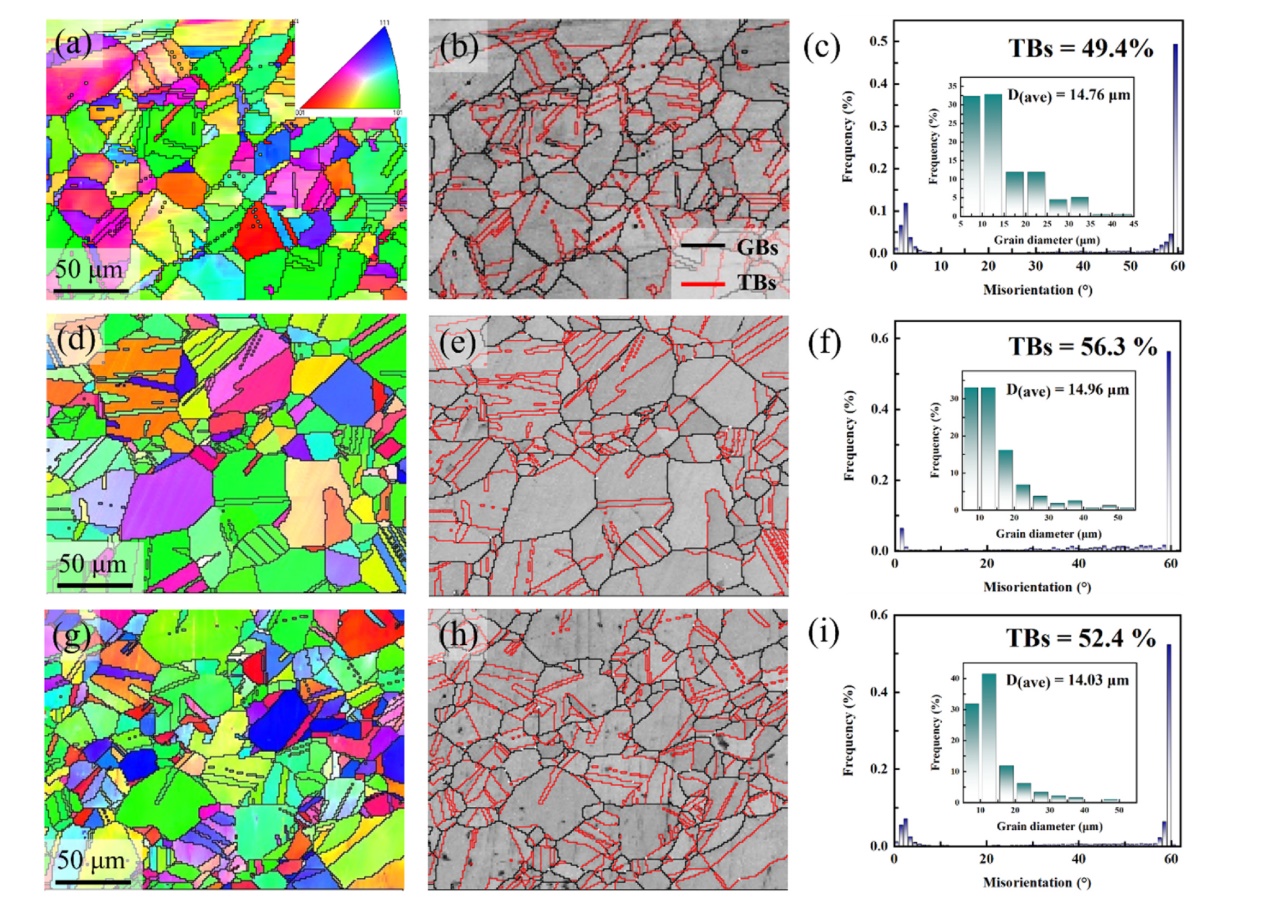
Fig. 2. Fully recrystallized microstructures and twin boundaries of the three MCCAs after annealing: (a-c) Ni32, (d-f) Ni40, and (g-i) Ni48. (a, d, g) EBSD inverse pole figure maps; (b, e, h) band contrast images showing high-density twin boundaries (red lines) and high-angle grain boundaries (black lines); (c, f, i) corresponding quantitative statistical results, indicating similar grain sizes and twin boundary fractions across the three alloys.
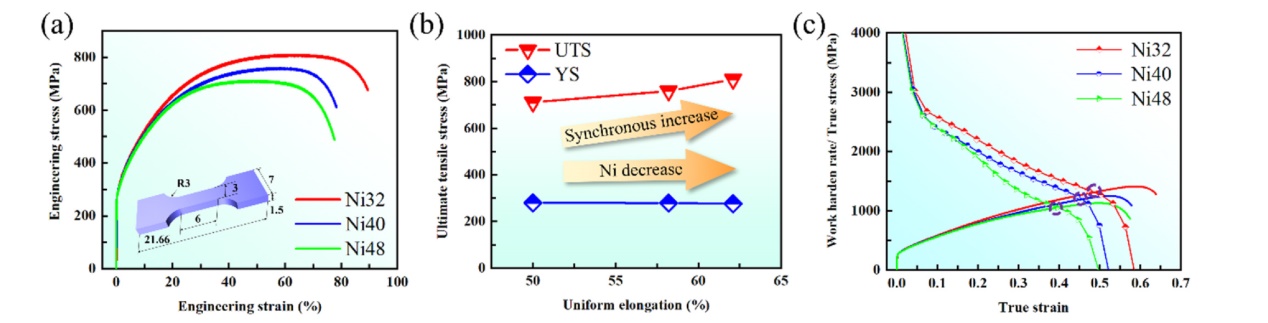
Fig. 3. Mechanical properties of three MCCAs. (a) Tensile engineering stress-strain curves. (b) Dependence of yield strength and tensile strength on uniform elongation showing synchronous increase in ductility with the decrease of Ni content. (c) Corresponding true stress versus true strain and work-hardening rate curves.
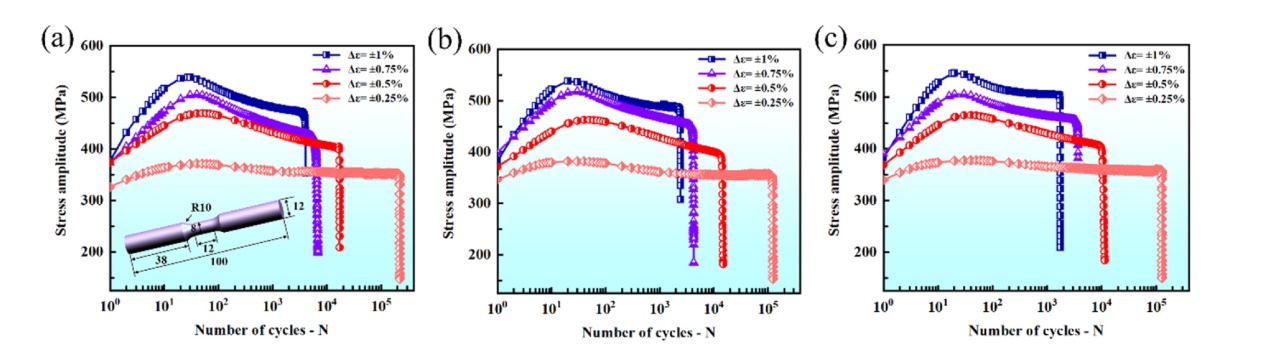
Fig. 4. Cyclic stress response (CSR) curves of three MCCAs at different strain amplitudes: (a) Ni32, (b) Ni40, (c) Ni48, respectively.

Fig. 5. Comparison of cyclic stress response (CSR) curves of different components at the same strain amplitude: (a) 1%, (b) 0.75%, (c) 0.5%, (d) 0.25%, respectively.
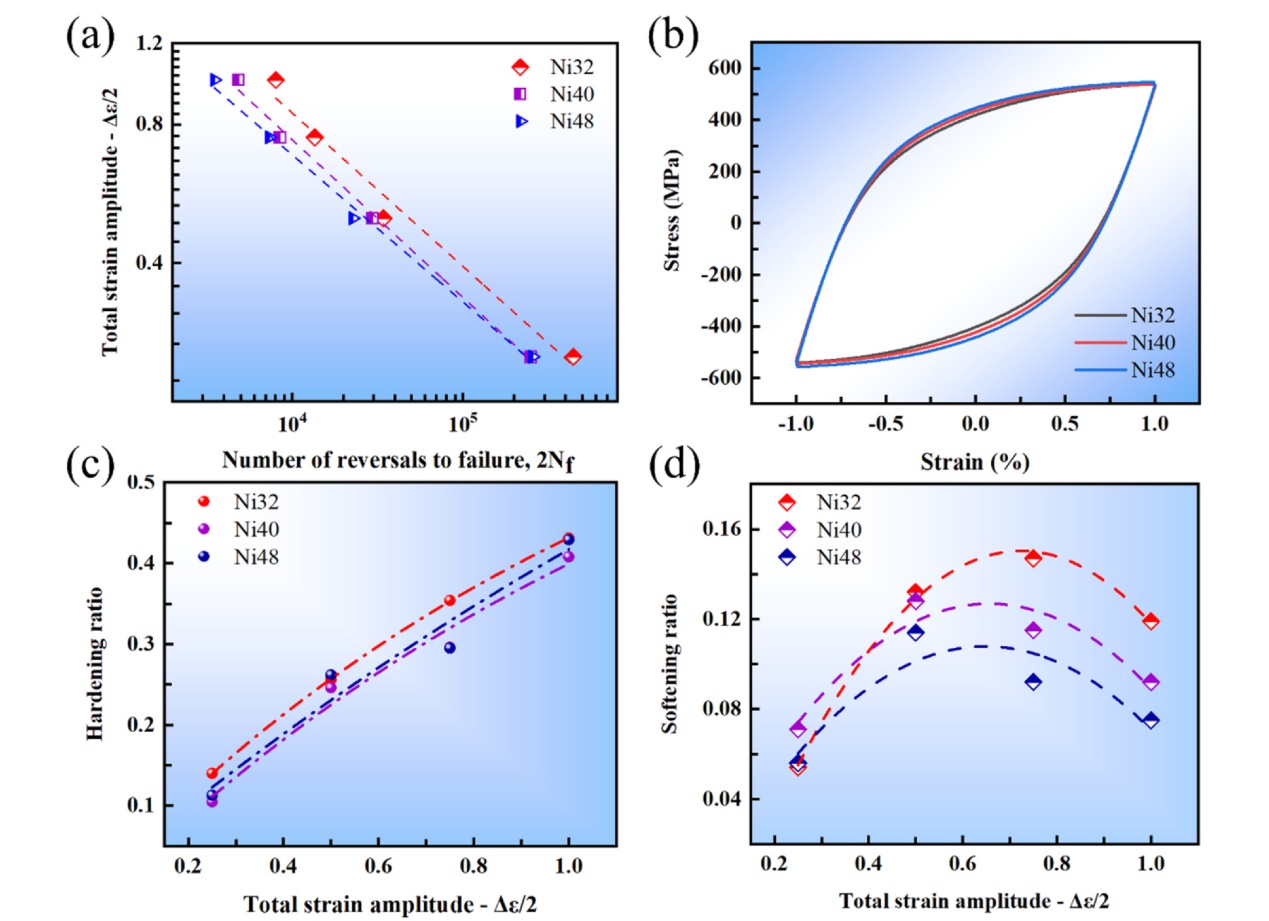
Fig. 6. (a) Comparison of LCF properties of three MCCAs. (b) Cyclic stress-strain hysteresis loops at max stress cycles. (c) Cyclic hardening and (d) cyclic softening abilities of three MCCAs.
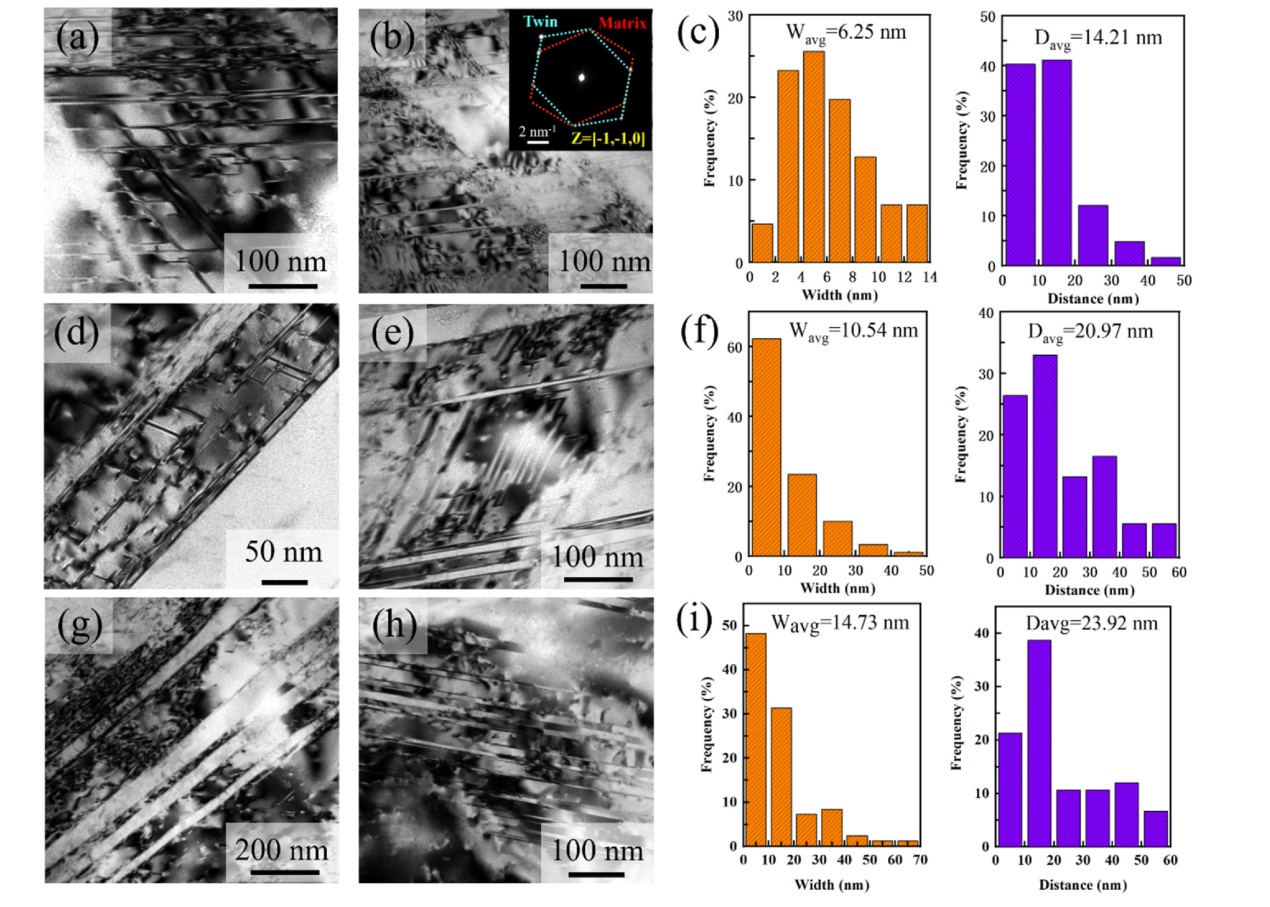
Fig. 7. TEM images displaying the deformation mechanism of three MCCAs under uniaxial loading, the transformation from single-level twin to multi-level twin. (a, b) Ni32. (d, e) Ni40. (g, h) Ni48. (c, f, i) Quantitative statistics of twin width and distance.

Fig. 8. SEM images of fracture (crack propagation region) features of three MCCAs after cyclic loading. (a, d, g) Ni32, Δε/2=0.25%, 𝑁f=222081. (b, e, h) Ni40, Δε/2=0.75%, 𝑁f=4239. (c, f, i) Ni48, Δε/2=1.0%, 𝑁f=1757.

Fig. 9. Surface deformation morphologies and fatigue cracking behaviors of three MCCAs after cyclic loading. (a) Ni32, Δε/2=1.0%, (b) Ni48, Δε/2=1.0%, (c) Ni40, Δε/2=0.75%, (d) Ni40, Δε/2=0.5%, (e) Ni32, Δε/2=0.25%, (f) Ni48, Δε/2=0.25%, the quantitative statistics about (g) the slip band density, (h) the crack density and (i) the ratio of GB/SB crack at various strain amplitudes.

Fig. 10. Bright field TEM images of deformation microstructure after cyclic loading of three MCCAs showing the transformation from twinning to plane slip and cross-slip. High-density twins at strain amplitude of 1.0% in (a) Ni32 and (b) Ni48. (c, d) Mixed deformation mechanism with twinning and planar slip at strain amplitude of 0.75% in Ni32. (e, f) Cross-slip and planar slip in Ni40. High-density dislocations in (111) plane at strain amplitudes of 0.5% and 0.25% in (g) Ni32, (h) Ni40 and (i) Ni48.

Fig. 11. TEM images show the evolution of deformation microstructure of three MCCAs from twinning to multiple slip to planar slip at different strain amplitudes.
| Total strain amplitude Δε/2 (%) | Fatigue life, 𝑁f | ||
|---|---|---|---|
| Ni32 | Ni40 | Ni48 | |
| 1% | 4018 | 2426 | 1757 |
| 0.75% | 6799 | 4240 | 3684 |
| 0.5% | 17137 | 14778 | 11358 |
| 0.25% | 222079 | 124888 | 127952 |
Table 1. Fatigue lives of the three MCCAs at different strain amplitudes.
| Total strain amplitude Δε/2 (%) | Fatigue life, 𝑁f | ||
|---|---|---|---|
| Ni32 | Ni40 | Ni48 | |
| 1% | 4018 | 2426 | 1757 |
| 0.75% | 6799 | 4240 | 3684 |
| 0.5% | 17137 | 14778 | 11358 |
| 0.25% | 222079 | 124888 | 127952 |
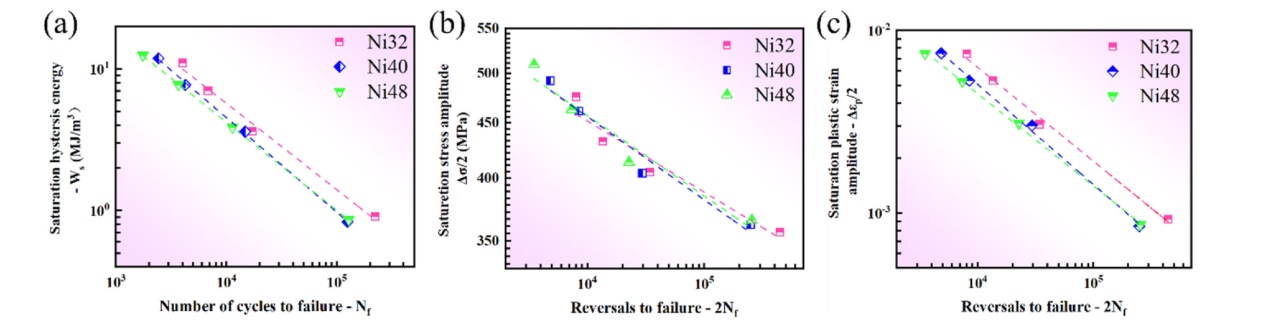
Fig. 12. Fatigue life prediction models and corresponding parameters: (a) the hysteresis energy model, (b) the Basquin model, (c) the Coffin-Manson model.
| Empty Cell | b | c | 𝑊0 | β | ||
|---|---|---|---|---|---|---|
| Ni32 | 828 | −0.0658 | 1.4027 | −0.5138 | 1567 | 1.64 |
| Ni40 | 925 | −0.0768 | 1.2736 | −0.5476 | 2129 | 1.5 |
| Ni48 | 908 | −0.0745 | 2.1301 | −0.5045 | 1292 | 1.61 |
Table 2. Comparison of different model parameters.
| Empty Cell | b | c | 𝑊0 | β | ||
|---|---|---|---|---|---|---|
| Ni32 | 828 | −0.0658 | 1.4027 | −0.5138 | 1567 | 1.64 |
| Ni40 | 925 | −0.0768 | 1.2736 | −0.5476 | 2129 | 1.5 |
| Ni48 | 908 | −0.0745 | 2.1301 | −0.5045 | 1292 | 1.61 |
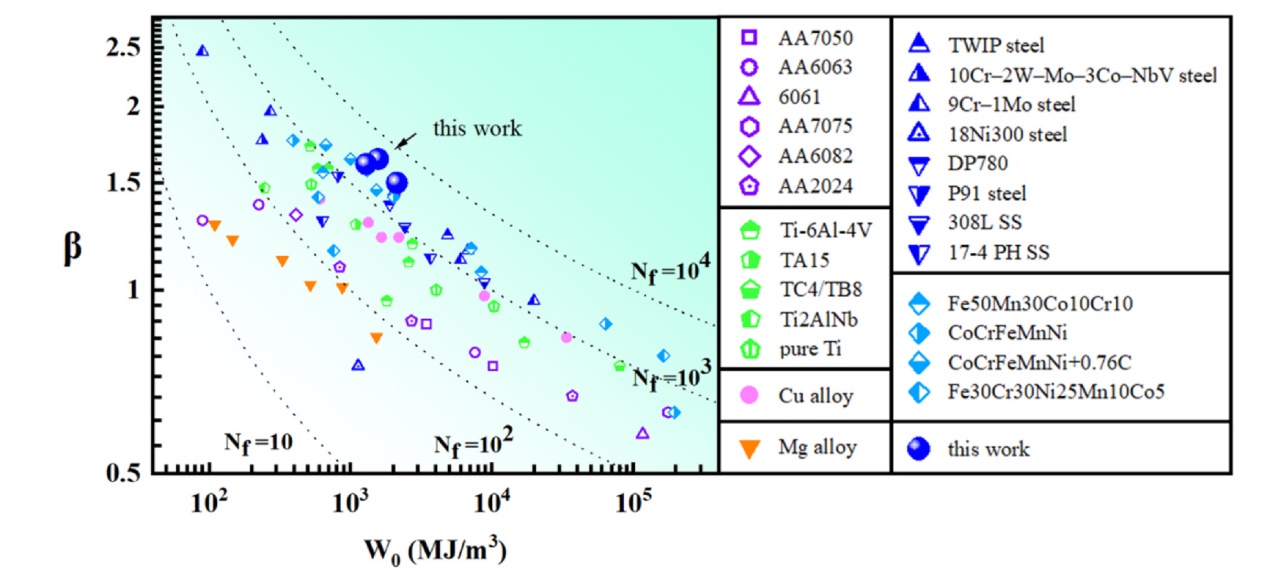
Fig. 13. Comparison of damage transition exponent β versus intrinsic fatigue toughness 𝑊0 with other common metallic materials in the literature available. The current MCCAs show the highest fatigue life in comparison with the other common metallic materials.
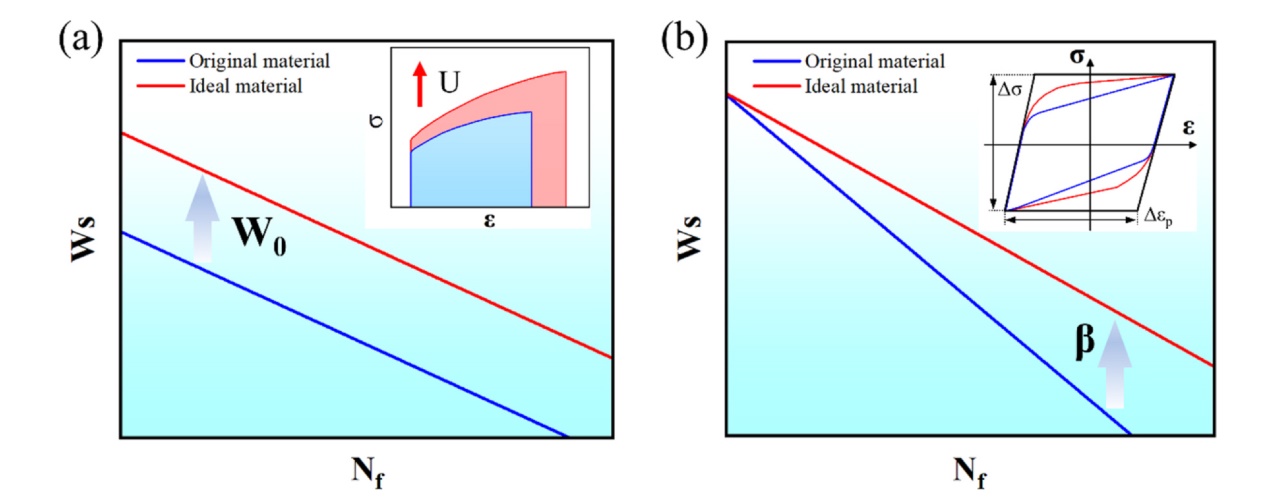
Fig. 14. Illustrations for improving LCF properties: (a) improving intrinsic fatigue toughness 𝑊0, (b) improving damage transition exponent β.
| [1] |
J. Yeh, S. Chen, S. Lin, J. Gan, T. Chin, T. Shun, C. Tsau, S. Chang, Adv. Eng. Mater. 6 (2004) 299-303.
DOI URL |
| [2] |
H.S. Oh, S.J. Kim, K. Odbadrakh, W.H. Ryu, K.N. Yoon, S. Mu, F. Körmann, Y. Ikeda, C. C. Tasan, D. Raabe, T. Egami, E.S. Park, Nat. Commun. 10 (2019) 2090.
DOI |
| [3] | S. Zhao, Z. Wang, M. Wang, Z. Ding, Y. Lu, Met. Adv. 40 (2026) 1-7. |
| [4] | G. Zhu, J. Tan, Z. Xing, J. Pang, H. Zhang, Z. Zhang, X. Wu, Met. Adv. 43 (2026) 83-97. |
| [5] |
E.P. George, D. Raabe, R.O. Ritchie, Nat. Rev. Mater. 4 (2019) 515-534.
DOI |
| [6] |
W. Li, D. Xie, D. Li, Y. Zhang, Y. Gao, P.K. Liaw, Prog. Mater. Sci. 118 (2021) 100777.
DOI URL |
| [7] | L. Chen, G. Qin, Y. Chen, Q. Wang, L. Wang, Y. Su, R. Chen, Met. Adv. 40 (2026) 26-47. |
| [8] | B. Cantor, I.T.H. Chang, P. Knight, A.J.B. Vincent, Mater. Sci. Eng. A 375-377 (2004) 213-218. |
| [9] |
P. Sathiyamoorthi, J.W. Bae, P. Asghari-Rad, J.M. Park, J.G. Kim,H.S Kim, Entropy 20 (2018) 849.
DOI URL |
| [10] |
D. Liu, Q. Yu, S. Kabra, M. Jiang, P.F. Kreutzer, R. Zhang, M. Payne, F. Walsh, B. Gludovatz, M. Asta, A.M. Minor, E.P. George,R.O Ritchie, Science 378 (2022) 978-983.
DOI URL |
| [11] |
G. Laplanche, A. Kostka, C. Reinhart, J. Hunfeld, G. Eggeler, E.P. George, Acta Mater. 128 (2017) 292-303.
DOI URL |
| [12] |
S. Yoshida, T. Bhattacharjee, Y. Bai, N. Tsuji, Scr. Mater. 134 (2017) 33-36.
DOI URL |
| [13] |
F. Lv, F. Yang, S.X. Li, Z.F. Zhang, Scr. Mater. 65 (2011) 53-56.
DOI URL |
| [14] | Z.Q. Wang, J.X. Yan, H.Z. Liu, X.G. Wang, Z.J. Zhang, Z.F. Zhang, Acta Metall. Sin. Acta Metall. Sin.-Eng. Lett. 38 (2025) 1735-1741. |
| [15] |
K. Lu, A. Chauhan, A.S. Tirunilai, J. Freudenberger, A. Kauffmann, M. Heilmaier, J. Aktaa, Acta Mater. 215 (2021) 117089.
DOI URL |
| [16] |
K. Lu, A. Chauhan, M. Walter, A.S. Tirunilai, M. Schneider, G. Laplanche, J. Freudenberger, A. Kauffmann, M. Heilmaier, J. Aktaa, Scr. Mater. 194 (2021) 113667.
DOI URL |
| [17] |
X.H. An, S.D. Wu, Z.G. Wang, Z.F. Zhang, Prog. Mater. Sci. 101 (2019) 1-45.
DOI |
| [18] | M. Jin, A. Piglione, B. Dovgyy, E. Hosseini, P.A. Hooper, S.R. Holdsworth, M. S. Pham, Addit. Manuf. 36 (2020) 101584. |
| [19] |
Y. Wang, T. Yu, Z. Wang, L. Li, G. Yuan, Z. Zhang, Int. J. Fatigue 180 (2024) 108105.
DOI URL |
| [20] |
R. Feng, Y. Rao, C. Liu, X. Xie, D. Yu, Y. Chen, M. Ghazisaeidi, T. Ungar, H. Wang, K. An, P.K. Liaw, Nat. Commun. 12 (2021) 3588.
DOI PMID |
| [21] | L.F. Coffin, Trans. ASME 76 (1954) 931-950. |
| [22] | S.S. Manson, National Advisory Committee for Aeronautics, Report 1170 (1953). |
| [23] | O.H. Basquin, ASTM-ASTEA 10 (1910) 625-630. |
| [24] |
C.W. Shao, P. Zhang, R. Liu, Z.J. Zhang, J.C. Pang, Q.Q. Duan, Z.F. Zhang, Acta Mater. 118 (2016) 196-212.
DOI URL |
| [25] |
C.W. Shao, P. Zhang, R. Liu, Z.J. Zhang, J.C. Pang, Z.F. Zhang, Acta Mater. 103 (2016) 781-795.
DOI URL |
| [26] |
R. Liu, Z.J. Zhang, P. Zhang, Z.F. Zhang, Acta Mater. 83 (2015) 341-356.
DOI URL |
| [27] |
S.J. Sun, Y.Z. Tian, H.R. Lin, H.J. Yang, X.G. Dong, Y.H. Wang, Z.F. Zhang, Mater. Sci. Eng. A 712 (2018) 603-607.
DOI URL |
| [28] |
H.K. Yang, Z.J. Zhang, Z.F. Zhang, Scr. Mater. 68 (2013) 992-995.
DOI URL |
| [29] |
I.S. Yasnikov, A. Vinogradov, Y. Estrin, Scr. Mater. 76 (2014) 37-40.
DOI URL |
| [30] |
P. Guo, L. Qian, J. Meng, F. Zhang, L. Li, Mater. Sci. Eng. A 584 (2013) 133-142.
DOI URL |
| [31] | S.K. Paul, J. Alloy. Metall. Syst. 9 (2025) 100153. |
| [32] |
D.D. Zhang, J.Y. Zhang, J. Kuang, G. Liu, J. Sun, Acta Mater. 220 (2021) 117288.
DOI URL |
| [33] |
K. Jiang, T. Ren, G. Shan, T. Ye, L. Chen, C. Wang, F. Zhao, J. Li, T. Suo, Mater. Sci. Eng. A 797 (2020) 140125.
DOI URL |
| [34] |
D. Huang, Y. Zhuang, C. Wang, Scr. Mater. 207 (2022) 114269.
DOI URL |
| [35] |
Z. Qu, Z.J. Zhang, J.X. Yan, P. Zhang, B.S. Gong, S.L. Lu, Z.F. Zhang, T.G. Langdon, J. Mater. Sci. Technol. 122 (2022) 54-67.
DOI |
| [36] |
P. Li, S.X. Li, Z.G. Wang, Z.F. Zhang, Prog. Mater. Sci. 56 (2011) 328-377.
DOI URL |
| [37] | E. Hassna, Y. Huang, T. Yan, Met. Adv. 39 (2026) 68-82. |
| [38] | S. Wang, H. Cheng, X. Li, B. Song, Y. Shi, Met. Adv. 40 (2026) 8-25. |
| [39] |
P. Li, Z.F. Zhang, S.X. Li, Z.G. Wang, Mater. Sci. Eng. A 527 (2010) 2305-2312.
DOI URL |
| [40] | S. Song, L. Tang, L. Huang, Y. Luo, H. Yang, C. Yang, Met. Adv. 42 (2026) 49-65. |
| [41] |
H. Mughrabi, Mater. Sci. Eng. 33 (1977) 207-233.
DOI URL |
| [42] |
C. Laird, S.I. Hong, Acta Metall. Mater. 38 (1990) 1581-1594.
DOI URL |
| [43] | P.M. Anderson, J.P. Hirth, J. Lothe, Theory of dislocations, Third edition, Cambridge University Press, 2017. |
| [44] |
L. Chen, S.K. Kim, B.C. DE Cooman, ISIJ Int. 47 (2007) 1804-1812.
DOI URL |
| [45] |
K.M. Rahman, V.A. Vorontsov, D. Dye, Acta Mater. 89 (2015) 247-257.
DOI URL |
| [46] |
E.P. George, W.A. Curtin, C.C. Tasan, Acta Mater. 188 (2020) 435-474.
DOI |
| [47] |
K.O. Leea, S.G. Hong, S.B. Lee, Mater. Sci. Eng. A 496 (2008) 471-477.
DOI URL |
| [48] |
L. Xue, Int. J. Fatigue 30 (2008) 1691-1698.
DOI URL |
| [49] |
V.M. Radhakrishnan, Fatigue Fract. Eng. Mater. Struct. 3 (1980) 75-84.
DOI URL |
| [50] |
D. Lefebvre, F. Ellyin, Int. J. Fatigue 6 (1984) 9-15.
DOI URL |
| [51] |
J.S. Santner, M.E. Fine, Scr. Metall. 11 (1977) 159-162.
DOI URL |
| [52] | A. Rohatgi, K.S. Vecchio, G.T. Gary III, Metall. Mater. Trans. A 32A (2001) 135A. |
| [53] |
Y. Tang, R. Wang, B. Xiao, Z. Zhang, S. Li, J. Qiao, S. Bai, Y. Zhang, P.K. Liaw, Prog. Mater. Sci. 135 (2023) 101090.
DOI URL |
| [54] |
L.G. Hou, W.L. Xiao, H. Su, C.M. Wu, D.G. Eskin, L. Katgerman, L.Z. Zhuang, J.S. Zhang, Int. J. Fatigue 142 (2021) 105919.
DOI URL |
| [55] |
A.V. Rex, S.K. Paul, A. Singh, Int. J. Fatigue 173 (2023) 107699.
DOI URL |
| [56] |
S. Nandy, A.P. Sekhar, T. Kar, K.K. Ray, D. Das, Philos. Mag. 97 (2017) 1978-2003.
DOI URL |
| [57] |
S.V. Sajadifar, E. Scharifi, T. Wegener, M. Krochmal, S. Lotz, K. Steinhoff, T. Niendorf, Int. J. Fatigue 156 (2022) 106676.
DOI URL |
| [58] |
A.T. Brammer, J.B. Jordon, P.G. Allison, M.E. Barkey, J. Mater. Eng. Perform. 22 (2012) 1348-1350.
DOI URL |
| [59] |
Y. Zhang, A. Feng, S. Qu, J. Shen, D. Chen, J. Mater. Sci. Technol. 44 (2020) 140-147.
DOI URL |
| [60] |
G. Kim, S.A.A. Shams, J.N. Kim, J.W. Won, S.W. Choi, J.K. Hong, C.S. Lee, Mater. Sci. Eng. A 803 (2021) 140698.
DOI URL |
| [61] |
C. Bai, L. Lan, R. Xin, S. Gao, B. He, Int. J. Fatigue 159 (2022) 106784.
DOI URL |
| [62] |
J. Xi, Y. Hu, H. Xing, Y. Han, H. Zhang, J. Jiang,K Nikbin, Materials 14 (2021) 6276.
DOI URL |
| [63] |
T. Li, W. Fan, X. Li, H. Wu, D. An, Q. Hu, J. Chen, Int. J. Plast. 179 (2024) 104033.
DOI URL |
| [64] |
Q. Wang, J.Q. Ren, C. Xin, P. Jiang, L. Zhang, Q.T. Liu, J.P. Wu, J. Alloy. Compd. 934 (2023) 167856.
DOI URL |
| [65] |
Y. Sun, I.V. Alexandrov, Y. Dong, R.Z. Valiev, H. Chang, L. Zhou, J. Mater. Res. Technol. 15 (2021) 5277-5287.
DOI URL |
| [66] |
P.F. Gao, Z.N. Lei, Y.K. Li, M. Zhan, Mater. Sci. Eng. A 736 (2018) 1-11.
DOI URL |
| [67] |
Z.J. Zhang, P. Zhang, Z.F. Zhang, Acta Mater. 121 (2016) 331-342.
DOI URL |
| [68] |
F. Lv, F. Yang, Q.Q. Duan, Y.S. Yang, S.D. Wu, S.X. Li, Z.F Zhang, Int. J. Fatigue 33 (2011) 672-682.
DOI URL |
| [69] |
L. Carneiro, B. Jalalahmadi, A. Ashtekar, Y. Jiang, Int. J. Fatigue 123 (2019) 22-30.
DOI URL |
| [70] | Y. Li, Y. Yuan, D. Wang, S. Fu, D. Song, M. Vedani, X. Chen, Addit. Manuf. 52 (2022) 102688. |
| [71] |
S.K. Paul, N. Stanford, A. Taylor, T. Hilditch, Int. J. Fatigue 80 (2015) 341-348.
DOI URL |
| [72] |
K. Guguloth, S. Sivaprasad, D. Chakrabarti, S. Tarafder, Mater. Sci. Eng. A 604 (2014) 196-206.
DOI URL |
| [73] |
R. Branco, J. Costa, F. Berto, S. Razavi, J. Ferreira, C. Capela, L. Santos,F Antunes, Metals 8 (2018) 32.
DOI URL |
| [74] |
P. Verma, N.C.S. Srinivas, S.R. Singh, V. Singh, Mater. Sci. Eng. A 652 (2016) 30-41.
DOI URL |
| [75] |
R. Mishnev, N. Dudova, R. Kaibyshev, Int. J. Fatigue 83 (2016) 344-355.
DOI URL |
| [76] |
F. Bahadur, R. Jain, K. Biswas, N.P Gurao, Int. J. Fatigue 155 (2022) 106545.
DOI URL |
| [77] |
A. Radi, S. Sajadifar, S.V. Seyedmohammadi, M. Krochmal, A. Bolender, T. Wegener, T. Niendorf, G.G. Yapici, Int. J. Fatigue 173 (2023) 107678.
DOI URL |
| [78] |
T. Niendorf, T. Wegener, Z. Li, D. Raabe, Scr. Mater. 143 (2018) 63-67.
DOI URL |
| [79] |
S.A.A. Shams, G. Kim, J.W. Won, J.N. Kim, H.S. Kim, C.S. Lee, Mater. Sci. Eng. A 810 (2021) 140985.
DOI URL |
| [80] |
S. Picak, T. Wegener, S.V. Sajadifar, C. Sobrero, J. Richter, H. Kim, T. Niendorf, I. Karaman, Acta Mater. 205 (2021) 116540.
DOI URL |
| [81] |
D.R. Fang, Q.Q. Duan, N.Q. Zhao, J.J. Li, S.D. Wu, Z.F. Zhang, Mater. Sci. Eng. A 459 (2007) 137-144.
DOI URL |
| [82] | W. Ramberg, W.R. Osgood, Description of stress-strain curves by three parameters, National Advisory Committee for Aeronautics, Washington, D.C., 1943 Technical Note No. 902. |
| [1] | Qichang He, Xiaodan Zhang, Yifei Cao, Huamiao Wang, Peidong Wu. Anisotropic deformation mechanisms of AZ31B Mg alloy under torsional and torsion-axial coupled loadings [J]. Metals Advances, 2026, 46(8): 50-61. |
| [2] | Mengyao He, Shuhui Hao, Huichao Duan, Rui Zhang, Chuanyong Cui, Kui Du. Deformation twinning in a wrought Ni-base superalloy at intermediate temperatures [J]. Metals Advances, 2026, 40(2): 71-77. |
| [3] | Guanghui Yang, En (Evan) Ma. Different trend patterns reflecting varying levels of strength-ductility trade-off in metallic materials [J]. Metals Advances, 2026, 48(10): 34-40. |
| [4] | Shudong Yang, Xiaoqian Guo, Chao Ma, Lu Shen, Lingyu Zhao, Wei Zhu. Anisotropic Mechanical Behavior in an Extruded AZ31 Magnesium Alloy: Experimental and Crystal Plasticity Modeling [J]. Acta Metallurgica Sinica (English Letters), 2025, 38(9): 1527-1544. |
| [5] | Yang Feng, Shuai Wang, Yang Zhao, Li-Qing Chen. Achieving High-Temperature Oxidation and Corrosion Resistance in Fe-Mn-Cr-Al-Cu-C TWIP Steel via Annealing Control [J]. Acta Metallurgica Sinica (English Letters), 2025, 38(4): 642-656. |
| [6] | Lingyu Zhao, Wei Zhu, Chao Zhang, Yunchang Xin, Changjian Yan, Yao Cheng, Zhaoyang Jin. Detwinning and Anneal-Hardening Behaviors of Pre-Twinned AZ31 Alloys under Cryogenic Loading [J]. Acta Metallurgica Sinica (English Letters), 2024, 37(9): 1551-1563. |
| [7] | Dongqiqiong Wang, Qiang Wang, Xiaowu Li, Zhefeng Zhang. Improving Fatigue Properties of 316L Stainless Steel Welded Joints by Surface Spinning Strengthening [J]. Acta Metallurgica Sinica (English Letters), 2024, 37(5): 840-854. |
| [8] | Fanchao Meng, Rui Zhang, Shuai Wang, Fengbo Sun, Run Chen, Lujun Huang, Lin Geng. Fatigue Crack Initiation and Propagation Dominated by Crystallographic Factors in TiB/near α-Ti Composite [J]. Acta Metallurgica Sinica (English Letters), 2024, 37(5): 763-776. |
| [9] | Chong Wang, Fuyuan Liu, Xuejian Wang, Enyu Guo, Zelong Du, Kunkun Deng, Zongning Chen, Huijun Kang, Guohao Du, Tongmin Wang. Tailoring the Microstructure and Mechanical Property of Mg-Zn Matrix Composite via the Addition of Al Element [J]. Acta Metallurgica Sinica (English Letters), 2024, 37(3): 438-452. |
| [10] | Xiaoguang Li, Jiatao Liu, Qing Liu, Chunbo Zhang, Hang Liang, Lei Cui, Yongchang Liu. High-Temperature Fatigue Behavior of Inertia Friction Welded Joints of GH4065A Ni-Based Superalloy [J]. Acta Metallurgica Sinica (English Letters), 2024, 37(11): 1935-1946. |
| [11] | Xiaoyuan Teng, Jianchao Pang, Feng Liu, Chenglu Zou, Xin Bai, Shouxin Li, Zhefeng Zhang. Fatigue Life Prediction of Gray Cast Iron for Cylinder Head Based on Microstructure and Machine Learning [J]. Acta Metallurgica Sinica (English Letters), 2023, 36(9): 1536-1548. |
| [12] | H. Zhang, H. L. Hao, G. Y. Fu, B. S. Liu, R. G. Li, R. Z. Wu, H. C. Pan. Microstructure and Mechanical Property of Hot-Rolled Mg-2Ag Alloy Prepared with Multi-pass Rolling [J]. Acta Metallurgica Sinica (English Letters), 2023, 36(2): 335-342. |
| [13] | Fei-Yang Chen, Peng-Cheng Guo, Zi-Han Jiang, Xiao Liu, Tie-Jun Song, Chao Xie. Abnormal Twinning Behavior and Constitutive Modeling of a Fine-Grained Extruded Mg-8.0Al-0.1Mn-2.0Ca Alloy under High-Speed Impact along Various Directions [J]. Acta Metallurgica Sinica (English Letters), 2023, 36(2): 281-294. |
| [14] | Wen-Ke Yang, Zhu-Man Song, Xue-Mei Luo, Guang-Ping Zhang. Evaluation of Tensile and Fatigue Properties of Metals Using Small Specimens [J]. Acta Metallurgica Sinica (English Letters), 2023, 36(1): 147-157. |
| [15] | Anqi Zuo, Xia Liu, Chendong Shao, Mingzhe Fan, Ninshu Ma, Fenggui Lu. In Situ DIC Study on LCF Behavior of Retired Weld Joint Subjected to Prolonged Service at Elevated Temperature [J]. Acta Metallurgica Sinica (English Letters), 2022, 35(8): 1317-1328. |
| Viewed | ||||||
|
Full text |
|
|||||
|
Abstract |
|
|||||
 WeChat
