
Metals Advances ›› 2026, Vol. 48: 34-40.DOI: 10.1016/j.metadv.2026.05.005
• Perspective Article • Previous Articles Next Articles
Guanghui Yang*( ), En (Evan) Ma*()
Received:2026-03-18
Revised:2026-04-28
Accepted:2026-05-07
Online:2026-10-10
Published:2026-07-07
Contact:
*E-mail addresses: gyang@xjtu.edu.cn (G. Yang),
maen@xjtu.edu.cn (E.E. Ma).
Guanghui Yang, En (Evan) Ma. Different trend patterns reflecting varying levels of strength-ductility trade-off in metallic materials[J]. Metals Advances, 2026, 48: 34-40.
Add to citation manager EndNote|Ris|BibTeX

Fig. 1. Mechanical properties of CR ASSs in comparison with reference alloys. (a) YS-UE “banana plot” of Ni [11], as an example representing the commonly observed hyperbolic strength-ductility trade-off. (b) Representative engineering stress-strain curves of CR ASSs. (c) YS × UE versus CR thickness reduction, compared with TRIP steels [12], TWIP steels [13], Ni [14], 304 SS [15], and HEA with high SFE [16]. AH ASS stands for as-homogenized ASS. (d) Overall YS-UE of CR ASSs versus fcc-single phase HEAs [3], [17], [18], [19], [20], [21], [22], [23], [24], [25], [26], [27], [28], [29], MEAs [28], [30], [31], [32], [33], and Ni [11].
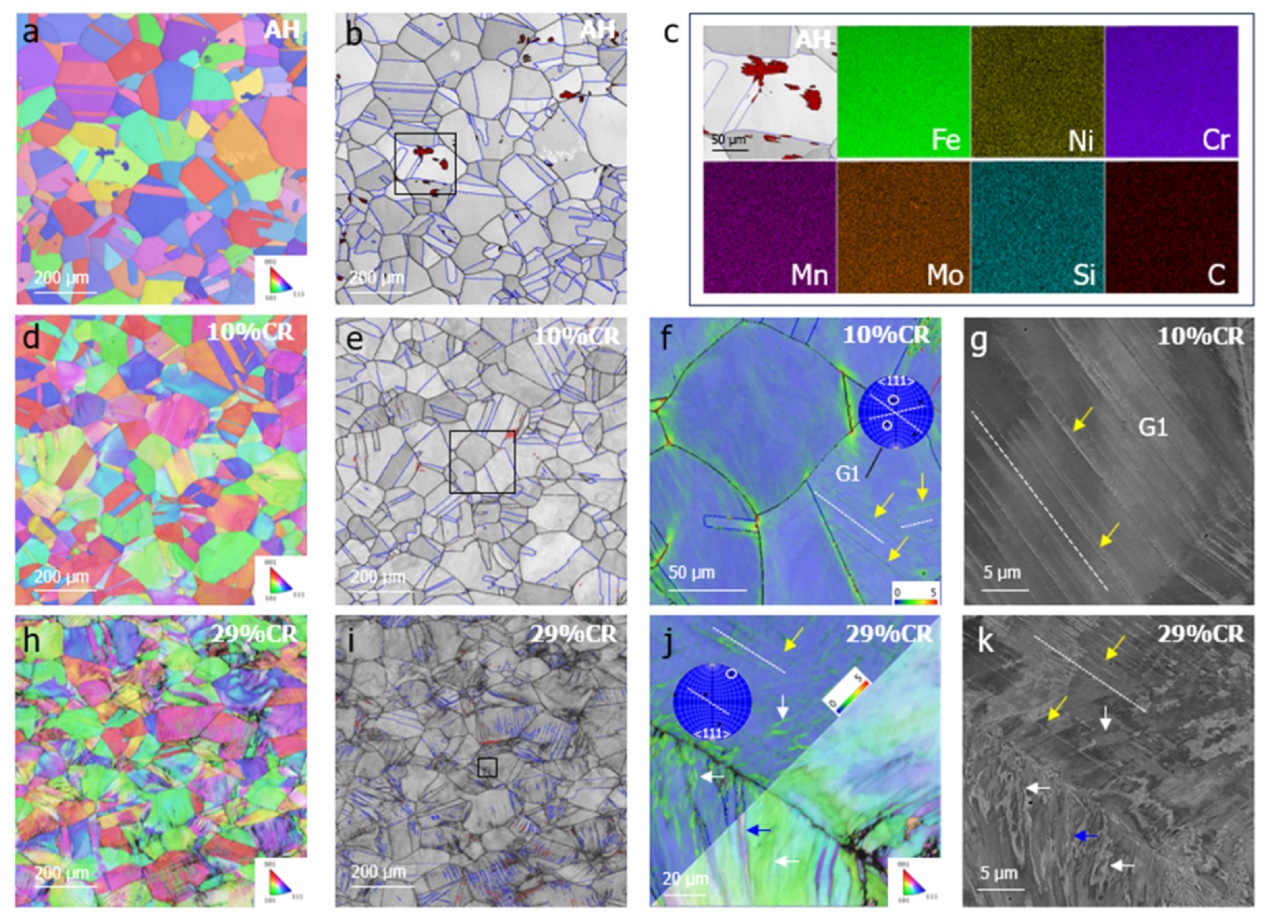
Fig. 2. Microstructure evolution during CR revealed by EBSD and BSE. (a-c) EBSD inverse pole figure (IPF) map, band-contrast (BC) map and EDS map of the AH sample. (d-g) Microstructure of the 10%CR sample: (d) IPF map, (e) BC map, (f) KAM map from the boxed region in (e) (with the 〈111〉 pole figure of grain 1 (G1) inset), and (g) corresponding BSE image of G1. (h-k) Microstructure of the 29%CR sample: (h) IPF map, (i) BC map, (j) combined KAM (upper left) and IPF (lower right) map from the boxed region in (i) (with the 〈111〉 pole figure of the upper grain inset), and (k) corresponding BSE image. Twin boundaries are highlighted in blue in all BC and KAM maps, and bcc regions are marked in red. In all KAM and BSE images, the {111} slip planes are indicated by dashed white lines and yellow arrows, guided by the corresponding 〈111〉 pole figures. White and blue arrows denote strain-concentrated boundaries and twin boundaries, respectively.
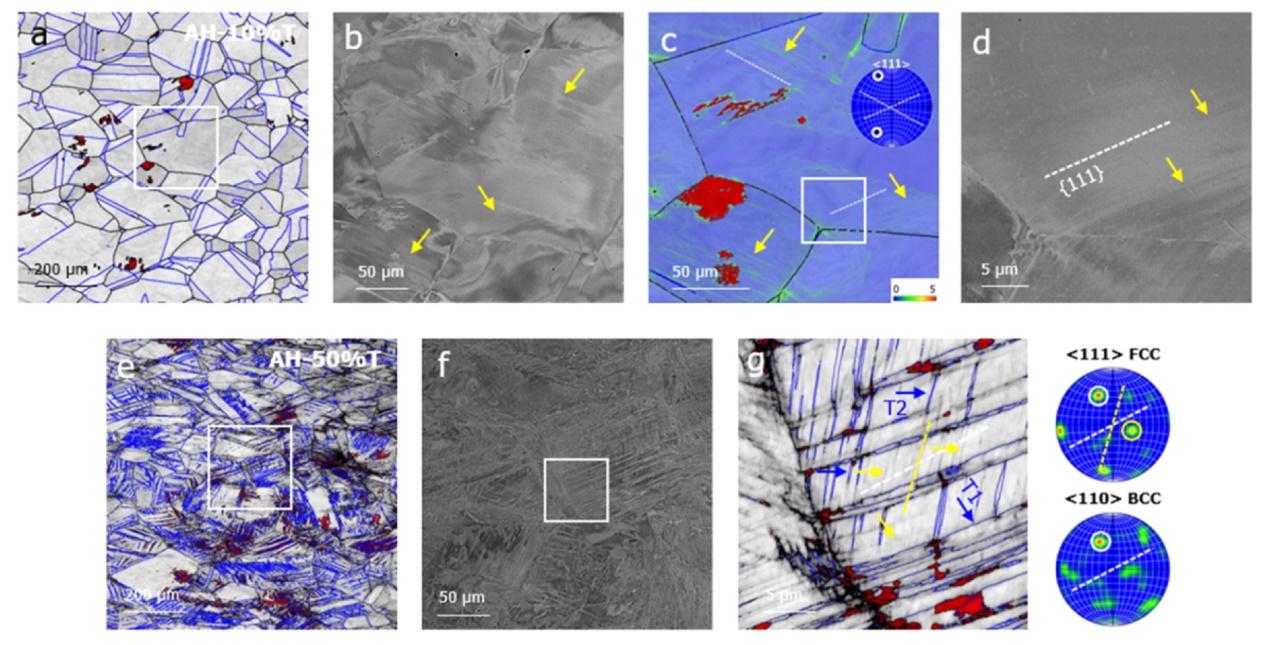
Fig. 3. Deformation mechanisms in AH samples revealed by EBSD and BSE. (a) Band-contrast (BC) map and (b) BSE image from the boxed region in (a), with the corresponding (c) KAM map and (d) BSE image from the boxed region in (c) of the AH−10%T sample. (e) BC map, (f) BSE image from the boxed region in (e), and (g) BC map of the boxed region in (f) with corresponding pole figures of the AH−50%T sample. Yellow and blue arrows indicate strain-induced planar slip traces and twin boundaries, respectively. T1 and T2 denote primary and secondary twin boundaries in (g). Dashed white and yellow lines correspond to the {111} slip planes.

Fig. 4. EBSD analysis of deformation mechanisms in 10%CR and 29%CR samples. (a-d) 10%CR−10%T: (a) BC map; (b) BSE image from the boxed region in (a); (c) IPF map; and (d) enlarged IPF map from the boxed region in (c). (e-h) 10%CR−50%T: (e) BC map; (f) enlarged BC map from boxed region in (e); (g-h) further magnified BC maps from boxed region 1 and 2 in (f). (i, j) 29%CR−10%T: (i) BC map; (b) enlarged BC map from the boxed region in (a). (k-m) Corresponding 〈111〉 fcc and 〈110〉 bcc pole figures extracted from regions (g), (h), and the boxed region in (j), respectively. Twin boundaries are highlighted in blue, and bcc regions are marked in red in all EBSD maps.
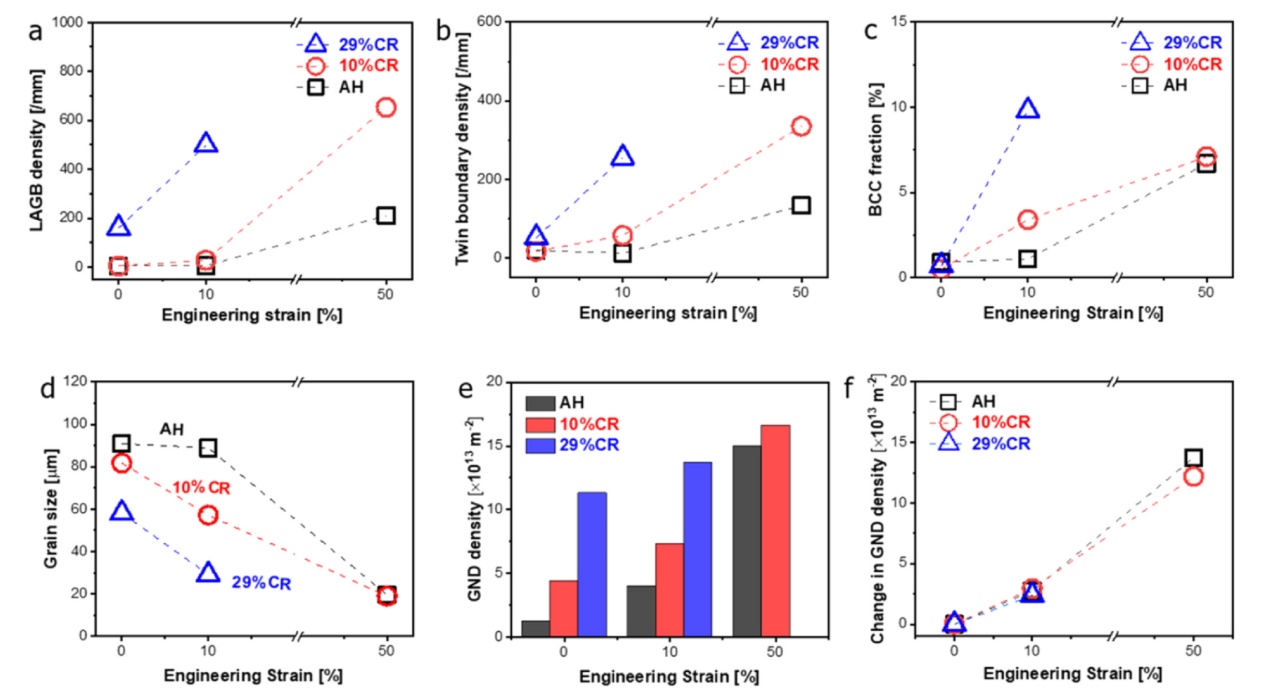
Fig. 5. EBSD quantification of microstructural evolution versus tensile strain. (a) LAGB density, (b) twin boundary density, (c) BCC fraction, (d) grain size, (e) GND density, and (f) the corresponding change in GND density for AH, 10%CR, and 29%CR samples.

Fig. 6. YS-UE of CR-processed ASSs in this work, in comparison with other state-of-the-art ASSs optimized via advanced approaches, including additive manufacturing (AM) [46], [47], [48], AM followed by annealing (AM + A) [48], cyclic torsion (CT) [49], [50], surface mechanical attrition treatment (SMAT) [51], [52], dynamic plastic deformation followed by annealing (DPD + A) [53], and partially recrystallization (PR) [54].
| [1] |
Y. Wei, Y. Li, L. Zhu, Y. Liu, X. Lei, G. Wang, Y. Wu, Z. Mi, J. Liu, H. Wang, Nat. Commun. 5 (2014) 3580.
DOI |
| [2] |
S. Wu, G. Wang, Q. Wang, Y. Jia, J. Yi, Q. Zhai, J. Liu, B. Sun, H. Chu, J. Shen, Acta Mater. 165 (2019) 444-458.
DOI |
| [3] |
Z. Li, K.G. Pradeep, Y. Deng, D. Raabe,C.C Tasan, Nature 534 (2016) 227-230.
DOI |
| [4] |
E. Ma, X. Wu, Nat. Commun. 10 (2019) 5623.
DOI |
| [5] |
Y. Tang, H. Wang, X. Ouyang, C. Wang, Q. Huang, Q. Zhao, X. Liu, Q. Zhu, Z. Hou, J. Wu, Nat. Commun. 15 (2024) 3932.
DOI PMID |
| [6] |
X. Li, R. Liu, J. Hou, Z. Zhang, Z. Zhang, Acta Mater. 289 (2025) 120942.
DOI URL |
| [7] |
T. Yang, Y. Zhao, Y. Tong, Z. Jiao, J. Wei, J. Cai, X. Han, D. Chen, A. Hu,J Kai, Science 362 (2018) 933-937.
DOI PMID |
| [8] |
Y. Sohail, C. Zhang, D. Xue, J. Zhang, D. Zhang, S. Gao, Y. Yang, X. Fan, H. Zhang, G. Liu, J. Sun, E. Ma, Nature, 643 (2025) 119-124.
DOI |
| [9] |
E. Ma, C. Liu, Prog. Mater. Sci. 143 (2024) 101252.
DOI URL |
| [10] |
T. Lu, B. Sun, Y. Li, S. Dai, N. Yao, W. Li, X. Dong, X. Chen, J. Niu, F. Ye, Nature 645 (2025) 385-391.
DOI |
| [11] |
X. Wu, F. Yuan, M. Yang, P. Jiang, C. Zhang, L. Chen, Y. Wei, E. Ma, Sci. Rep. 5 (2015) 11728.
DOI |
| [12] | Y. Fu, J. Liu, J. Shi, W. Cao, H. Dong, J. Iron Steel Res. Int. 20 (2013) 50-56. |
| [13] |
N. Tewary, S. Ghosh, S. Bera, D. Chakrabarti, S. Chatterjee, Mater. Sci. Eng. A 615 (2014) 405-415.
DOI URL |
| [14] |
Z. Li, H. Gu, K. Luo, C. Kong, H. Yu, Engineering 33 (2024) 190-203.
DOI URL |
| [15] |
M. Milad, N. Zreiba, F. Elhalouani, C. Baradai, J. Mater. Process. Technol. 203 (2008) 80-85.
DOI URL |
| [16] |
M. Klimova, N. Stepanov, D. Shaysultanov, R. Chernichenko, N. Yurchenko, V Sanin,S Zherebtsov, Materials 11 (2017) 53.
DOI URL |
| [17] |
J. He, W. Liu, H. Wang, Y. Wu, X. Liu, T. Nieh, Z. Lu, Acta Mater. 62 (2014) 105-113.
DOI URL |
| [18] |
Z. Wang, I. Baker, W. Guo, J.D. Poplawsky, Acta Mater. 126 (2017) 346-360.
DOI URL |
| [19] |
A. Zaddach, R. Scattergood, C. Koch, Mater. Sci. Eng. A 636 (2015) 373-378.
DOI URL |
| [20] |
B. Gludovatz, A. Hohenwarter, D. Catoor, E.H. Chang, E.P. George,R.O Ritchie, Science 345 (2014) 1153-1158.
DOI PMID |
| [21] |
W. Liu, Z. Lu, J. He, J. Luan, Z. Wang, B. Liu, Y. Liu, M. Chen, C. Liu, Acta Mater. 116 (2016) 332-342.
DOI URL |
| [22] |
K. Ming, X. Bi, J. Wang, Scr. Mater. 137 (2017) 88-93.
DOI URL |
| [23] |
J.W. Bae, J.M. Park, J. Moon, W.M. Choi, B.J. Lee, H.S. Kim, J. Alloy. Compd. 781 (2019) 75-83.
DOI URL |
| [24] |
M. Komarasamy, N. Kumar, Z. Tang, R. Mishra, P. Liaw, Mater. Res. Lett. 3 (2015) 30-34.
DOI URL |
| [25] |
J. Hou, M. Zhang, H. Yang,J Qiao, Metals 7 (2017) 111.
DOI URL |
| [26] |
S. Ma, S. Zhang, J. Qiao, Z. Wang, M. Gao, Z. Jiao, H. Yang,Y Zhang, Intermetallics 54 (2014) 104-109.
DOI URL |
| [27] | M. Yao, K.G. Pradeep, C.C. Tasan, D. Raabe, Scr. Mater. 72 (2014) 5-8. |
| [28] |
Z. Wu, H. Bei, G.M. Pharr, E.P. George, Acta Mater. 81 (2014) 428-441.
DOI URL |
| [29] |
L. Chen, R. Wei, K. Tang, J.Y. Zhang, F. Jiang, L. He, J. Sun, Mater. Sci. Eng. A 716 (2018) 150-156.
DOI URL |
| [30] |
Z. Li, S. Ma, S. Zhao, W. Zhang, F. Peng, Q. Li, T. Yang, C.Y. Wu, D. Wei, Y.C. Chou, Mater. Today 63 (2023) 108-119.
DOI URL |
| [31] |
S.S. Sohn, A. Kwiatkowski da Silva, Y. Ikeda, F. Körmann, W. Lu, W.S. Choi, B. Gault, D. Ponge, J. Neugebauer, D. Raabe, Adv. Mater. 31 (2019) 1807142.
DOI URL |
| [32] |
Y. Wang, Y. Wu, Y. Yu, Y. He, X. Yu, X. Liu, H. Wang, S. Jiang, X. Zhang, Z. Lu, Adv. Sci. 12 (2025) e06962.
DOI URL |
| [33] |
H. Huang, J. Wang, H. Yang, S. Ji, H. Yu, Z. Liu, Scr. Mater. 188 (2020) 216-221.
DOI URL |
| [34] |
R. Schramm, R. Reed, Metall. Trans. A 6 (1975) 1345-1351.
DOI URL |
| [35] |
S. Karewar, J. Sietsma, M.J. Santofimia, Acta Mater. 142 (2018) 71-81.
DOI URL |
| [36] | S.H. Wang, Z.Y. Liu, G.H. Wang, J.L. Liu, G.F. Liang, Q.L. Li, J. Iron Steel Res. Int. 17 (2010) 70-74. |
| [37] |
R. Van Tol, J. Kim, L. Zhao, J. Sietsma, B. De Cooman, J. Mater. Sci. 47 (2012) 4845-4850.
DOI URL |
| [38] |
J. Talonen, H. Hänninen, Acta Mater. 55 (2007) 6108-6118.
DOI URL |
| [39] |
F. Yin, S. Hu, R. Xu, X. Han, D. Qian, W. Wei, L. Hua, K. Zhao, Int. J. Plast. 129 (2020) 102696.
DOI URL |
| [40] |
E. Ma, T. Zhu, Mater. Today 20 (2017) 323-331.
DOI URL |
| [41] | M.F. Ashby, J. Met. 21 (1970) 399-424. |
| [42] |
J. Wang, S. Cheng, Y. Wu, T. Wang, X. Qin, L. Zhou, J. Alloy. Compd. 937 (2023) 168383.
DOI URL |
| [43] | Y. Wang, J. Chen, R. Ding, W. Wang, J. He, X. Zhou, J. Mater. Sci. Technol. 839 (2022) 142862. |
| [44] |
D. Li, L. Qian, C. Wei, S. Liu, F. Zhang, J. Meng, Mater. Sci. Eng. A 839 (2022) 142862.
DOI URL |
| [45] |
X. Li, L. Lu, J. Li, X. Zhang, H. Gao, Nat. Rev. Mater. 5 (2020) 706-723.
DOI |
| [46] |
Y.M. Wang, T. Voisin, J.T. McKeown, J. Ye, N.P. Calta, Z. Li, Z. Zeng, Y. Zhang, W. Chen, T.T. Roehling, Nat. Mater. 17 (2018) 63-71.
DOI URL |
| [47] |
W. Woo, J. Jeong, D.K. Kim, C. Lee, S.H. Choi, J.Y. Suh, S. Lee, S. Harjo, T. Kawasaki, Sci. Rep. 10 (2020) 1350.
DOI PMID |
| [48] |
Z. Zhou, J. Lv, M. Gui, W. Yang, Int. J. Plast. 178 (2024) 104008.
DOI URL |
| [49] |
Q. Pan, K. Ding, S. Guo, N. Lu, N. Tao, T. Zhu, L. Lu, Science 388 (2025) 82-88.
DOI URL |
| [50] | S. Guo, Y. Wang, K. Ding, T. Zhu, Q. Pan, L. Lu, Acta Mater. 288 (2025) 121415. |
| [51] |
A. Chen, H. Ruan, J. Wang, H. Chan, Q. Wang, Q. Li, J. Lu, Acta Mater. 59 (2011) 3697-3709.
DOI URL |
| [52] |
X. Wu, M. Yang, F. Yuan, L. Chen, Y. Zhu, Acta Mater. 112 (2016) 337-346.
DOI URL |
| [53] |
F. Yan, G. Liu, N. Tao, K. Lu, Acta Mater. 60 (2012) 1059-1071.
DOI URL |
| [54] |
D. Zhang, J. Hu, S. Wang, P. Peng, J. Li, C. Huang, Y. Li, Mater. Sci. Eng. A 933 (2025) 148305.
DOI URL |
| [55] |
W. Ma, R. Zhou, P. Vivegananthan, M. Wu, H. Gao, K. Zhou, Prog. Mater. Sci. 140 (2023) 101194.
DOI URL |
| [56] |
E. Ma, Sci. Adv. 11 (2025) eaeb7908.
DOI URL |
| [1] | Sen Ge, Ben Niu, Zhen-Hua Wang, Qian-Fu Pan, Chao-Hong Liu, Qing Wang. Recrystallization Behavior and Mechanical Property of a Medium-Si 12%Cr Reduced Activation Ferritic/Martensitic Steel Cladding Tube During the Manufacture [J]. Acta Metallurgica Sinica (English Letters), 2025, 38(8): 1385-1396. |
| [2] | Yang Feng, Shuai Wang, Yang Zhao, Li-Qing Chen. Achieving High-Temperature Oxidation and Corrosion Resistance in Fe-Mn-Cr-Al-Cu-C TWIP Steel via Annealing Control [J]. Acta Metallurgica Sinica (English Letters), 2025, 38(4): 642-656. |
| [3] | Cheng Ren, Xiaohua Min, Sujie Zhang, Weiqiang Wang. Springback Behavior and Biocompatibility in β-Type Ti-Mo-O Alloys [J]. Acta Metallurgica Sinica (English Letters), 2025, 38(2): 313-326. |
| [4] | Zhenghong Liu, Zhigang Wu, Ying Han, Xiaolei Song, Guoqing Zu, Weiwei Zhu, Xu Ran. Combination of High Yield Strength and Improved Ductility of 21Cr Lean Duplex Stainless Steel by Tailoring Cold Deformation and Low-Temperature Short-Term Aging [J]. Acta Metallurgica Sinica (English Letters), 2024, 37(4): 695-702. |
| [5] | Chuan Rong, Jieren Yang, Xiaoliang Zhao, Ke Huang, Ying Liu, Xiaohong Wang, Dongdong Zhu, Ruirun Chen. Microstructure Recrystallization and Mechanical Properties of a Cold-Rolled TiNbZrTaHf Refractory High-Entropy Alloy [J]. Acta Metallurgica Sinica (English Letters), 2024, 37(4): 633-647. |
| [6] | Xihai Li, Hong Yan, Rongshi Chen. Tailoring the Texture and Mechanical Anisotropy of Multi-cross Rolled Mg-Zn-Gd Alloy by Annealing [J]. Acta Metallurgica Sinica (English Letters), 2023, 36(2): 251-265. |
| [7] | Qinghang Wang, Haowei Zhai, Hongbo Xia, Lintao Liu, Junjie He, Dabiao Xia, Hong Yang, Bin Jiang. Relating Initial Texture to Deformation Behavior During Cold Rolling and Static Recrystallization Upon Subsequent Annealing of an Extruded WE43 Alloy [J]. Acta Metallurgica Sinica (English Letters), 2022, 35(11): 1793-1811. |
| [8] | Shaoheng Sun, Yun Zhang, Zhiyong Xue, Jiankun Lin, Xiaohua Chen. Deformation Mechanism in Fe61Mn18Si11Cr10 Medium Entropy Alloy Under Different Strain Rates [J]. Acta Metallurgica Sinica (English Letters), 2021, 34(8): 1109-1119. |
| [9] | Xiaohui Shi, Zuhan Cao, Zhiyuan Fan, Junwei Qiao. Texture Evolution Behavior and Its Triggered Mechanical Anisotropy of CP Ti During Severe Cold Rolling and Subsequent Annealing [J]. Acta Metallurgica Sinica (English Letters), 2020, 33(9): 1271-1282. |
| [10] | Han Zheng, Liming Fu, Xinbo Ji, Ziyong Li, Yanle Sun, Sixin Zhao, Wei Wang, Aidang Shan. Granular Carbides-Assisted Ultrafine-Ferrite Fabrication in the Pearlitic Steel Without Severe Plastic Deformation and Annealing [J]. Acta Metallurgica Sinica (English Letters), 2020, 33(12): 1645-1656. |
| [11] | Dong-Xu Qiao, Hui Jiang, Wen-Na Jiao, Yi-Ping Lu, Zhi-Qiang Cao, Ting-Ju Li. A Novel Series of Refractory High-Entropy Alloys Ti2ZrHf0.5VNbx with High Specific Yield Strength and Good Ductility [J]. Acta Metallurgica Sinica (English Letters), 2019, 32(8): 925-931. |
| [12] | Sohail Ahmad, Li-Feng Lv, Li-Ming Fu, Huan-Rong Wang, Wei Wang, Ai-Dang Shan. Effect of Annealing on Microstructure and Mechanical Properties of Ultrafine-Grained Low-Carbon Medium-Manganese Steel Produced by Heavy Warm Rolling [J]. Acta Metallurgica Sinica (English Letters), 2019, 32(3): 361-371. |
| [13] | Yang Zhao, Wen-Ting Zhu, Shu Yan, Li-Qing Chen. Effect of Microstructure on Tensile Behavior and Mechanical Stability of Retained Austenite in a Cold-Rolled Al-Containing TRIP Steel [J]. Acta Metallurgica Sinica (English Letters), 2019, 32(10): 1237-1243. |
| [14] | Li Xiang, Xiao-Hua Min, Xin Ji, Satoshi Emura, Cong-Qian Cheng, Koichi Tsuchiya. Effect of Pre-cold Rolling-Induced Twins and Subsequent Precipitated ω-Phase on Mechanical Properties in a β-Type Ti-Mo Alloy [J]. Acta Metallurgica Sinica (English Letters), 2018, 31(6): 604-614. |
| [15] | Ri-Ming Wu, Wei Li, Cheng-Lin Wang, Yi Xiao, Li Wang, Xue-Jun Jin. Stability of Retained Austenite Through a Combined Intercritical Annealing and Quenching and Partitioning (IAQP) Treatment [J]. Acta Metallurgica Sinica (English Letters), 2015, 28(3): 386-393. |
| Viewed | ||||||
|
Full text |
|
|||||
|
Abstract |
|
|||||
 WeChat
