
Metals Advances ›› 2026, Vol. 39: 26-37.DOI: 10.1016/j.metadv.2025.12.003
• Review Article • Previous Articles Next Articles
X.L. Wanga, J.Y. Lib, Q.S. Meia,*( )
Received:2025-09-04
Revised:2025-09-24
Accepted:2025-09-29
Online:2026-01-10
Published:2026-03-10
Contact:
*E-mail address: qsmei@whu.edu.cn (Q.S. Mei).
X.L. Wang, J.Y. Li, Q.S. Mei. Recent progress in Zn matrix composites for biomedical applications[J]. Metals Advances, 2026, 39: 26-37.
Add to citation manager EndNote|Ris|BibTeX

Fig. 1. Potential application scenarios of ZMCs.

Fig. 2. A schematic of the biological roles of Zn [31].
| Sample | Corrosion medium | Immersion time (day) | Method | Corrosion rate (mm/y) | Ref. |
|---|---|---|---|---|---|
| Mg | 10% fetal bovine serum | 7 | Immersion | 0.75 ± 0.45 | [ |
| Stainless steel | / | / | / | Corrosion resistant | [ |
| Zn | SBF | 14 | Immersion | 0.26 | [ |
| AZ91 | Nor's solution | 4 | Weight loss | 3.5 | [ |
| AZ31 | EBSS | 14 | Weight loss | 0.67 | [ |
| MgxZny/Zn | Hanks | 30 | Immersion | 0.05-0.26 | [ |
| 1HA/Zn | HBSS | 50 | Immersion | 0.0026 | [ |
| 5HA/Zn | HBSS | 50 | Immersion | 0.01 | [ |
| 3β-TCP/Zn-1Mg | SBF | 30 | Electrochemical | 0.893 | [ |
| 5β-TCP/Zn-1Mg | SBF | 30 | Electrochemical | 1.239 | [ |
| 0.7GNS/Zn | SBF | 36 | Immersion | 0.302 | [ |
| 0.3GNS/Zn | SBF | 36 | Immersion | 0.213 | [ |
| 1ND/Zn | HBSS | / | Immersion | 0.45 mg/d | [ |
| 2.5ND/Zn | HBSS | / | Immersion | 0.26 mg/d | [ |
| 0.1GNP/Zn | HBSS | 30 | Electrochemical | 0.224 | [ |
| 0.2GNP/Zn | HBSS | 30 | Electrochemical | 0.224 | [ |
| 0.1GNP/Zn | HBSS | 30 | Electrochemical | 0.224 | [ |
| 0.1GNP/Zn | HBSS | 30 | Electrochemical | 0.224 | [ |
| 0.25Fe2O3 @GO/Zn | SBF | 30 | Immersion | 1.177 | [ |
| 0.5Fe2O3 @GO/Zn | SBF | 30 | Immersion | 1.410 | [ |
| 1Fe2O3 @GO/Zn | SBF | 30 | Immersion | 1.047 | [ |
| 2.5Fe2O3 @GO/Zn | SBF | 30 | Immersion | 3.036 | [ |
Table 1. Degradation rates of ZMCs and other metallic biomaterials.
| Sample | Corrosion medium | Immersion time (day) | Method | Corrosion rate (mm/y) | Ref. |
|---|---|---|---|---|---|
| Mg | 10% fetal bovine serum | 7 | Immersion | 0.75 ± 0.45 | [ |
| Stainless steel | / | / | / | Corrosion resistant | [ |
| Zn | SBF | 14 | Immersion | 0.26 | [ |
| AZ91 | Nor's solution | 4 | Weight loss | 3.5 | [ |
| AZ31 | EBSS | 14 | Weight loss | 0.67 | [ |
| MgxZny/Zn | Hanks | 30 | Immersion | 0.05-0.26 | [ |
| 1HA/Zn | HBSS | 50 | Immersion | 0.0026 | [ |
| 5HA/Zn | HBSS | 50 | Immersion | 0.01 | [ |
| 3β-TCP/Zn-1Mg | SBF | 30 | Electrochemical | 0.893 | [ |
| 5β-TCP/Zn-1Mg | SBF | 30 | Electrochemical | 1.239 | [ |
| 0.7GNS/Zn | SBF | 36 | Immersion | 0.302 | [ |
| 0.3GNS/Zn | SBF | 36 | Immersion | 0.213 | [ |
| 1ND/Zn | HBSS | / | Immersion | 0.45 mg/d | [ |
| 2.5ND/Zn | HBSS | / | Immersion | 0.26 mg/d | [ |
| 0.1GNP/Zn | HBSS | 30 | Electrochemical | 0.224 | [ |
| 0.2GNP/Zn | HBSS | 30 | Electrochemical | 0.224 | [ |
| 0.1GNP/Zn | HBSS | 30 | Electrochemical | 0.224 | [ |
| 0.1GNP/Zn | HBSS | 30 | Electrochemical | 0.224 | [ |
| 0.25Fe2O3 @GO/Zn | SBF | 30 | Immersion | 1.177 | [ |
| 0.5Fe2O3 @GO/Zn | SBF | 30 | Immersion | 1.410 | [ |
| 1Fe2O3 @GO/Zn | SBF | 30 | Immersion | 1.047 | [ |
| 2.5Fe2O3 @GO/Zn | SBF | 30 | Immersion | 3.036 | [ |

Fig. 3. (a) Platelets adhesion number; (b) hemolysis percentage of pure Zn and Zn-GNS composites [20].

Fig. 4. The cell viability of MC3T3-E1 cells after 1, 2 and 4 days' incubation in pure Zn and Zn-HA composite extraction mediums [16].

Fig. 5. Tensile strength and elongation of Zn and ZMCs in comparison with those of other typical metallic biomaterials [46], [63], [64], [65], [66], [67], [68], [69].

Fig. 6. (a) Ultimate tensile strength of ZA27 alloy matrix composites; (b) Ultimate tensile strength of ZA37 alloy matrix composites [30].

Fig. 7. Mechanical properties of pure Zn and Zn-HA composites. (a) Compressive strength, (b) microhardness and (c) compressive stress-strain curves [16].
| Samples | Process | Ultimate Strength (MPa) | Yield Strength (MPa) | Failure strain (%) | Hardness (HV) | Note | Ref. |
|---|---|---|---|---|---|---|---|
| Zn | SPS | 140.5±2.3 | 109.9±3.3 | ≥ 40 | 54.1±3.7 | C | [ |
| Zn | PM | 33 | / | 16 | 18 | C | [ |
| Zn | HE | 153.6±11.1 | 243.8±1.5 | / | 45.6±2 | C | [ |
| Zn | SPS | 127.2±5.3 | 156.8±6.1 | ≥ 40 | 47.4±1.7 | C | [ |
| Zn | SPS | 171±14 | 53±18 | / | 43.8±1.3 | C | [ |
| 0.25Fe2O3 @GO/Zn | SPS | 140.4±3.2 | 124.0±6.4 | ≥ 40 | 57.5±3.4 | C | [ |
| 0.5Fe2O3 @GO/Zn | SPS | 141.4±0.9 | 130.9±0.7 | ≥ 40 | 60.5±2.2 | C | [ |
| 1Fe2O3 @GO/Zn | SPS | 144.6±3.2 | 137.2±6.4 | ≥ 40 | 67.4±6.7 | C | [ |
| 2.5Fe2O3 @GO/Zn | SPS | 193.2±2.8 | 183.7±7.5 | ≥ 40 | 88.7±5.8 | C | [ |
| Zn-3Cu-10ZnO | PM | 82.8±6.9 | 95.4±7.6 | 5.0±1.6 | 70.4±4.3 | C | [ |
| Zn-3Cu-10ZnO | HF | 191.6±9.6 | 221.6±9.1 | 10.5±2.3 | 74.8±2.2 | C | [ |
| Zn-3Cu-10ZnO | HPS | 340.8±8.3 | 514.2±15.7 | ≥ 70 | 105.2±8 | C | [ |
| 3ZnO/Zn | SPS | 134.7±4.9 | 165.6±6.6 | ≥ 40 | 56.1±1.8 | C | [ |
| 3CuO/Zn | SPS | 202.9±5.5 | 301.2±4.4 | ≥ 40 | 90.7±2.8 | C | [ |
| 3MgO/Zn | SPS | 161.7±9.2 | 156.1±8.3 | 8.8±3.1 | 53.6±3.5 | C | [ |
| 4Cu2O-GO/Zn | SPS | 222.9±7.5 | 331.3±6.7 | ≥ 40 | 101.8±3 | C | [ |
| 1HA/Zn | SPS | 158±8 | 70±11 | / | 45.7±1.5 | C | [ |
| 5HA/Zn | SPS | 109±10 | 43±11 | / | 43.6±1.0 | C | [ |
| 10HA/Zn | SPS | 74±5 | 47±10 | / | 44.3±1.5 | C | [ |
| 8HA/Zn | HE | 169±4 | 113±5 | / | 44.7±4.5 | C | [ |
| 8HA/Zn | SPS | 89±7 | 68±7 | / | 34.3±4.5 | C | [ |
| 16HA/Zn | SPS | 65±5 | 46±3 | / | 24±5 | C | [ |
| 1β-TCP/Zn-1Mg | HE | 330.1 | 249.3 | 11.7 | / | T | [ |
| 1β-TCP/Zn-1Mg | HE | 331±9 | 251±7 | 11.7±3 | / | T | [ |
| 3β-TCP/Zn-1Mg | HE | 308±7 | 220±8 | 4.5±2 | / | T | [ |
| 5β-TCP/Zn-1Mg | HE | 299±9 | 195±8 | 3.9±3 | / | T | [ |
| 3vol.%TiB2/Zn | HE | 143.8 | 70.2 | 22.8 | 63.9 | T | [ |
| 10vol.%WC/Zn | CC+M | 507±65 | 116±11 | / | 60.1 | T | [ |
| 0.5MWCNTs/Zn | SPS+HR | 151 | / | / | 71.7 | T | [ |
| 1MWCNTs/Zn | SPS+HR | 174 | / | / | 73.0 | T | [ |
| 1.5MWCNTs/Zn | SPS+HR | 217 | / | / | 80.4 | T | [ |
| 2MWCNTs/Zn | SPS+HR | 267 | / | / | 87.8 | T | [ |
| 3MWCNTs/Zn | SPS+HR | 281 | / | 4 | 89.6 | T | [ |
| 0.7GNS/Zn | SPS | 254 | 200 | 16.5 | 65 | T | [ |
| 0.3GNS/Zn | SPS | 185 | 155 | 16.5 | 58.7 | T | [ |
| 0.1RGO/Zn | LPBF | 148±10.6 | 111.3±9.7 | 11.7±1.2 | / | T | [ |
| 0.2RGO/Zn | LPBF | 182.1±15.4 | 142.9±13.4 | 14.1±1.8 | / | T | [ |
| 0.3RGO/Zn | LPBF | 155.2±18.1 | 111.5±17.5 | 12.9±2.3 | / | T | [ |
| 0.1PUCNTs/Zn | SPS | 185 | 157 | 113 | / | T | [ |
| 0.2PUCNTs/Zn | SPS | 210 | 169 | 67 | / | T | [ |
| 0.3PUCNTs/Zn | SPS | 131 | 118 | 58 | / | T | [ |
| 0.1PUCNTs/Zn | SPS | 133 | 125 | 52 | / | T | [ |
Table 2. Mechanical properties of ZMCs with different reinforcements.
| Samples | Process | Ultimate Strength (MPa) | Yield Strength (MPa) | Failure strain (%) | Hardness (HV) | Note | Ref. |
|---|---|---|---|---|---|---|---|
| Zn | SPS | 140.5±2.3 | 109.9±3.3 | ≥ 40 | 54.1±3.7 | C | [ |
| Zn | PM | 33 | / | 16 | 18 | C | [ |
| Zn | HE | 153.6±11.1 | 243.8±1.5 | / | 45.6±2 | C | [ |
| Zn | SPS | 127.2±5.3 | 156.8±6.1 | ≥ 40 | 47.4±1.7 | C | [ |
| Zn | SPS | 171±14 | 53±18 | / | 43.8±1.3 | C | [ |
| 0.25Fe2O3 @GO/Zn | SPS | 140.4±3.2 | 124.0±6.4 | ≥ 40 | 57.5±3.4 | C | [ |
| 0.5Fe2O3 @GO/Zn | SPS | 141.4±0.9 | 130.9±0.7 | ≥ 40 | 60.5±2.2 | C | [ |
| 1Fe2O3 @GO/Zn | SPS | 144.6±3.2 | 137.2±6.4 | ≥ 40 | 67.4±6.7 | C | [ |
| 2.5Fe2O3 @GO/Zn | SPS | 193.2±2.8 | 183.7±7.5 | ≥ 40 | 88.7±5.8 | C | [ |
| Zn-3Cu-10ZnO | PM | 82.8±6.9 | 95.4±7.6 | 5.0±1.6 | 70.4±4.3 | C | [ |
| Zn-3Cu-10ZnO | HF | 191.6±9.6 | 221.6±9.1 | 10.5±2.3 | 74.8±2.2 | C | [ |
| Zn-3Cu-10ZnO | HPS | 340.8±8.3 | 514.2±15.7 | ≥ 70 | 105.2±8 | C | [ |
| 3ZnO/Zn | SPS | 134.7±4.9 | 165.6±6.6 | ≥ 40 | 56.1±1.8 | C | [ |
| 3CuO/Zn | SPS | 202.9±5.5 | 301.2±4.4 | ≥ 40 | 90.7±2.8 | C | [ |
| 3MgO/Zn | SPS | 161.7±9.2 | 156.1±8.3 | 8.8±3.1 | 53.6±3.5 | C | [ |
| 4Cu2O-GO/Zn | SPS | 222.9±7.5 | 331.3±6.7 | ≥ 40 | 101.8±3 | C | [ |
| 1HA/Zn | SPS | 158±8 | 70±11 | / | 45.7±1.5 | C | [ |
| 5HA/Zn | SPS | 109±10 | 43±11 | / | 43.6±1.0 | C | [ |
| 10HA/Zn | SPS | 74±5 | 47±10 | / | 44.3±1.5 | C | [ |
| 8HA/Zn | HE | 169±4 | 113±5 | / | 44.7±4.5 | C | [ |
| 8HA/Zn | SPS | 89±7 | 68±7 | / | 34.3±4.5 | C | [ |
| 16HA/Zn | SPS | 65±5 | 46±3 | / | 24±5 | C | [ |
| 1β-TCP/Zn-1Mg | HE | 330.1 | 249.3 | 11.7 | / | T | [ |
| 1β-TCP/Zn-1Mg | HE | 331±9 | 251±7 | 11.7±3 | / | T | [ |
| 3β-TCP/Zn-1Mg | HE | 308±7 | 220±8 | 4.5±2 | / | T | [ |
| 5β-TCP/Zn-1Mg | HE | 299±9 | 195±8 | 3.9±3 | / | T | [ |
| 3vol.%TiB2/Zn | HE | 143.8 | 70.2 | 22.8 | 63.9 | T | [ |
| 10vol.%WC/Zn | CC+M | 507±65 | 116±11 | / | 60.1 | T | [ |
| 0.5MWCNTs/Zn | SPS+HR | 151 | / | / | 71.7 | T | [ |
| 1MWCNTs/Zn | SPS+HR | 174 | / | / | 73.0 | T | [ |
| 1.5MWCNTs/Zn | SPS+HR | 217 | / | / | 80.4 | T | [ |
| 2MWCNTs/Zn | SPS+HR | 267 | / | / | 87.8 | T | [ |
| 3MWCNTs/Zn | SPS+HR | 281 | / | 4 | 89.6 | T | [ |
| 0.7GNS/Zn | SPS | 254 | 200 | 16.5 | 65 | T | [ |
| 0.3GNS/Zn | SPS | 185 | 155 | 16.5 | 58.7 | T | [ |
| 0.1RGO/Zn | LPBF | 148±10.6 | 111.3±9.7 | 11.7±1.2 | / | T | [ |
| 0.2RGO/Zn | LPBF | 182.1±15.4 | 142.9±13.4 | 14.1±1.8 | / | T | [ |
| 0.3RGO/Zn | LPBF | 155.2±18.1 | 111.5±17.5 | 12.9±2.3 | / | T | [ |
| 0.1PUCNTs/Zn | SPS | 185 | 157 | 113 | / | T | [ |
| 0.2PUCNTs/Zn | SPS | 210 | 169 | 67 | / | T | [ |
| 0.3PUCNTs/Zn | SPS | 131 | 118 | 58 | / | T | [ |
| 0.1PUCNTs/Zn | SPS | 133 | 125 | 52 | / | T | [ |

Fig. 8. (a) Optical micrographs of pure zinc, Zn-1HA, Zn-5HA, and Zn-10HA composites [16]; (b) Microstructure of Zn-1Mg alloy and β-TCP/Zn-1Mg composite [78]; (c) SEM micrographs of PM, HF, and HPS Zn-3Cu-10ZnO composites [74].

Fig. 9. (a) TEM images of the Zn-PUCNTs composites [64]; (b) TEM images of GNS displayed in composite material [49]; (c) The microstructure of the Zn-CF composites [118].
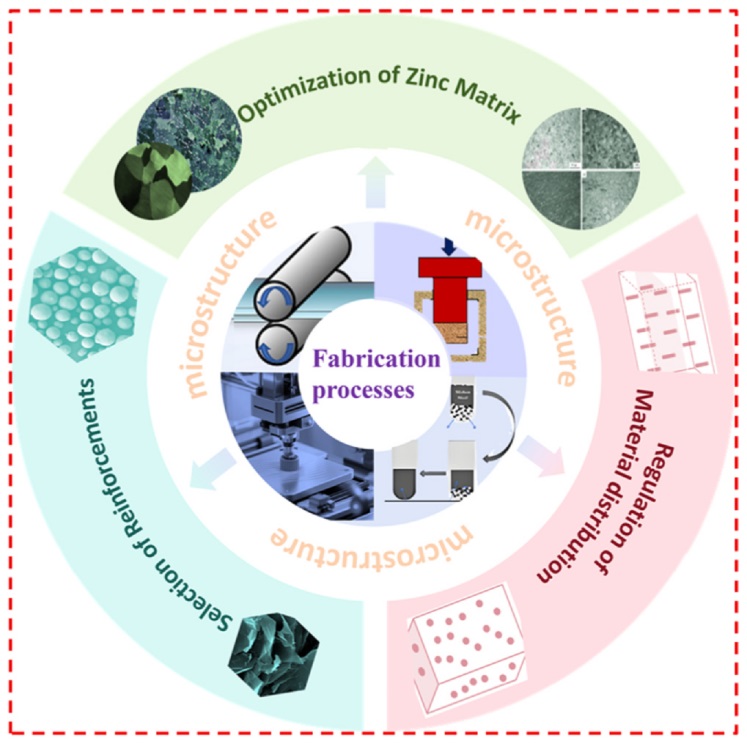
Fig. 10. The impact of fabrication processes on ZMCs [30].
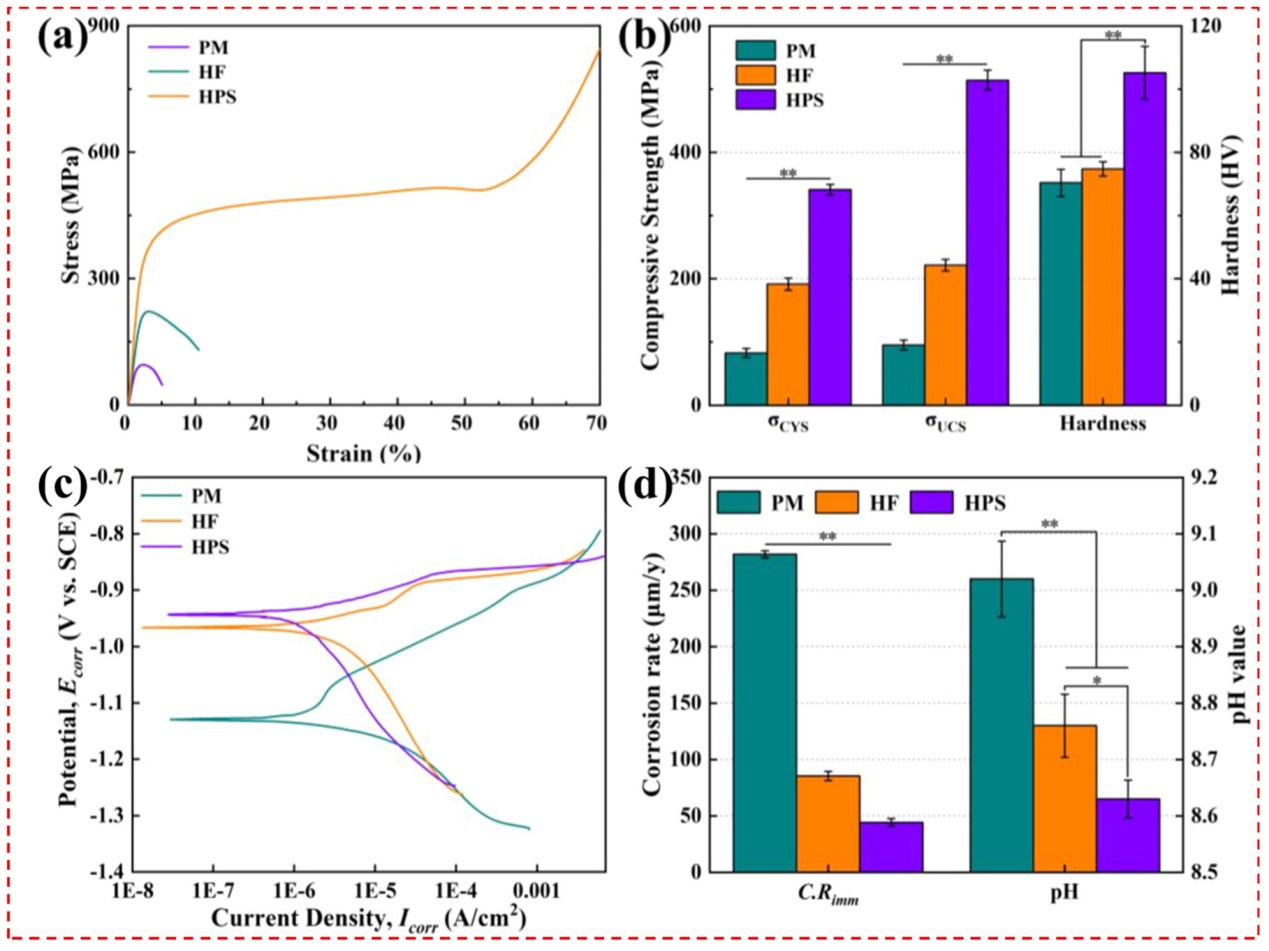
Fig. 11. Compressive properties and hardness of PM, HF, and HPS Zn-3Cu-10ZnO composites: (a) compressive stress-strain curves; (b) bar chart of σCYS, σUCS, and hardness. Corrosion behaviors of PM, HF, and HPS Zn-3Cu-10ZnO composites in Hanks' solution: (c) potentiodynamic polarization curves; (d) degradation rate and pH value of Hanks' solution after immersion for 1 month [74].
| Samples | Corrosion rate (mm/y) | Yield strength (MPa) | Failure strain (%) | Ref. |
|---|---|---|---|---|
| 1HA/Zn | 0.0026 | 70 | / | [ |
| 5HA/Zn | 0.01 | 43 | / | [ |
| 3β-TCP/Zn-1Mg | 0.893 | 220 | 4.5 | [ |
| 5β-TCP/Zn-1Mg | 1.239 | 195 | 3.9 | [ |
| 0.3GNS/Zn | 0.213 | 155 | 16.5 | [ |
| 0.7GNS/Zn | 0.302 | 200 | 16.5 | [ |
| MgxZny/Zn | 0.05-0.26 | 560 | 12 | [ |
Table 3. A comparison of the key properties of several typical ZMCs.
| Samples | Corrosion rate (mm/y) | Yield strength (MPa) | Failure strain (%) | Ref. |
|---|---|---|---|---|
| 1HA/Zn | 0.0026 | 70 | / | [ |
| 5HA/Zn | 0.01 | 43 | / | [ |
| 3β-TCP/Zn-1Mg | 0.893 | 220 | 4.5 | [ |
| 5β-TCP/Zn-1Mg | 1.239 | 195 | 3.9 | [ |
| 0.3GNS/Zn | 0.213 | 155 | 16.5 | [ |
| 0.7GNS/Zn | 0.302 | 200 | 16.5 | [ |
| MgxZny/Zn | 0.05-0.26 | 560 | 12 | [ |
| [1] |
Y.W. Cui, L. Wang, L.C. Zhang, Prog. Mater. Sci. 144 (2024) 101277.
DOI URL |
| [2] | N. Kumar, R.K. Duhan, B.C. Kandpal, Mater. Today Proc. (2023), https://doi.org/10.1016/j.matpr.2023.10.058. |
| [3] |
P. Qin, L.Y. Chen, C.H. Zhao, Y.J. Liu, C.D. Cao, H. Sun, L.C. Zhang, Corros. Sci. 189 (2021) 109609.
DOI URL |
| [4] | R. Venkatesh, H. Kanagasabapathy, Mater. Today Proc. (2023), https://doi.org/10.1016/j.matpr.2023.03.039. |
| [5] |
N.S. Manam, W.S.W. Harun, D.N.A. Shri, S.A.C. Ghani, T. Kurniawan, M.H. Ismail, M. H.I. Ibrahim, J. Alloy. Compd. 701 (2017) 698-715.
DOI URL |
| [6] |
L. Kong, Z. Heydari, G.H. Lami, A. Saberi, M.S. Baltatu, P. Vizureanu, Materials 16 (2023) 4797.
DOI URL |
| [7] |
J. Lin, X. Tong, Z. Shi, D. Zhang, L. Zhang, K. Wang, A. Wei, L. Jin, J. Lin, Y. Li, C. Wen, Acta Biomater. 106 (2020) 410-427.
DOI URL |
| [8] |
M.S. Baltatu, M.C. Spataru, L. Verestiuc, V. Balan, C. Solcan, A.V. Sandu, V. Geanta, I. Voiculescu, P. Vizureanu, Materials 14 (2021) 6806.
DOI URL |
| [9] |
M.S. Baltatu, A.V. Sandu, M. Nabialek, P. Vizureanu, G. Ciobanu, Micromachines 12 (2021) 1447.
DOI URL |
| [10] |
S.F. Jawed, C.D. Rabadia, Y.J. Liu, L.Q. Wang, P. Qin, Y.H. Li, X.H. Zhang, L. C. Zhang, Mater. Sci. Eng. C 110 (2020) 110728.
DOI URL |
| [11] |
M. Ali, M.A. Hussein, N. Al-Aqeeli, J. Alloy. Compd. 792 (2019) 1162-1190.
DOI URL |
| [12] |
K. Munir, J. Lin, C. Wen, P.F.A. Wright, Y. Li, Acta Biomater. 102 (2020) 493-507.
DOI URL |
| [13] |
M. He, L. Chen, M. Yin, S. Xu, Z. Liang, J. Mater. Res. Technol. 23 (2023) 4396-4419.
DOI URL |
| [14] | A.H. Md Yusop, M.F. Ulum, A. Al Sakkaf, D. Hartanto, H. Nur, Biotechnol. J. 16 (2021) 0255. |
| [15] | S. Seetharaman, D. Sankaranarayanan, M. Gupta, J. Func. Biomater. 14 (2023) 324. |
| [16] |
H. Yang, X. Qu, W. Lin, C. Wang, D. Zhu, K. Dai, Y. Zheng, Acta Biomater. 71 (2018) 200-214.
DOI URL |
| [17] |
Y. Meng, L. Liu, D. Zhang, C. Dong, Y. Yan, A.A. Volinsky, L.N. Wang, Bioact. Mater. 4 (2019) 87-96.
DOI PMID |
| [18] |
T. Suzuki, Y. Kajita, S.I. Katsumata, H. Matsuzaki, K. Suzuki, J. Nutr. Sci. Vitaminol. 61 (2015) 382-390.
DOI URL |
| [19] |
J. Kubásek, D. Vojtěch, I. Pospíšilová, A. Michalcová, J. Maixner, Int. J. Miner. Metall. Mater. 23 (2016) 1167-1176.
DOI URL |
| [20] |
M. Fan, F. Zhao, S. Peng, Q. Dai, Y. Liu, S. Yin, Z. Zhang, Materials 15 (2022) 6481.
DOI URL |
| [21] |
G. Lu, Y. Dai, S. He, C. Chen, X. Liu, K. Tang, L. Guo, D. Zhang, J. Lin, C. Wen, Corros. Sci. 239 (2024) 112399.
DOI URL |
| [22] |
W.Y. Li, Y.L. Dai, W.H. Cai, S.H. Lin, L. Guo, D.C. Zhang, Y. Li, C. Wen, Rare Metals 43 (2024) 5284-5304.
DOI URL |
| [23] |
M. Zhang, F. Li, Y.L. Dai, J.G. Lin, X.K. Zhang, D.C. Zhang, Y. Li, C. Wen, Rare Metals 44 (2025) 7615-7633.
DOI URL |
| [24] |
Y.F. Zheng, X.N. Gu, F. Witte, Mater. Sci. Eng. R 77 (2014) 1-34.
DOI URL |
| [25] |
Z. Mei, Y.H. Zhu, W.B. Lee, T.M. Yue, G.K.H. Pang, Compos. Pt. A Appl. Sci. Manuf. 37 (2006) 1345-1350.
DOI URL |
| [26] |
O. Avior, N. Ben Ghedalia-Peled, T. Ron, J. Goldman, R. Vago, E. Aghion, Metals 12 (2022) 76.
DOI URL |
| [27] | Z. Zhang, A. Liu, J. Fan, M. Wang, J. Dai, X. Jin, H. Deng, X. Wang, Y. Liang, H. Li, Y. Zhao, P. Wen, Y. Li, Bioact. Mater. 27 (2023) 488-504. |
| [28] |
J. Yang, Z. Chu, Y. Jiang, W. Zheng, J. Sun, L. Xu, Y. Ma, W. Wang, M. Shao, H. Qian, Adv. Healthc. Mater. 12 (2023) 2300725.
DOI URL |
| [29] | H. Kabir, K. Munir, C. Wen, Y. Li, Bioact. Mater. 6 (2021) 836-879. |
| [30] | K.A. Sheikh, M.M. Khan, JALMES 10 (2025) 100173. |
| [31] |
W. Yuan, D. Xia, S. Wu, Y. Zheng, Z. Guan, J.V. Rau, Bioact. Mater. 7 (2022) 192-216.
DOI PMID |
| [32] |
N.S. Murni, M.S. Dambatta, S.K. Yeap, G.R.A. Froemming, H. Hermawan, Mater. Sci. Eng. C 49 (2015) 560-566.
DOI URL |
| [33] |
G. Katarivas Levy, J. Goldman, E. Aghion, Metals 7 (2017) 402.
DOI URL |
| [34] |
L. Zhao, Z. Zhang, Y. Song, S. Liu, Y. Qi, X. Wang, Q. Wang, C. Cui, Mater. Des. 108 (2016) 136-144.
DOI URL |
| [35] |
X. Liu, H. Yang, Y. Liu, P. Xiong, H. Guo, H.H. Huang, Y. Zheng, JOM 71 (2019) 1414-1425.
DOI |
| [36] | J.J.D. Venezuela, S. Johnston, M.S. Dargusch, Adv. Healthc. Mater. 8 (2019) 408. |
| [37] |
L. Liu, Y. Meng, A.A. Volinsky, H.J. Zhang, L.N. Wang, Corros. Sci. 153 (2019) 341-356.
DOI URL |
| [38] |
H. Guo, R.H. Cao, Y.F. Zheng, J. Bai, F. Xue, C.L. Chu, J. Mater. Sci. Technol. 35 (2019) 1662-1670.
DOI |
| [39] |
K. Törne, M. Larsson, A. Norlin, J. Weissenrieder, J. Biomed. Mater. Res. Part B 104 (2015) 1141-1151.
DOI URL |
| [40] | Y. Liu, T. Du, A. Qiao, Y. Mu, H. Yang, J. Func. Biomater. 13 (2022) 164. |
| [41] |
C. Pan, X. Sun, G. Xu, Y. Su, D. Liu, Mater. Sci. Eng. C 108 (2020) 110397.
DOI URL |
| [42] |
H. Kabir, K. Munir, C. Wen, Y. Li, Acta Biomater. 157 (2023) 701-719.
DOI URL |
| [43] |
Y. Liu, T. Wen, M. Zhao, B. Meng, H. Hao, Z. Yuan, X. Meng, Z. Wang, H. Jin, L. Hou, X. Wu, Y. Wu, X. Xu, J. An, J. Qu, X. Lu, Mater. Chem. Phys. 324 (2024) 129621.
DOI URL |
| [44] |
X. Wen, J. Wang, X. Pei, X. Zhang, J. Mater. Chem. B 11 (2023) 11405-11425.
DOI URL |
| [45] |
Q. Song, L. Yang, F. Yi, C. Chen, J. Guo, Z. Qi, Y. Song, Crystals 14 (2024) 939.
DOI URL |
| [46] |
S. Agarwal, J. Curtin, B. Duffy, S. Jaiswal, Mater. Sci. Eng. C 68 (2016) 948-963.
DOI URL |
| [47] | J. Walker, S. Shadanbaz, N.T. Kirkland, E. Stace, T. Woodfield, M.P. Staiger, G.J. Dias, J. Biomed. Mater. Res. Part B 100B ( 2012) 1134-1141. |
| [48] |
J. Lin, Y. Chen, Y. Dai, X. Zhang, D. Zhang, Y. Li, C. Wen, Acta Biomater. 194 (2025) 514-529.
DOI URL |
| [49] |
Q. Dai, S. Peng, Z. Zhang, Y. Liu, M. Fan, F. Zhao, Front. Bioeng. Biotechnol. 9 (2021) 635338.
DOI URL |
| [50] |
M. Yu, C. George, Y. Cao, D. Wootton, J. Zhou, J. Mater. Sci. 49 (2014) 3629-3641.
DOI URL |
| [51] |
Y. Lin, Z. Li, X. Wang, W. Li, H. Han, C. Shi, C. Liang, X. Sun, D. Liu, Mater. Des. 254 (2025) 114096.
DOI URL |
| [52] |
C.J. Shuai, S. Li, S.P. Peng, P. Feng, Y.X. Lai, C.D. Gao, Mater. Chem. Front. 3 (2019) 544-562.
DOI URL |
| [53] |
P.K. Bowen, E.R. Shearier, S. Zhao, R.J. Guillory II, F. Zhao, J. Goldman, J.W. Drelich, Adv. Healthc. Mater. 5 (2016) 1121-1140.
DOI URL |
| [54] | L.M. Plum, L. Rink, H. Haase, Int. J. Environ. Res. Public Health 7 (2010) 1342-1365. |
| [55] |
G. Li, H. Yang, Y. Zheng, X.H. Chen, J.A. Yang, D. Zhu, L. Ruan, K. Takashima, Acta Biomater. 97 (2019) 23-45.
DOI URL |
| [56] |
J. Ma, N. Zhao, D. Zhu, ACS Biomater. Sci. Eng. 1 (2015) 1174-1182.
DOI URL |
| [57] |
S.K. Mishra, S. Biswas, A. Satapathy, Mater. Des. 55 (2014) 958-965.
DOI URL |
| [58] |
X. Sun, X. Yu, W. Li, M. Chen, D. Liu, Mater. Sci. Eng. C 130 (2021) 112431.
DOI URL |
| [59] | K.H.W. Seah, S.C. Sharma, B.M. Girish, Mater. Des. 16 (1995) 271-275. |
| [60] | B.O. Fatile, B.O. Adewuyi, H.T. Owoyemi, Eng. Sci. Technol. 20 (2017) 1147-1154. |
| [61] |
O.P. Modi, S. Rathod, B.K. Prasad, A.K. Jha, G. Dixit, Tribol. Int. 40 (2007) 1137-1146.
DOI URL |
| [62] | Z.M. El-Baradie, M. Waly, A.N. Abd El-Azim, J. Mater. Res. Technol. 114 (2001) 194-200. |
| [63] |
C. Song, W. Xia, J. Zhang, Y. Guo, Q. Zhai, Mater. Des. 51 (2013) 262-267.
DOI URL |
| [64] |
M. Fan, F. Zhao, Y. Liu, S. Yin, S. Peng, Z. Zhang, Crystals 12 (2022) 1110.
DOI URL |
| [65] |
S. Sankaranarayanan, S. Jayalakshmi, M. Gupta, Mater. Sci. Eng. A 530 (2011) 149-160.
DOI URL |
| [66] |
K. Wang, X. Tong, J. Lin, A. Wei, Y. Li, M. Dargusch, C. Wen, J. Mater. Sci. Technol. 74 (2021) 216-229.
DOI |
| [67] | J.B. Jin, S. Zhou, H. Yang, J. Yang, Z. Zhang, B. Guo, L.C. Zhang, Int. J. Extreme Manuf. 7 (2025) 065003. |
| [68] |
C.W. Liu, J. Li, X. Gao, Y. Mu, Z. He, H. Wang, Y. Jia, B. Yuan, G. Wang, H.X. Peng, J. Mater. Sci. Technol. 221 (2025) 220-232.
DOI URL |
| [69] | W. Di, H. Ren, W. Li, D. Liu, X. Sun, Mater. Today Commun. 39 (2024) 109059. |
| [70] |
M. Wątroba, W. Bednarczyk, J. Kawałko, K. Mech, M. Marciszko, G. Boelter, M. Banzhaf, P. Bała, Mater. Des. 183 (2019) 108154.
DOI URL |
| [71] |
P. Sotoudeh Bagha, S. Khaleghpanah, S. Sheibani, M. Khakbiz, A. Zakeri, J. Alloy. Compd. 735 (2018) 1319-1327.
DOI URL |
| [72] |
J. Pinc, J. Čapek, V. Hybášek, F. Průša, K. Hosová, J. Maňák, D. Vojtěch, Materials 13 (2020) 1716.
DOI URL |
| [73] |
X. Sun, Z. Zhang, M. Liu, P. Zhang, L. Nie, Y. Liu, Y. Chen, F. Xu, Z. Liu, Y. Zeng, Biomed. Pharmacother. 148 (2022) 112722.
DOI URL |
| [74] |
W. Cai, X. Tong, D. Zhang, L. Guo, J. Lin, J. Lin, J. Mater. Res. Technol. 26 (2023) 5193-5208.
DOI URL |
| [75] |
X. Sun, X. Wang, Y. Xu, W. Li, D. Liu, Mater. Des. 220 (2022) 110870.
DOI URL |
| [76] | J. Pinc, F.E. Miklášová, J.Č. Průša, J. Drahokoupil, D. Vojtěch, Manuf. Technol. 19 (2019) 836-841. |
| [77] |
J. Pinc, J. Čapek, J. Kubásek, F. Průša, V. Hybášek, P. Veřtát, I. Sedlářová, D. Vojtěch, Metals 10 (2020) 372.
DOI URL |
| [78] |
G.L. Lu, G.Q. Xu, B. Helian, L. Li, D. Liu, Mater. Res. Express 6 (2019) 0865i1.
DOI URL |
| [79] | Z. Guan, G. Yao, Y. Zeng, X. Li, Procedia Manuf. 48 (2020) 332-337. |
| [80] |
I. Hwang, Z. Guan, X. Li, J. Manuf. Sci. Eng. Trans. ASME 140 (2018) 084503.
DOI URL |
| [81] |
H. Ao, S. Peng, Z. Zhang, Y. Liu, Q. Dai, Y. Han, F. Zhao, Mater. Res. Express 7 (2020) 066516.
DOI |
| [82] | Y. Yang, Y. Cheng, S. Peng, L. Xu, C. He, F. Qi, M. Zhao, C. Shuai, Bioact. Mater. 6 (2021) 1230-1241. |
| [83] |
H. Aghajani Derazkola, A. Simchi, J. Mech. Behav. Biomed. Mater. 79 (2018) 246-253.
DOI PMID |
| [84] |
C. Xu, M.Y. Ban, H.Y. Zhang, Q.P. Liu, L.Q. Ren, Mater. Des. 224 (2022) 111319.
DOI URL |
| [85] |
S.Z. Khalajabadi, N. Ahmad, S. Izman, A.B.H. Abu, W. Haider, M.R.A. Kadir, J. Alloy. Compd. 696 (2017) 768-781.
DOI URL |
| [86] |
T.J. Webster, C. Ergun, R.H. Doremus, R. Bizios, J. Biomed. Mater. Res. 59 (2002) 312-317.
DOI URL |
| [87] |
Z. Cui, Y. Zhang, Y. Cheng, D. Gong, W. Wang, Mater. Sci. Eng. C 99 (2019) 1035-1047.
DOI URL |
| [88] | P.V.S. Mahesh, S. Akhil, P. Chiranjeevi, Y. Sivaji, V.V. Kondaiah, M.A. Rao, R. Dumpala, B.R. Sunil, IOP Conf. Ser. Mater. Sci. Eng. 1116 (2021) 012002. |
| [89] |
K. Hosová, J. Pinc, A. Školáková, V. Bartůněk, P. Veřtát, T. Školáková, F. Průša, D. Vojtěch, J. Čapek, Metals 11 (2021) 499.
DOI URL |
| [90] |
D.K. Pathak, P.M. Pandey, J. Mater. Eng. Perform. 30 (2021) 3510-3523.
DOI |
| [91] |
Y. Wang, J.W. Liu, T. Wang, L.Z. Liu, C.C. Tian, Y. Cui, W.J. Shao, X. Hua, Y. Shi, Y.X. Wang, Food Packaging Shelf Life 40 (2023) 101167.
DOI URL |
| [92] |
C. Gao, M. Yao, S. Peng, W. Tan, C. Shuai, J. Adv. Res. 38 (2022) 143-155.
DOI URL |
| [93] |
C.D. Gao, M. Yao, C.J. Shuai, S.P. Peng, Y.W. Deng, J. Mater. Sci. Technol. 35 (2019) 2608-2617.
DOI URL |
| [94] |
Z. Guan, C.S. Linsley, S. Pan, C. DeBenedetto, J. Liu, B.M. Wu, X. Li, Metall. Mater. Trans. A-Phys. Metall. Mater. Sci 51 (2020) 4406-4413.
DOI |
| [95] |
Z.G. Li, Mater. Lett. 121 (2014) 1-4.
DOI URL |
| [96] |
V. Kumar, L. Ranakoti, G. Gautam, A. Negi, T. Singh, Results Eng. 22 (2024) 102346.
DOI URL |
| [97] |
F. Chen, B. Wang, Z. Cao, Metals 10 (2020) 1663.
DOI URL |
| [98] | B.K. Prasad, Wear 262 (2007) 262-273. |
| [99] |
S.C. Sharma, B.M. Girish, R. Kamath, B.M. Satish, Wear 213 (1997) 33-40.
DOI URL |
| [100] |
A. Saberi, H.R. Bakhsheshi-Rad, E. Karamian, M. Kasiri-Asgarani, H. Ghomi, J. Alloy. Compd. 821 (2020) 153379.
DOI URL |
| [101] |
A. Saberi, H.R. Bakhsheshi-Rad, E. Karamian, M. Kasiri-Asgarani, H. Ghomi, M. Omidi, S. Abazari, A.F. Ismail, S. Sharif, F. Berto, Phys. Mesomech. 24 (2021) 486-502.
DOI |
| [102] |
J. Zhao, M. Haowei, A. Saberi, Z. Heydari, M.S. Baltatu, Coatings 12 (2022) 1589.
DOI URL |
| [103] |
J. Liu, X. Wang, A. Saberi, Z. Heydari, J. Mech. Behav. Biomed. Mater. 138 (2023) 105601.
DOI URL |
| [104] |
M. Shahin, K. Munir, C. Wen, Y. Li, J. Alloy. Compd. 828 (2020) 154461.
DOI URL |
| [105] |
K. Munir, C. Wen, Y. Li, J. Magnes. Alloy. 8 (2020) 269-290.
DOI URL |
| [106] |
I. Ahmad, M. Islam, S. Parvez, N. AlHabis, A. Umar, K.S. Munir, N. Wang, Y. Zhu, Int. J. Refract. Met. Hard Mater. 84 (2019) 105018.
DOI URL |
| [107] |
Z.Y. Liu, B.L. Xiao, W.G. Wang, Z.Y. Ma, J. Mater. Sci. Technol. 30 (2014) 649-655.
DOI |
| [108] | M. Pul, Materia-Rio De Janeiro 27 (2022) 13226. |
| [109] |
B.M. Girish, K.R. Prakash, B.M. Satish, P.K. Jain, P. Prabhakar, Mater. Des. 32 (2011) 1050-1056.
DOI URL |
| [110] |
C. Fragassa, M. Babic, C.P. Bergmann, G. Minak, Metals 9 (2019) 557.
DOI URL |
| [111] |
C. Shuai, B. Wang, S. Bin, S. Peng, C. Gao, Mater. Des. 191 (2020) 108612.
DOI URL |
| [112] |
M. Wojtoniszak, X. Chen, R.J. Kalenczuk, A. Wajda, J. Łapczuk, M. Kurzewski, M. Drozdzik, P.K. Chu, E. Borowiak-Palen, Colloid Surf. B-Biointerfaces 89 (2012) 79-85.
DOI URL |
| [113] |
Y. Talukdar, J.T. Rashkow, G. Lalwani, S. Kanakia, B. Sitharaman, Biomaterials 35 (2014) 4863-4877.
DOI PMID |
| [114] | A. Owhal, A.D. Pingale, S.U. Belgamwar, J.S. Rathore, Mater. Today Proc. 44 (2021) 222-228. |
| [115] |
Y. Zou, C.H. Li, L. Hu, J.A. Liu, J.M. Wu, Y.S. Shi, Ceram. Int. 46 (2020) 12102-12110.
DOI URL |
| [116] | L. Lin, A.K. Schlarb, Wear 432-433 (2019) 202928. |
| [117] |
X. Ma, H. Sun, S. Kou, S. Fan, J. Deng, L. Zhang, L. Cheng, Ceram. Int. 47 (2021) 24130-24138.
DOI URL |
| [118] |
B. Zhong, S. Hu, Z. Yu, X. Qiang, H. Yang, Materials 15 (2022) 1087.
DOI URL |
| [119] |
X. Tong, W. Cai, J. Lin, K. Wang, L. Jin, Z. Shi, D. Zhang, J. Lin, Y. Li, M. Dargusch, C. Wen, Acta Biomater. 123 (2021) 407-417.
DOI URL |
| [120] | L.Y. Chen, P. Qin, L. Zhang, L.C. Zhang, Int. J. Extreme Manuf. 6 (2024) 052006. |
| [121] |
Y. Fu, Y. Zhuang, X. Xu, R. Zhang, P. Zhang, H. Wei, X. Jin, Z. Liu, B. Zhang, J. Wu, X. Sun, J. Mater. Eng. Perform. 29 (2020) 7908-7914.
DOI |
| [122] |
P. Xiao, Y. Gao, C. Yang, Z. Liu, Y. Li, F. Xu, Mater. Sci. Eng. A 710 (2018) 251-259.
DOI URL |
| [123] | G.R. Gurunagendra, K.S. Anil Kumar, V. Ravikumar, H. Yaragudri, R. Suresh Kumar, C. Durga Prasad, C. Solaimuthu, A. Tiwari, S.R. Prabhu, Results Surf. Interf. 20 (2025) 100598. |
| [124] | A. Olad, M. Barati, H. Shirmohammadi, Prog. Org. Coat. 72 (2011) 599-604. |
| [125] |
M.M. Khan, A. Dey, Ceram. Int. 48 (2022) 22928-22942.
DOI URL |
| [126] |
C. Liu, X. Jiang, Z. Zhong, H. Sun, R. Shu, Y. Pang, Z. Wu, L. Yang, J. Alloy. Compd. 1037 (2025) 182276.
DOI URL |
| [127] |
P. Li, J. Qian, W. Zhang, C. Schille, E. Schweizer, A. Heiss, U.E. Klotz, L. Scheideler, G. Wan, J. Geis-Gerstorfer, Surf. Coat. Technol. 405 (2021) 126678.
DOI URL |
| [128] | Y. Li, D. Jiang, R. Zhu, C. Yang, L. Wang, L.C. Zhang, Int. J. Extreme Manuf. 7 (2025) 022002. |
| [129] |
S.M. Mousavi, G. Behbudi, A. Gholami, S.A. Hashemi, Z.M. Nejad, S. Bahrani, W.H. Chiang, L.C. Wei, N. Omidifar, Biomater. Res. 26 (2022) 4.
DOI URL |
| [1] | Shang Zhao, Zhaolin Wang, Mingliang Wang, Zeyu Ding, Yiping Lu. A critical review of advances and application prospects of soft magnetic high entropy alloys [J]. Metals Advances, 2026, 40(2): 1-7. |
| [2] | Wei-Peng Chen, Jia-Qi Pei, Hua Hou, Yu-Hong Zhao. Phase-field simulation of α-Mg dendrite growth in magnesium alloys: A review [J]. Metals Advances, 2026, 40(2): 48-61. |
| [3] | Peng Han, Wen Wang, Jun Cai, Jia Lin, Hubin Yang, Qianzhi Ma, Feng Gao, Ke Qiao, Fengming Qiang, Kuaishe Wang. Excellent superplasticity for lamellar microstructure in nugget of a double-sided friction stir welded Ti-4.5Al-3V-2Mo-2Fe alloy joint [J]. Metals Advances, 2026, 40(2): 110-123. |
| [4] | Lei Qin, Shengfeng Zhou, Jianbo Jin, Huan Yang, Kunmao Li, Cheng Deng, Yujie Yuan, Seyed Reza Elmi Hosseini, Lai-Chang Zhang. Effect of molybdenum content on the microstructure and tribological properties of Ti-Nb-Cu alloys produced by LPBF additive manufacturing [J]. Metals Advances, 2026, 39(1): 13-25. |
| [5] | Zhizhi Wang, Pei Liu, Jingyi Guo, Yiwen Yan, Aiqin Wang, Jingpei Xie. Excellent mechanical properties and biocompatibility of Ti-15Mo alloy via interstitial nitrogen atoms [J]. Metals Advances, 2026, 39(1): 38-46. |
| [6] | Kunmao Li, Shengfeng Zhou, Jing Liu, Feng Yang, Chengliang Yang. A review on the biomedical Ti-Cu alloys: Design, preparation, microstructure and properties [J]. Metals Advances, 2026, 39(1): 47-67. |
| [7] | Eman Hassna, Yuxin Huang, Tingting Yan. Biodegradable metals for cardiovascular and orthopaedic implants: A comparative review of magnesium, iron and zinc [J]. Metals Advances, 2026, 39(1): 68-82. |
| [8] | Yuanyuan Feng, Jianchao Pang, Xiaoyuan Teng, Chenglu Zou, Jingjing Liang, Yuping Zhu, Shouxin Li, Jinguo Li, Zhefeng Zhang. Quasi-in-situ EBSD Study on the Microstructure and Tensile Properties of Selective Laser Melted Inconel 718 Alloy Processed by Different Heat Treatments [J]. Acta Metallurgica Sinica (English Letters), 2025, 38(9): 1499-1512. |
| [9] | B. M. Shi, Y. T. Pang, B. H. Shan, B. B. Wang, Y. Liu, P. Xue, J. F. Zhang, Y. N. Zan, Q. Z. Wang, B. L. Xiao, Z. Y. Ma. Microstructure Evolution and Fracture Behavior of (B4C+Al2O3)/Al Friction Stir Welded Joints [J]. Acta Metallurgica Sinica (English Letters), 2025, 38(9): 1513-1526. |
| [10] | H. Q. Dai, N. Li, L. H. Wu, J. Wang, P. Xue, F. C. Liu, D. R. Ni, B. L. Xiao, Z. Y. Ma. Low-Temperature Superplastic Deformation Behavior of Bimodal Microstructure of Friction Stir Processed Ti-6Al-4V Alloy [J]. Acta Metallurgica Sinica (English Letters), 2025, 38(9): 1559-1569. |
| [11] | Shuyi Ren, Jiao Li, Kai Wu, Xiaoge Li, Yaqiang Wang, Jinyu Zhang, Gang Liu, Jun Sun. Thermal Stability and Mechanical Properties of Nanotwinned Ni-W Alloyed Films [J]. Acta Metallurgica Sinica (English Letters), 2025, 38(9): 1570-1582. |
| [12] | F. S. Li, L. H. Wu, Y. Kan, H. B. Zhao, D. R. Ni, P. Xue, B. L. Xiao, Z. Y. Ma. Microstructure Evolution and Fracture Mechanisms in Electron Beam Welded Joint of Ti-6Al-4V ELI Alloy Ultra-thick Plates [J]. Acta Metallurgica Sinica (English Letters), 2025, 38(8): 1317-1330. |
| [13] | Haoyu Cheng, Chenyang Hou, Jianlei Zhang, Xiaodong Mao, Yuanxiang Zhang, Yanyun Zhao, Chulun Shen, Changjiang Song. An Innovative Large-Scale Preparation Method for ODS Steel: Zone Melting with Built-In Precursor Powder [J]. Acta Metallurgica Sinica (English Letters), 2025, 38(8): 1397-1409. |
| [14] | Haoran Pang, Liwei Lu, Gongji Yang, Xiaojun Wang, Wen Wang, Hua Zhang, Yujuan Wu. Amelioration of Mechanical Properties of Rolled Mg-4.5Al-2.5Zn Alloy by Cryogenic Cycling Treatment [J]. Acta Metallurgica Sinica (English Letters), 2025, 38(8): 1436-1452. |
| [15] | Qi Zhou, Yufeng Xia, Yu Duan, Baihao Zhang, Yuqiu Ye, Peitao Guo, Lu Li. Microstructure and Mechanical Properties of Yb-Containing AZ80 Cast Alloys [J]. Acta Metallurgica Sinica (English Letters), 2025, 38(7): 1095-1108. |
| Viewed | ||||||
|
Full text |
|
|||||
|
Abstract |
|
|||||
 WeChat
