
Metals Advances ›› 2026, Vol. 39: 38-46.DOI: 10.1016/j.metadv.2026.01.002
• Research Article • Previous Articles Next Articles
Zhizhi Wanga, Pei Liua ,b ,c,*( ), Jingyi Guoa, Yiwen Yana, Aiqin Wanga,b,c, Jingpei Xiea,b,c
Received:2025-10-02
Revised:2025-11-01
Accepted:2025-11-07
Online:2026-01-10
Published:2026-03-10
Contact:
*E-mail address: liupei@haust.edu.cn (P. Liu).
Zhizhi Wang, Pei Liu, Jingyi Guo, Yiwen Yan, Aiqin Wang, Jingpei Xie. Excellent mechanical properties and biocompatibility of Ti-15Mo alloy via interstitial nitrogen atoms[J]. Metals Advances, 2026, 39: 38-46.
Add to citation manager EndNote|Ris|BibTeX
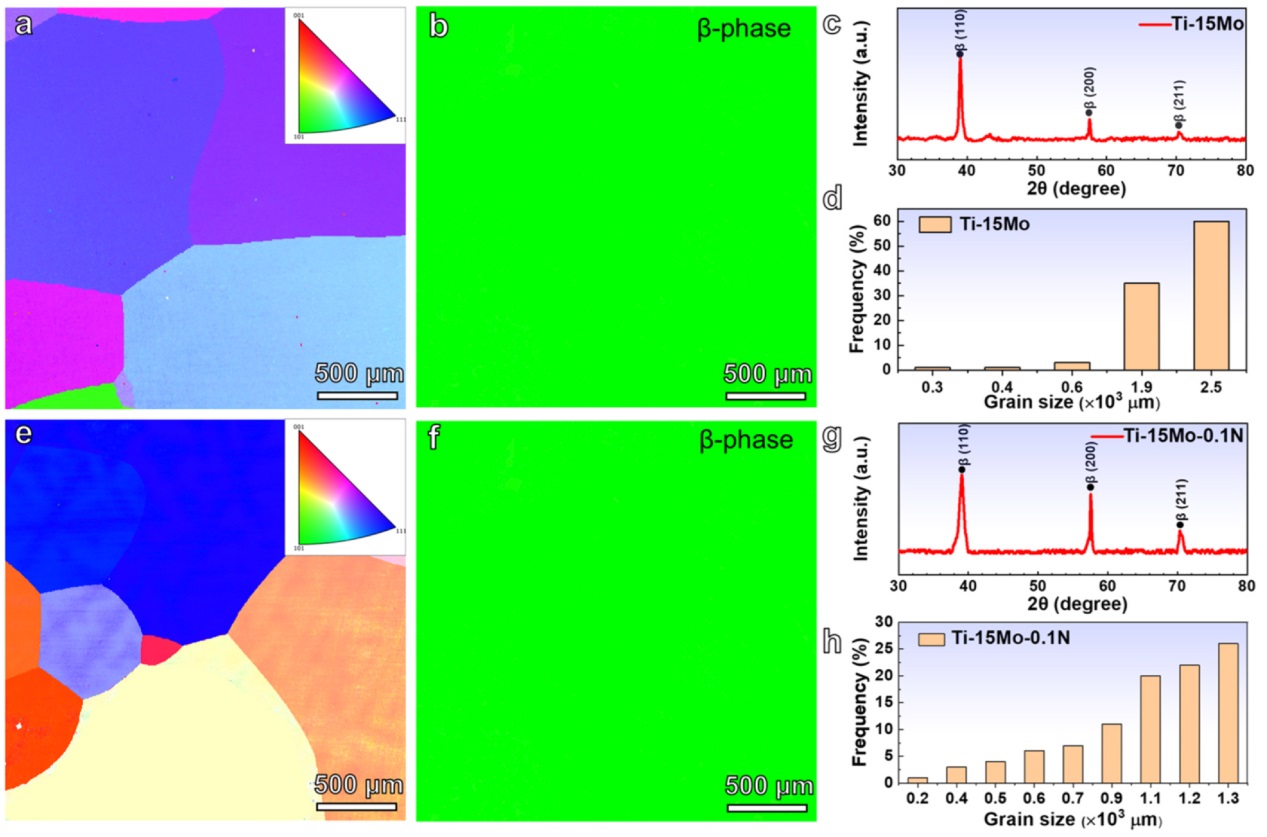
Fig. 1. EBSD analysis and XRD pattern of the as-cast TM and TMN alloys: (a) IPF map of TM alloy; (b) phase map of TM alloy; (c) XRD pattern of TM alloy; (d) grain size of TM alloy; (e) IPF map of TMN alloy; (f) phase map of TMN alloy; (g) XRD pattern of TMN alloy; (h) grain size of TMN alloy.
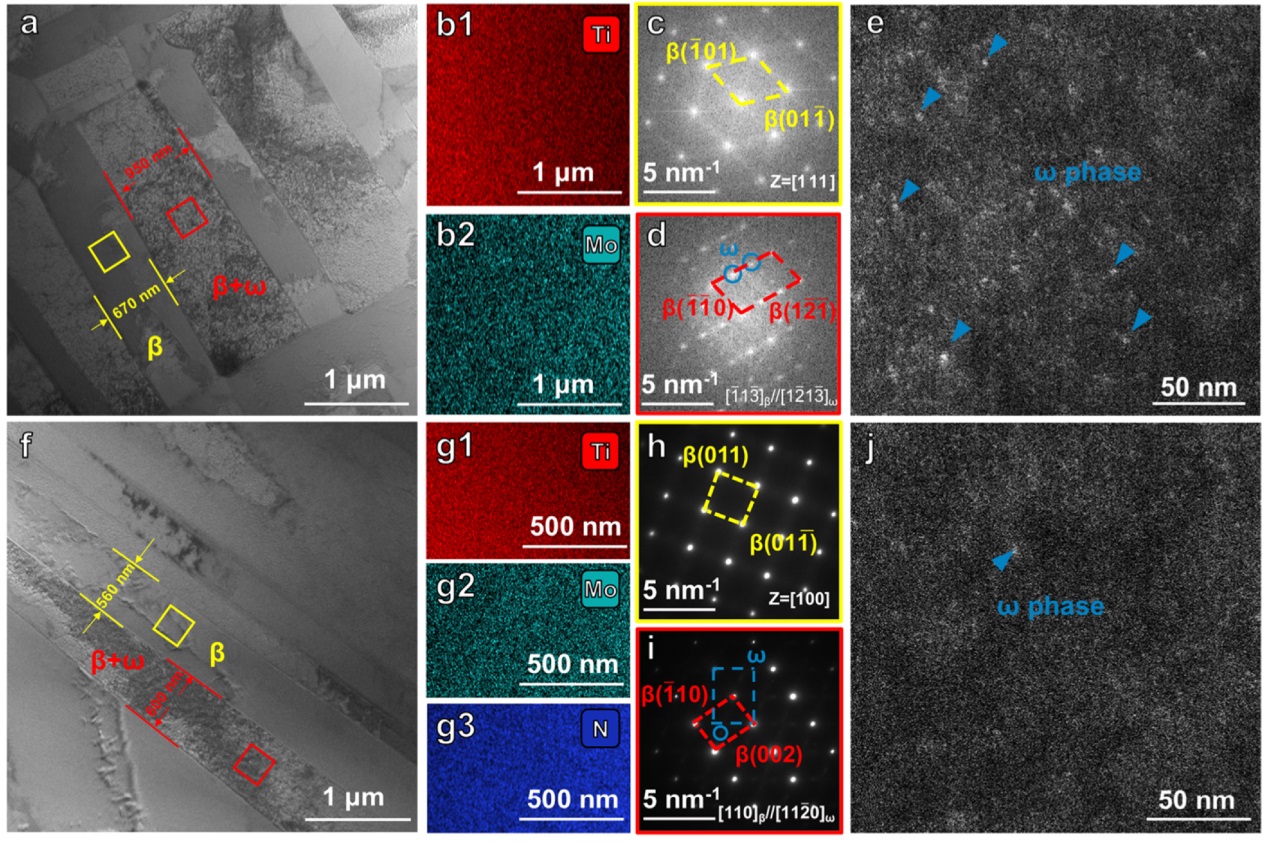
Fig. 2. TEM analysis of the as-cast TM and TMN alloys: (a) TEM image of TM alloy; (b1, b2) elemental distribution of (a); (c, d) SAED patterns of yellow and red squares in (a); (e) enlarged DF-TEM image in the dark-colored region of (a); (f) TEM image of TMN alloy; (g1-g3) elemental distribution of (f); (h, i) SAED patterns of yellow and red squares in (f); (j) enlarged DF-TEM image in the dark-colored region of (f).

Fig. 3. Room-temperature tensile properties of TM and TMN alloys: (a) engineering stress-strain curves; (b) true stress-strain curves; (c) strain hardening rate-true strain curves; (d) comparison of the mechanical properties (yield strength vs. ultimate elongation vs. elastic modulus) between TMN and some other literature data of Ti alloys [40], [41], [42], [43], [44], [45], [46], [47], [48], [49], [50], [51].
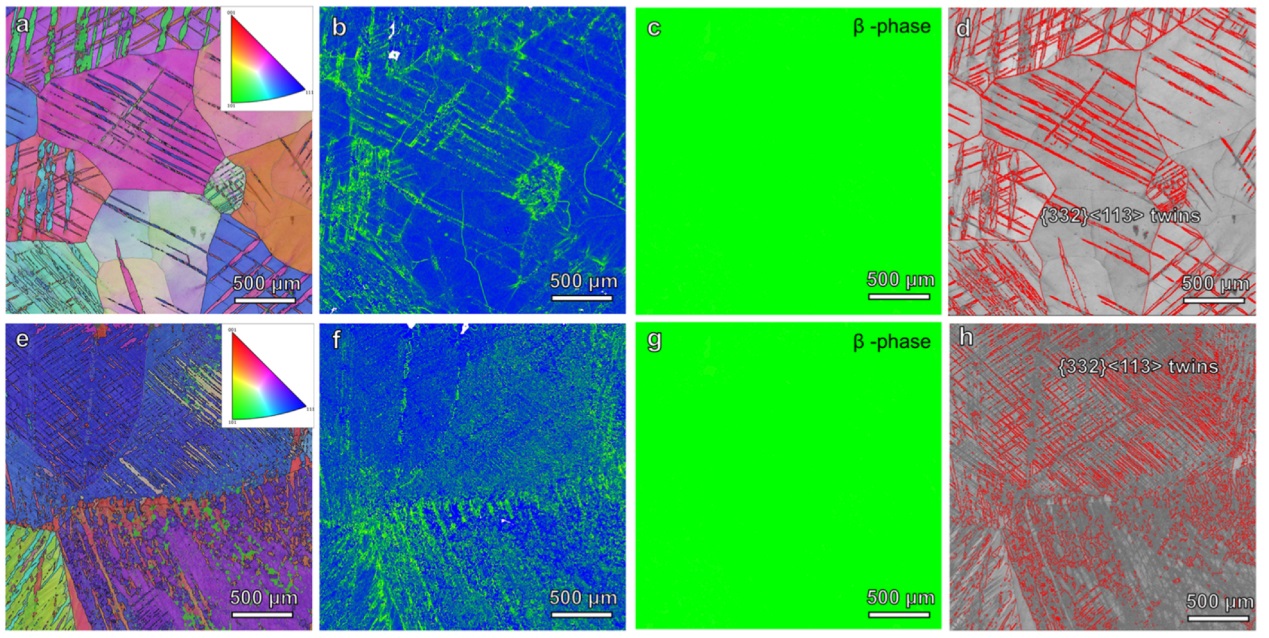
Fig. 4. EBSD mappings of TM and TMN alloys after tensile deformation with the strain of 5%: (a) IPF map of TM alloy; (b) KAM map of TM alloy; (c) phase map of TM alloy; (d) BC map of TM alloy; (e) IPF map of TMN alloy; (f) KAM map of TMN alloy; (g) phase map of TMN alloy; (h) BC map of TMN alloy, ({332}<113> twin boundaries are shown as red lines).
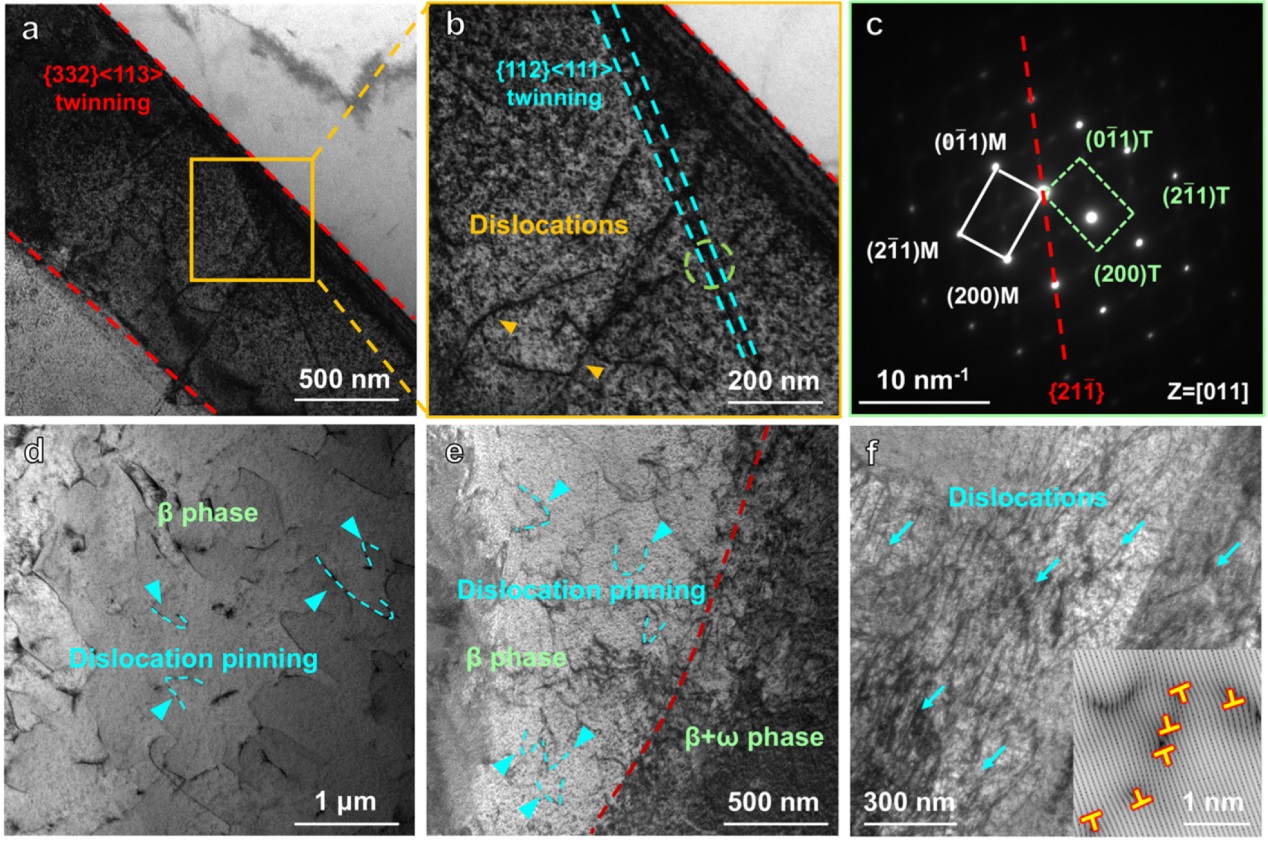
Fig. 5. TEM analysis of single β-Ti phase region in TMN alloy after deformation: (a) TEM image of the area for {332}<113>twinning; (b) enlarge TEM image of orange square in (a); (c) SAED patterns from the green cycle in (b); (d)-(f) BF-TEM image in single β-Ti phase region showing the dislocation pinning.
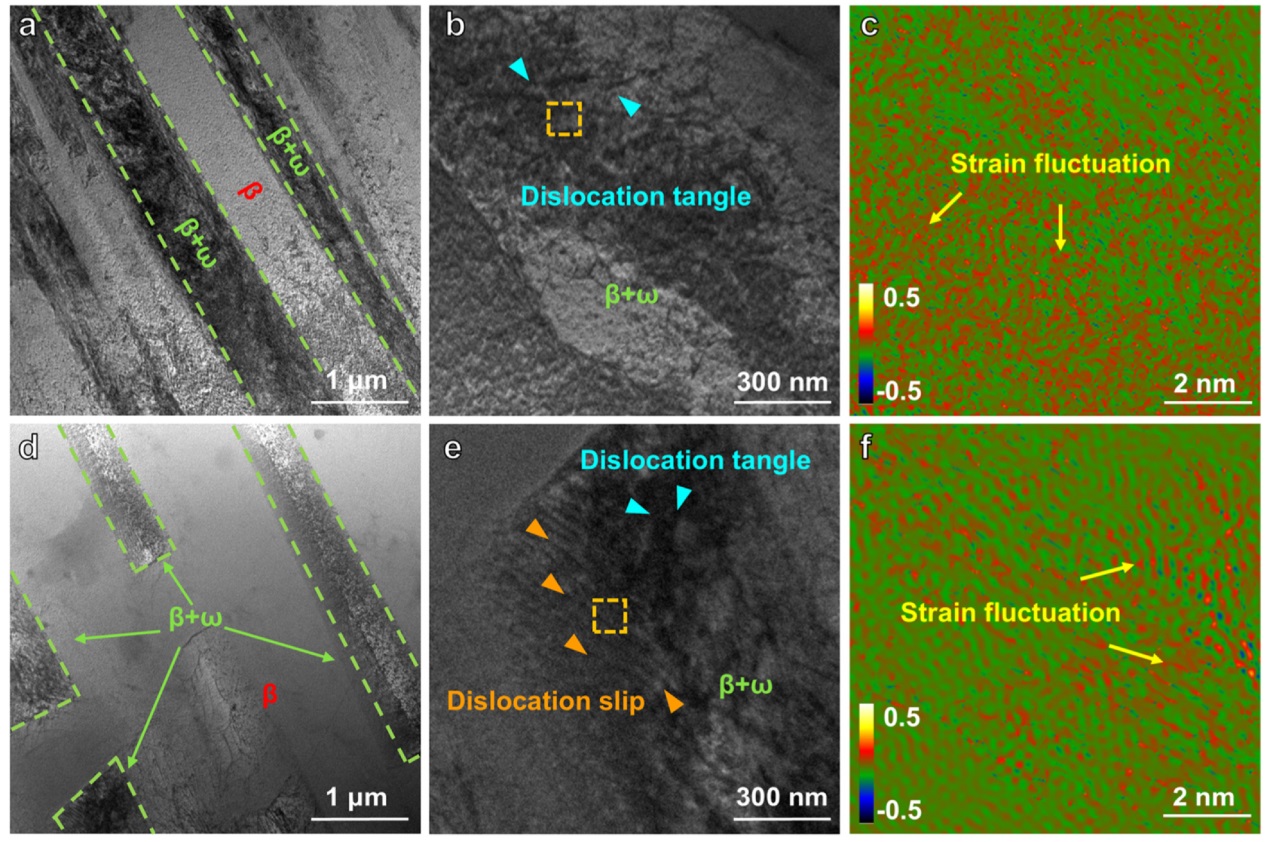
Fig. 6. TEM analysis of β+ω phase regions in TM and TMN alloy after deformation: (a) TEM image of TM alloy; (b) enlarged TEM image of a β+ω phase region; (c) GPA image of orange dashed box in (b); (d) TEM image of TMN alloy; (e) enlarged TEM image of a β+ω phase region; (f) GPA image of orange dashed box in (e).

Fig. 7. Schematic sketches for the deformation behavior of TM and TMN alloys.
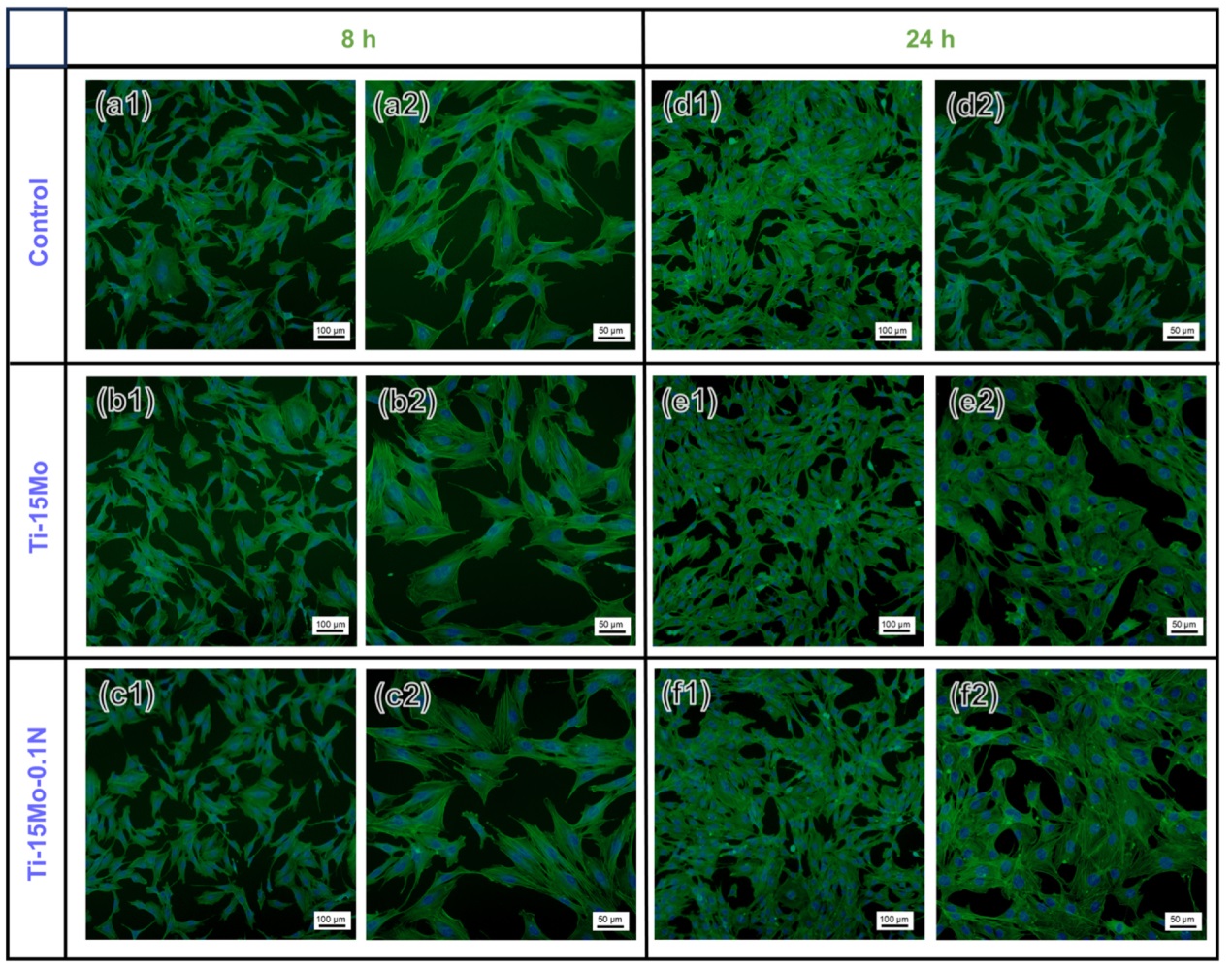
Fig. 8. Fluorescence photos of MC3T3-E1 cells cultured on minimum essential medium, TM and TMN alloys for 8 h in (a1-c1) and (a2-c2), and for 24 h in (d1-f1) and (d2-f2); (a1-f1) ×100, (a2-f2) ×200. The cytoskeletons are green and the nuclei are blue: (a1, a2) and (d1, d2) cells control, (b1, b2) and (e1, e2) TM alloy, (c1, c2) and (f1, f2) TMN alloy.

Fig. 9. (a) Proliferation of MC3T3-E1 cells cultured on MEM, TM and TMN alloys for one, two and three days; (b) the relative growth rate of different groups after one, two and three days.
| [1] |
J. Stráský, D. Preisler, H. Seiner, L. Bodnárová, M. Janovská, T. Kośutová, P. Harcuba, K. Šalata, K. Halmešová, K. Džugan, M. Janeček, Mater. Sci. Eng. A 839 (2022) 142833.
DOI URL |
| [2] | X. Luo, C. Yang, D.D. Li, L.C. Zhang, Acta Metall. Sin.-Engl. Lett. 37 (2024) 17-28. |
| [3] |
W. Abd-Elaziem, M.A. Darwish, A. Hamada, W.M. Daoush, Mater. Des. 241 (2024) 112850.
DOI URL |
| [4] |
Z.L. Hua, D.C. Zhang, L. Guo, S.H. Lin, Y.C. Li, C.E. Wen, Acta Biomater. 190 (2024) 623-641.
DOI URL |
| [5] |
A. Chmielewska, D. Dean, Acta Biomater. 173 (2024) 51-65.
DOI URL |
| [6] | C.Y. Mao, W.J. Yu, M. Jin, Y.C. Wang, X.Q. Shang, L. Lin, X.Q. Zeng, L.Q. Wang, E. Lu, Bioact. Mater. 16 (2022) 15-26. |
| [7] |
W.Y. Li, C.C. Cao, S. Yin, Prog. Mater. Sci. 110 (2020) 100633.
DOI URL |
| [8] |
A.L. Martinez, D.O. Flamini, S.B. Saidman, Trans. Nonferrous Met. Soc. 32 (2022) 1896-1909.
DOI URL |
| [9] |
N.S. Manam, W.S.W. Harun, D.N.A. Shri, S.A.C. Ghani, T. Kurniawan, M.H. Ismail, M. H.I. Ibrahim, J. Alloy. Compd. 701 (2017) 698-715.
DOI URL |
| [10] |
C.W. Lin, C.P. Ju, J.H.C. Lin, Biomaterials 26 (2005) 2899-2907.
DOI URL |
| [11] |
P. Majumdar, S.B. Singh, M. Chakraborty, J. Mech. Behav. Biomed. Mater. 4 (2011) 1132-1144.
DOI PMID |
| [12] |
R.S. Yin, J.Z. Gong, P.Y. Li, Y.J. Zhang, J.S. Zhang, S.X. Liang, X.Y. Zhang, J. Alloy. Compd. 1035 (2025) 181530.
DOI URL |
| [13] |
E. Alabort, Y.T. Tang, D. Barba, R.C. Reed, Acta Mater. 229 (2022) 117749.
DOI URL |
| [14] | Y.H. Li, Y.X. He, Q. Zhang, C.W. Zhang, L.B. Niu, Y.J. Liu, S.S. Zhu, P. Wang, Acta Metall. Sin.-Engl. Lett. 38 (2025) 1839-1852. |
| [15] |
Y.H. Li, D.Y. Jiang, R. Zhu, C.L. Yang, L.Q. Wang, L.C. Zhang, Int. J. Extrem. Manuf. 7 (2025) 022002.
DOI |
| [16] |
J.B. Jin, S.F. Zhou, H. Yang, J.J. Yang, Z.G. Zhang, B.S. Guo, L.C. Zhang, Int. J. Extrem. Manuf. 7 (2025) 065003.
DOI |
| [17] |
J.B. Jin, H. Yang, Y.J. Liu, J.J. Yang, K.M. Li, Y.L. Yi, D.C. Chen, W.C. Zhang, S.F. Zhou, Mater. Sci. Eng. A 890 (2024) 145889.
DOI URL |
| [18] |
Q.M. Shi, S.F. Yang, Y. Sun, Y.F. Gu, B. Mercelis, S.P. Zhong, B.V. Meerbeek, C. Politis, J. Mater. Sci. Technol. 115 (2022) 81-96.
DOI URL |
| [19] |
X.F. Zhao, M. Niinomi, M. Nakai, J. Hieda, Acta Biomater. 8 (2012) 1990-1997.
DOI URL |
| [20] |
S.S. Cui, S. Liu, J.J. Nie, D.F. Chen, X.B. Wu, G.W. Qin, E.L. Zhang, J. Alloy. Compd. 908 (2022) 164639.
DOI URL |
| [21] | R.X. Duan, S. Li, B. Cai, W.W. Zhu, F.Z. Ren, M.M. Attallah, Addit. Manuf. 37 (2021) 101708. |
| [22] |
L. Ren, W.L. Xiao, C.L. Ma, R.X. Zheng, L. Zhou, Scr. Mater. 156 (2018) 47-50.
DOI URL |
| [23] |
J.J. Gao, P. Castany, T. Glorian, Acta Mater. 236 (2022) 118140.
DOI URL |
| [24] |
X.L. An, W.T. Jiang, S. Ni, Z.B. Chen, Z.W. Wang, M. Song, Mater. Charact. 197 (2023) 112674.
DOI URL |
| [25] |
K. Chen, Q.B. Fan, J.H. Yao, L. Yang, S. Xu, W. Lei, D.D. Wang, J.J. Yuan, H.C. Gong, X. W. Cheng, J. Mater. Sci. Technol. 131 (2022) 276-286.
DOI |
| [26] |
X.H. Min, P.F. Bai, S. Emura, X. Ji, C.Q. Cheng, B.B. Jiang, K.C. Tsuchiya, Mater. Sci. Eng. A 684 (2017) 534-541.
DOI URL |
| [27] |
P. Liu, H. Zhang, F. Yang, Z.Z. Wang, A.Q. Wang, J.P. Xie, Y.J. Yuan, L.C. Zhang, Acta Mater. 304 (2026) 121812.
DOI URL |
| [28] |
T. Saito, T. Furuta, J.H. Hwang, S. Nishino, N. Suzuki, R. Chen, A. Yamada, K. Ito, Y. Seno, T. Nonaka, H. Ikehata, N. Nagasako, C. Iwamoto, Y. Ikuhara, T. Sakuma, Science 300 (2003) 464-467.
DOI URL |
| [29] |
R. Song, D. Ponge, D. Raabe, J. Speer, D.K. Matlock, Mater. Sci. Eng. A 441 (2006) 1-17.
DOI URL |
| [30] |
T.P. Ma, X.H. Min, M.Y. Lv, J. Alloy. Compd. 1036 (2025) 181884.
DOI URL |
| [31] |
Q.L. Liang, Z. Kloenne, Y.F. Zheng, D. Wang, S. Antonov, Y.P. Gao, Y.L. Hao, R. Yang, Y.Z. Wang, H.L. Fraser, Scr. Mater. 177 (2020) 181-185.
DOI URL |
| [32] |
Y.F. Zheng, D. Banerjee, H.L. Fraser, Scr. Mater. 116 (2016) 131-134.
DOI URL |
| [33] |
D.D. Fontaine, N.E. Paton, J.C. Williams, Acta Met. 19 (1971) 1153-1162.
DOI URL |
| [34] |
H.E. Cook, Acta Met. 22 (1974) 239-247.
DOI URL |
| [35] |
C. Lin, G.L. Yin, A.M. Zhang, Y.Q. Zhao, Q.C. Li, Scr. Mater. 117 (2016) 28-31.
DOI URL |
| [36] |
J. Ballor, T. Li, F. Prima, C.J. Boehlert, A. Devaraj, Int. Mater. Rev. 68 (2023) 26-45.
DOI URL |
| [37] |
H.H. Liu, M. Niinomi, M. Nakai, K. Cho, K. Narita, M. Sen, H. Shiku, T. Matsue, Acta Biomater. 12 (2015) 352-361.
DOI URL |
| [38] |
Y. Chong, T. Tsuru, B.Q. Guo, R. Gholizadeh, K. Inoue, N. Tsuji, Acta Mater. 240 (2022) 118356.
DOI URL |
| [39] |
Y. Gao, W.L. Xiao, D. Kent, J.S. Wang, W.T. Jiang, F.Q. Meng, Z.L. Peng, Y. Fu, C. L. Ma, J. Mater. Sci. Technol. 215 (2025) 58-70.
DOI URL |
| [40] |
D. Kuroda, M. Niinomi, M. Morinaga, Y. Kato, T. Yashiro, Mater. Sci. Eng. A 243 (1998) 244-249.
DOI URL |
| [41] |
Y.W. Cui, L. Wang, L.C. Zhang, Prog. Mater. Sci. 144 (2024) 101277.
DOI URL |
| [42] |
M. Niinomi, Mater. Sci. Eng. A 243 (1998) 231-236.
DOI URL |
| [43] |
L.C. Zhang, L.Y. Chen, Adv. Eng. Mater. 21 (2019) 1801215.
DOI URL |
| [44] | W.L. Xiao, Y. Fu, D. Zeng, X.W. Liang, H. Chen, X.Q. Zhao, C.L. Ma, J. Mater. Eng. 51 (2023) 52-66. |
| [45] |
X.Y. Yang, C.R. Hutchinson, Acta Biomater. 42 (2016) 429-439.
DOI URL |
| [46] |
K. Ronoh, F. Mwema, S. Dabees, D. Sobola, Biomed. Eng. Adv. 4 (2022) 100047.
DOI URL |
| [47] |
Z.X. Du, H. Guo, J.W. Liu, J. Cheng, X.P. Zhao, X.P. Wang, F. Liu, X.M. Cui, Mater. Sci. Eng. A 791 (2020) 139677.
DOI URL |
| [48] |
H.R. Lu, Y.H. Tang, H.Y. Shi, B. Li, P.F. Ji, Z. Xu, S.X. Liang, J.S. Zhang, S.Z. Zhang, X. Y. Zhang, R.P. Liu, J. Alloy. Compd. 998 (2024) 174994.
DOI URL |
| [49] | Y. Gao, W.T. Jiang, D. Zeng, X.W. Liang, C.L. Ma, W.L. Xiao, Rev. Mater. Res. 1 (2025) 100011. |
| [50] |
W. Abd-Elaziem, M.A. Darwish, A. Hamada, W.M. Daoush, Mater. Des. 241 (2024) 112850.
DOI URL |
| [51] |
L.C. Zhang, L.Y. Chen, S.F. Zhou, Z. Luo, J. Alloy. Compd. 936 (2023) 168099.
DOI URL |
| [52] |
J.F. Xiao, Z.H. Nie, Z.W. Ma, G.F. Liu, F. Hao, C.W. Tan, Mater. Sci. Eng. A 772 (2020) 138687.
DOI URL |
| [53] |
Z.X. Wang, K. Yao, B.K. Du, S.Y. He, X.H. Min, S.W. Xin, S.J. Zheng, J. Mater. Sci. Technol. 198 (2024) 56-62.
DOI URL |
| [54] |
Q. Xue, Y.J. Ma, J.F. Lei, R. Yang, C. Wang, J. Mater. Sci. Technol. 34 (2018) 2507-2514.
DOI |
| [55] |
M.S. Hooshmand, M. Ghazisaeidi, Acta Mater. 188 (2020) 711-719.
DOI |
| [56] |
X.H. Min, S. Emura, K. Tsuchiya, T. Nishimura, K. Tsuzaki, Mater. Sci. Eng. A 590 (2014) 88-96.
DOI URL |
| [57] |
Z.F. Lei, X.J. Liu, Y. Wu, H. Wang, S.H. Jiang, S.D. Wang, X.D. Wu, B. Gault, P. Kontis, D. Raabe, L. Gu, Q.H. Zhang, H.W. Chen, H.T. Wang, J.B. Liu, K. An, Q.S. Zeng, T.G. Nieh, Z.P. Lu, Nature 563 (2018) 546-550.
DOI |
| [1] | X.L. Wang, J.Y. Li, Q.S. Mei. Recent progress in Zn matrix composites for biomedical applications [J]. Metals Advances, 2026, 39(1): 26-37. |
| [2] | Eman Hassna, Yuxin Huang, Tingting Yan. Biodegradable metals for cardiovascular and orthopaedic implants: A comparative review of magnesium, iron and zinc [J]. Metals Advances, 2026, 39(1): 68-82. |
| [3] | Yuanyuan Feng, Jianchao Pang, Xiaoyuan Teng, Chenglu Zou, Jingjing Liang, Yuping Zhu, Shouxin Li, Jinguo Li, Zhefeng Zhang. Quasi-in-situ EBSD Study on the Microstructure and Tensile Properties of Selective Laser Melted Inconel 718 Alloy Processed by Different Heat Treatments [J]. Acta Metallurgica Sinica (English Letters), 2025, 38(9): 1499-1512. |
| [4] | Yuanxiao Dai, Yue Zhang, Mei Wang, Jie Liu, Yaobo Hu, Bin Jiang. Three-Point Bending Deformation Behavior of a High Plasticity Mg-2.6Er-0.6Zr Alloy Sheet [J]. Acta Metallurgica Sinica (English Letters), 2025, 38(7): 1109-1126. |
| [5] | Hongbin Liu, Zhenqiang Xing, Yitong Yang, Jingyu Pang, Wen Li, Zhengwang Zhu, Long Zhang, Aimin Wang, Haifeng Zhang, Hongwei Zhang. A Novel BCC/B2 Structural Nb38Ti35Al15V6Cr4(TaHfMoW)2 Refractory High-Entropy Alloy with Excellent Specific Yield Strength-Plasticity Synergy [J]. Acta Metallurgica Sinica (English Letters), 2025, 38(3): 396-406. |
| [6] | Ji-Peng Yang, Hai-Feng Zhang, Hong-Chao Ji, Nan Jia. Molecular Dynamics Simulations of Micromechanical Behaviours for AlCoCrFeNi2.1 High Entropy Alloy during Nanoindentation [J]. Acta Metallurgica Sinica (English Letters), 2025, 38(2): 218-232. |
| [7] | Cheng Ren, Xiaohua Min, Sujie Zhang, Weiqiang Wang. Springback Behavior and Biocompatibility in β-Type Ti-Mo-O Alloys [J]. Acta Metallurgica Sinica (English Letters), 2025, 38(2): 313-326. |
| [8] | Rashad A. Al-Hammadi, Rui Zhang, Chuanyong Cui, Xipeng Tao, Yizhou Zhou. Deformation Mechanism and Fracture Behavior of a Coarse-Grain Ni-Co-Based Superalloy During Superplasticity [J]. Acta Metallurgica Sinica (English Letters), 2025, 38(11): 2024-2034. |
| [9] | Ruoyu Di, Yonghua Sun, Runhua Yao, Sen Pei, Xiaohong Yao, Ruiqiang Hang. Preparation of TiO2 Nano-Flower Coating on Ti Substrates with Good Physical Sterilization Effect and Biocompatibility [J]. Acta Metallurgica Sinica (English Letters), 2024, 37(9): 1581-1589. |
| [10] | J. Sharath Kumar, Rakesh Kumar, Rajeev Verma. Surface Modification Aspects for Improving Biomedical Properties in Implants: A Review [J]. Acta Metallurgica Sinica (English Letters), 2024, 37(2): 213-241. |
| [11] | Mingtao Ge, Xinguang Wang, Yongmei Li, Zihao Tan, Xipeng Tao, Yanhong Yang, Liang Wang, Chunhua Zhang, Song Zhang, Yizhou Zhou, Xiaofeng Sun. Effect of Ta on Tensile Behavior and Deformation Mechanism of a Nickel-Based Single Crystal Superalloy [J]. Acta Metallurgica Sinica (English Letters), 2024, 37(11): 1921-1934. |
| [12] | Zenglong Yan, Shuyuan Zhang, Ling Ren, Xizhuang Bai, Ke Yang, Xiang Wei. Anodic Etching Surface Treatment and Antibacterial Properties of Ti-Cu [J]. Acta Metallurgica Sinica (English Letters), 2024, 37(10): 1767-1776. |
| [13] | Xuan Luo, Chao Yang, Dongdong Li, Lai-Chang Zhang. Laser Powder Bed Fusion of Beta-Type Titanium Alloys for Biomedical Application: A Review [J]. Acta Metallurgica Sinica (English Letters), 2024, 37(1): 17-28. |
| [14] | Jin-Wang Liu, Xian Luo, Bin Huang, Yan-Qing Yang, Wen-Jie Lu, Xiao-Wei Yi, Hong Wang. Nano-Twinning and Martensitic Transformation Behaviors in 316L Austenitic Stainless Steel During Large Tensile Deformation [J]. Acta Metallurgica Sinica (English Letters), 2023, 36(5): 758-770. |
| [15] | Ke Wang, Honghui Li, Yu Zhou, Jingfeng Wang, Renlong Xin, Qing Liu. Dislocation Slip and Crack Nucleation Mechanism in Dual-Phase Microstructure of Titanium Alloys: A Review [J]. Acta Metallurgica Sinica (English Letters), 2023, 36(3): 353-365. |
| Viewed | ||||||
|
Full text |
|
|||||
|
Abstract |
|
|||||
 WeChat
