
Metals Advances ›› 2026, Vol. 48: 49-58.DOI: 10.1016/j.metadv.2026.06.007
• Research Article • Previous Articles Next Articles
Dong Fanga,c,1, Qiangbing Doua,1, Cheng Xua,1, Yachuan Yub, Zhaoyang Ranc,d, Tinglong Chenc,d, Liang Dengc,d, Quan Zhenga, Qiwei Wanga, Frank Wittee,*( ), Yongqiang Haoc,d,*(), Ke Yangf,*(), Liangye Suna,**()
Received:2026-03-17
Revised:2026-06-28
Accepted:2026-06-29
Online:2026-10-10
Published:2026-07-31
Contact:
**E-mail addresses: frank.witte@charite.de (F. Witte),
hao_yongqiang@hotmail.com (Y. Hao),
kyang@imr.ac.cn (K. Yang),
2336020275@stu.ahmu.edu.cn (L. Sun).
About author:1 These authors contribute equally to this work.
Dong Fang, Qiangbing Dou, Cheng Xu, Yachuan Yu, Zhaoyang Ran, Tinglong Chen, Liang Deng, Quan Zheng, Qiwei Wang, Frank Witte, Yongqiang Hao, Ke Yang, Liangye Sun. Biological functions of 3D-printed porous Cu-containing titanium alloy[J]. Metals Advances, 2026, 48: 49-58.
Add to citation manager EndNote|Ris|BibTeX
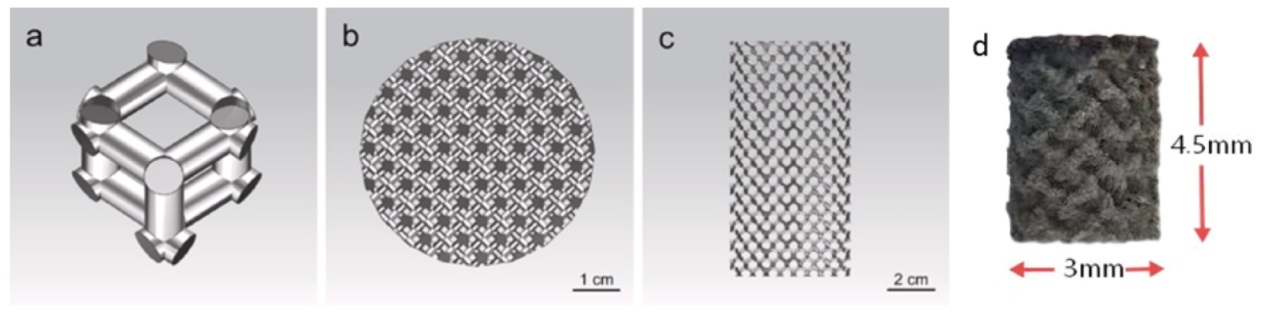
Fig. 1. Structural design renderings of 3D-printed porous titanium alloys: (a) structure unit, (b) top view of the structure, (c) side view of the structure, (d) photo of a 3D-printed scaffold.
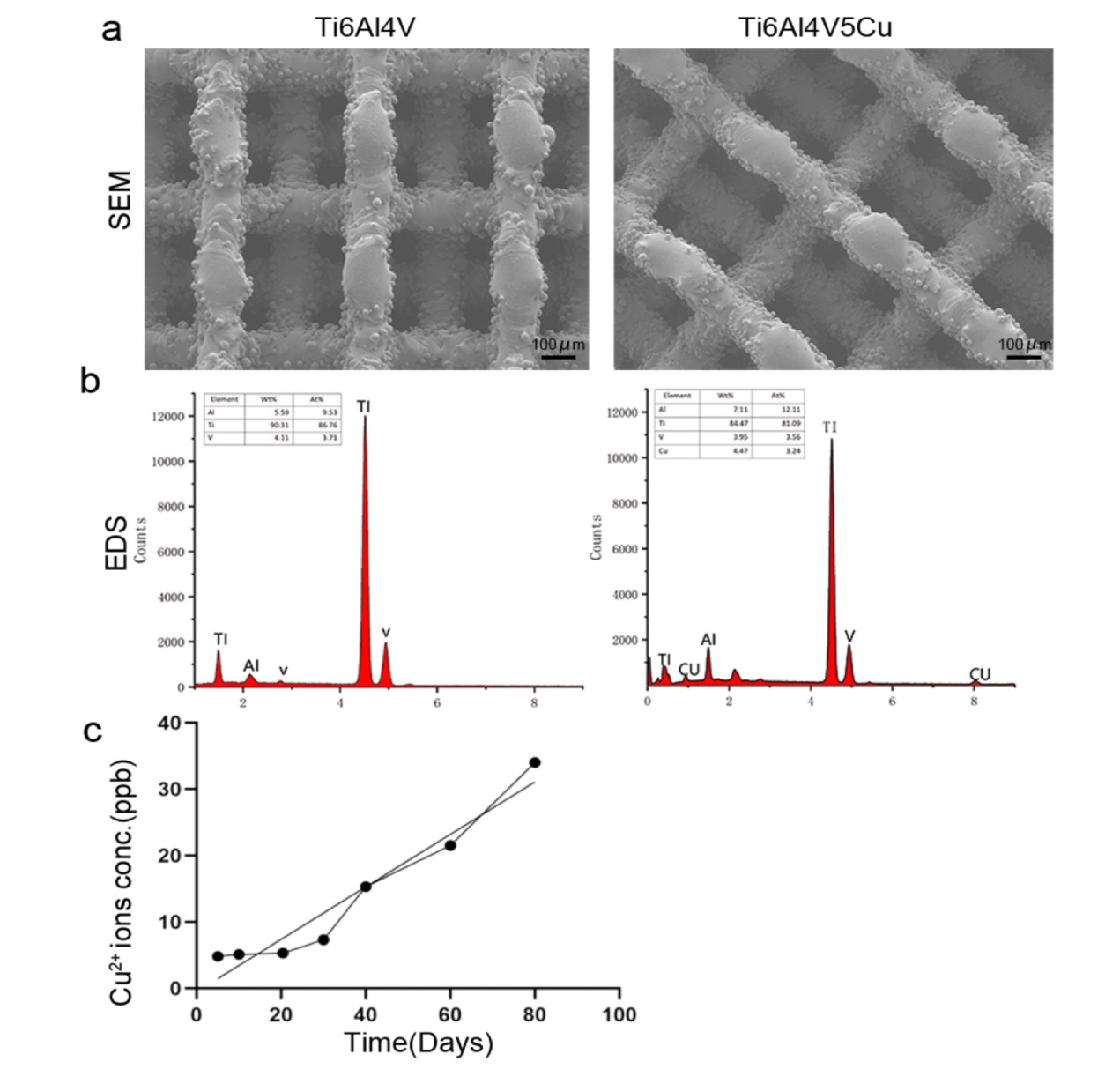
Fig. 2. Characterization of porous Ti6Al4V5Cu and Ti6Al4V alloys: (a) surface micrographs of 3D-printed porous alloy scaffolds under SEM, (b) EDS planar scanning results of 3D-printed porous alloy scaffolds, (c) Cu ion release curve of 3D-printed porous Ti6Al4V5Cu alloy scaffolds.
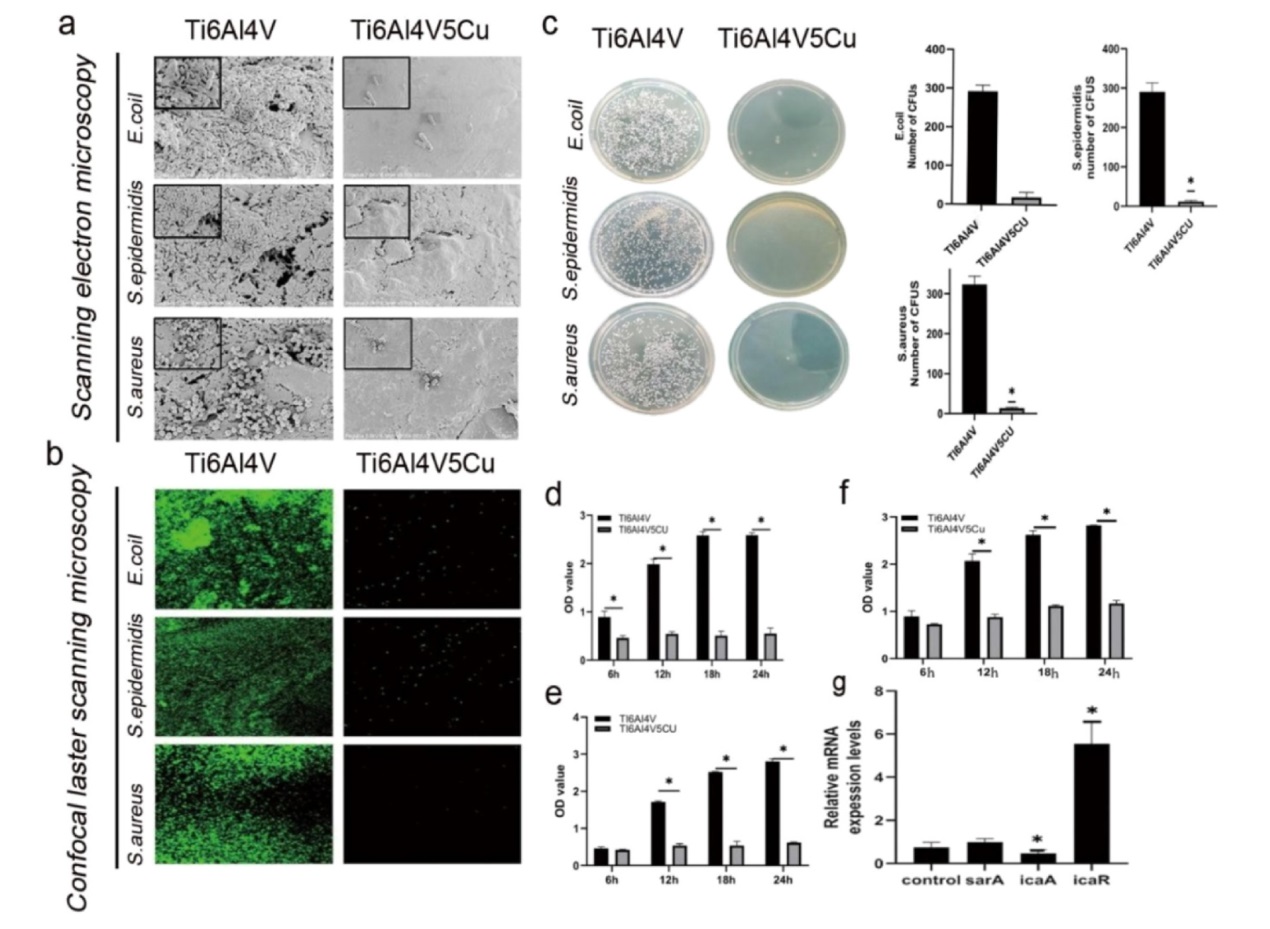
Fig. 3. (a) SEM images of bacterial biofilm growth on Ti6Al4V5Cu and Ti6Al4V scaffolds after 24 h of co-culture with different bacteria. (b) CLSM observation of bacterial biofilm growth on Ti6Al4V5Cu and Ti6Al4V scaffolds after 24 h of co-culture with different bacteria. (c) Number and representative images of colonies growing on Ti6Al4V5Cu and Ti6Al4V scaffolds after 24 h of co-culture. (d) Crystal violet absorption values of Staphylococcus aureus on Ti6Al4V5Cu and Ti6Al4V scaffolds at different time points. (e) Crystal violet absorption values of Staphylococcus epidermosus on Ti6Al4V5Cu and Ti6Al4V scaffolds at different time points. (f) Crystal violet absorption values of E. coli on Ti6Al4V5Cu and Ti6Al4V scaffolds at different time points. (g) mRNA expression of icaA, icaR and SarA genes associated with biofilm for Ti6Al4V5Cu group, and their expression relative to Ti6Al4V group. Data were analyzed by two-sided Student-t test, and were expressed as mean±SD; n=3; *p<0.05.
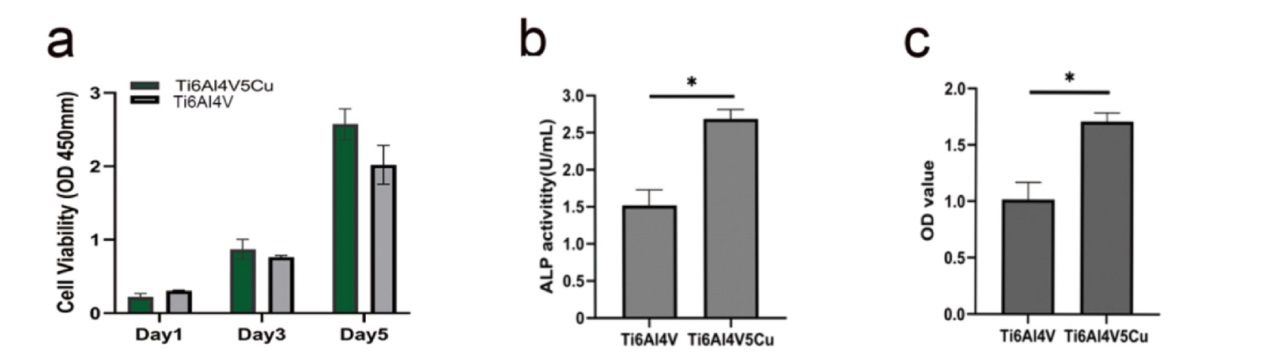
Fig. 4. (a) Cell viability of rat BMSCs on Ti6Al4V5Cu and Ti6Al4V scaffolds. (b) ALP activity of rat BMSCs on Ti6Al4V5Cu and Ti6Al4V scaffolds after 7 days of co-culture. (c) Absorption by alizarin red staining after 21 days of co-culture. Two-sided Student-t test was used, and data were expressed as mean±SD. n=3; *p<0.05.
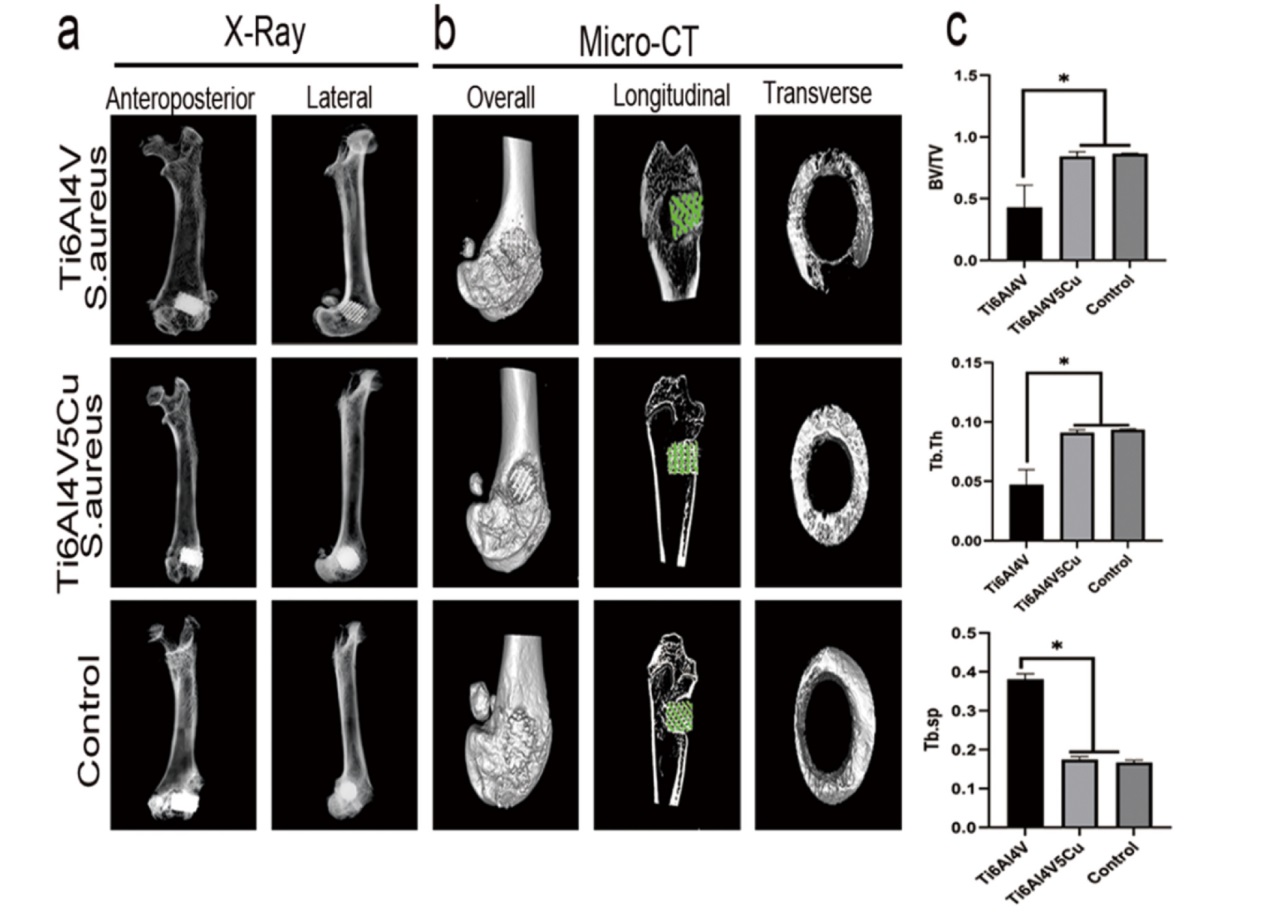
Fig. 5. (a) X-ray imaging evaluation of Ti6Al4V5Cu and Ti6Al4V scaffolds after 4 weeks of implantation. (b) Micro-CT imaging evaluation of the implants after 4 weeks implantation of Ti6Al4V5Cu and Ti6Al4V scaffolds. (c) Quantitative analysis of bone mineral density of Ti6Al4V5Cu and Ti6Al4V scaffolds. Two-sided Student-t test was used, and data were expressed as mean±SD. n=3; *p<0.05.
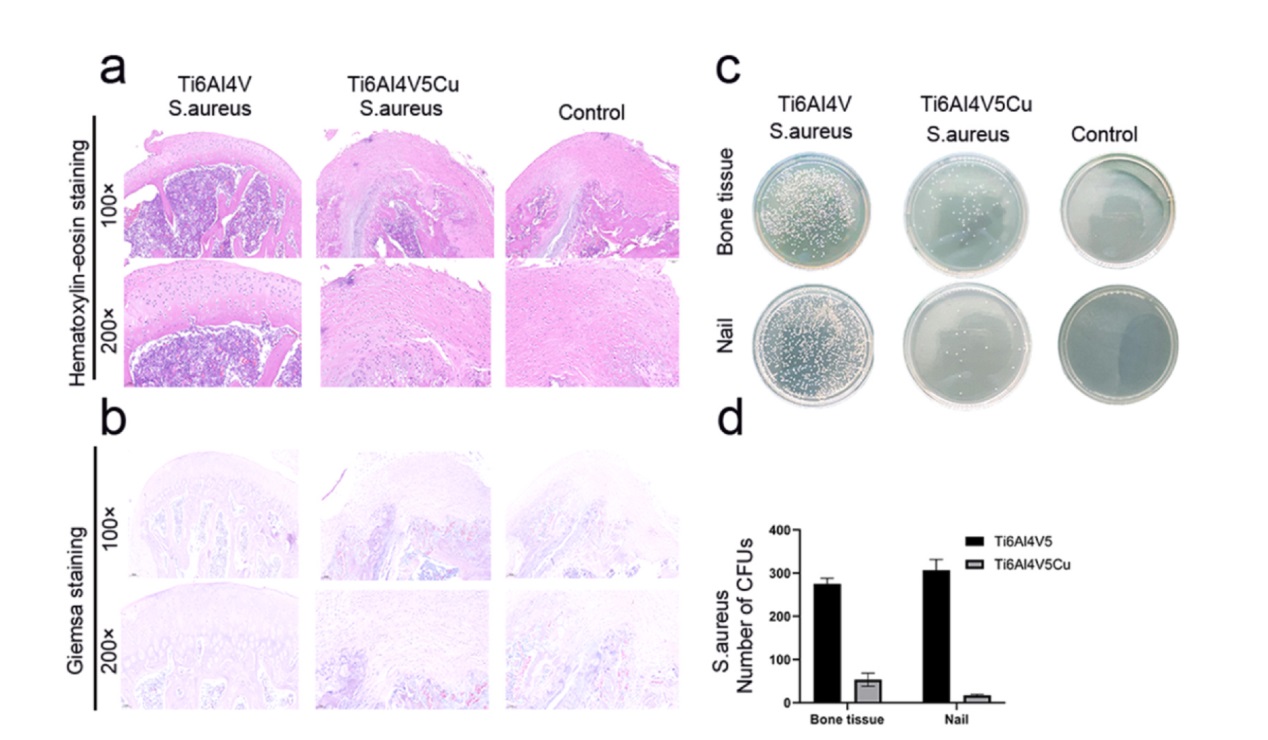
Fig. 6. (a) Histological evaluation of the implant using HE staining. (b) Histological assessment of implants using Giemsa staining. (c, d) Representative images and colony counts of bacteria on the implant surface and surrounding bone tissue. A two-sided Student-t test was used, and data were expressed as mean±SD. n=3; *p<0.05.
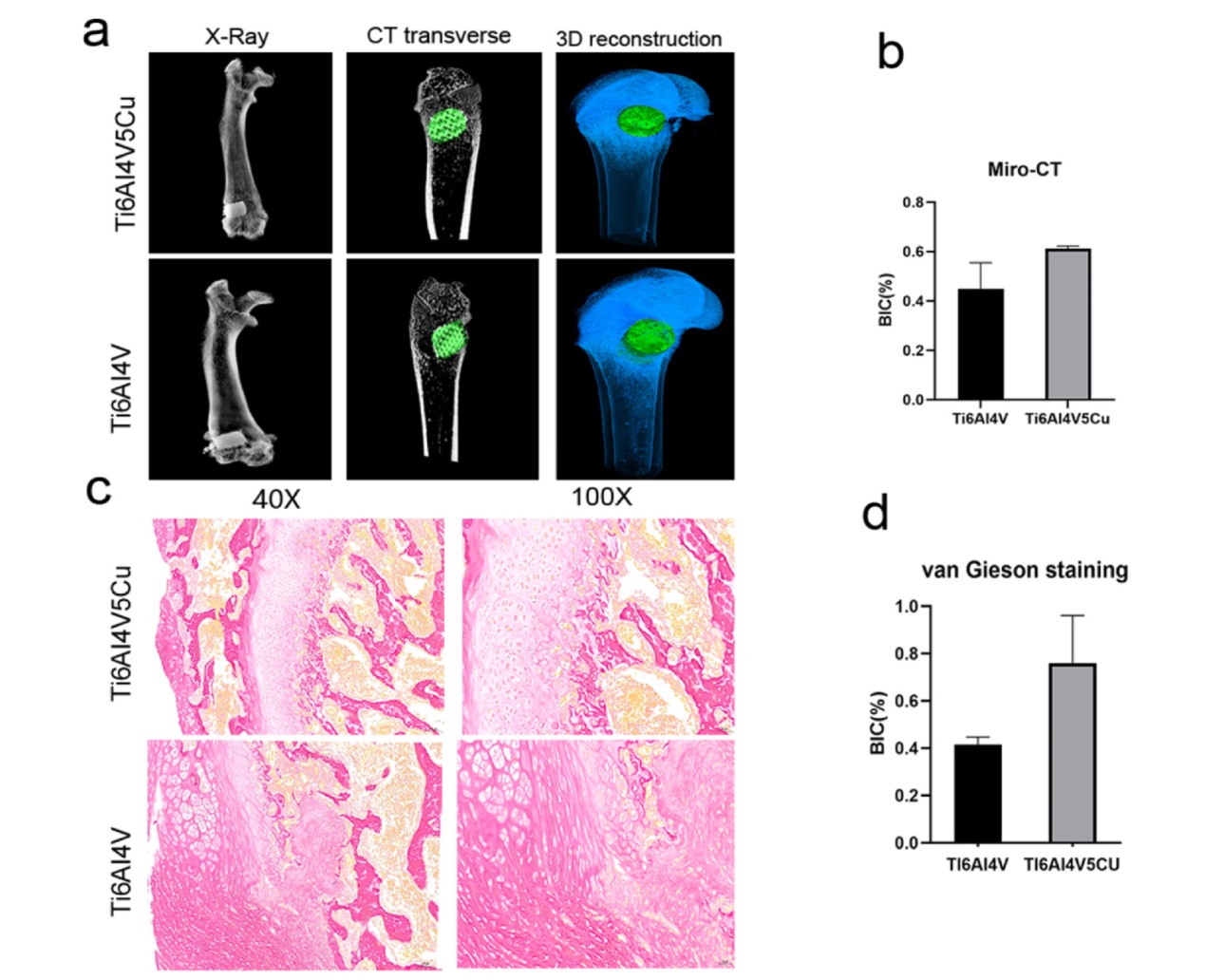
Fig. 7. Evaluations of bone-implant osseointegration using micro-CT (a) and van Gieson staining (c). (b, d) Corresponding bone-implant contacts (BIC) were calculated. Data were expressed as mean±SD. n=3. *p<0.05, two-sided Student-t test was used.
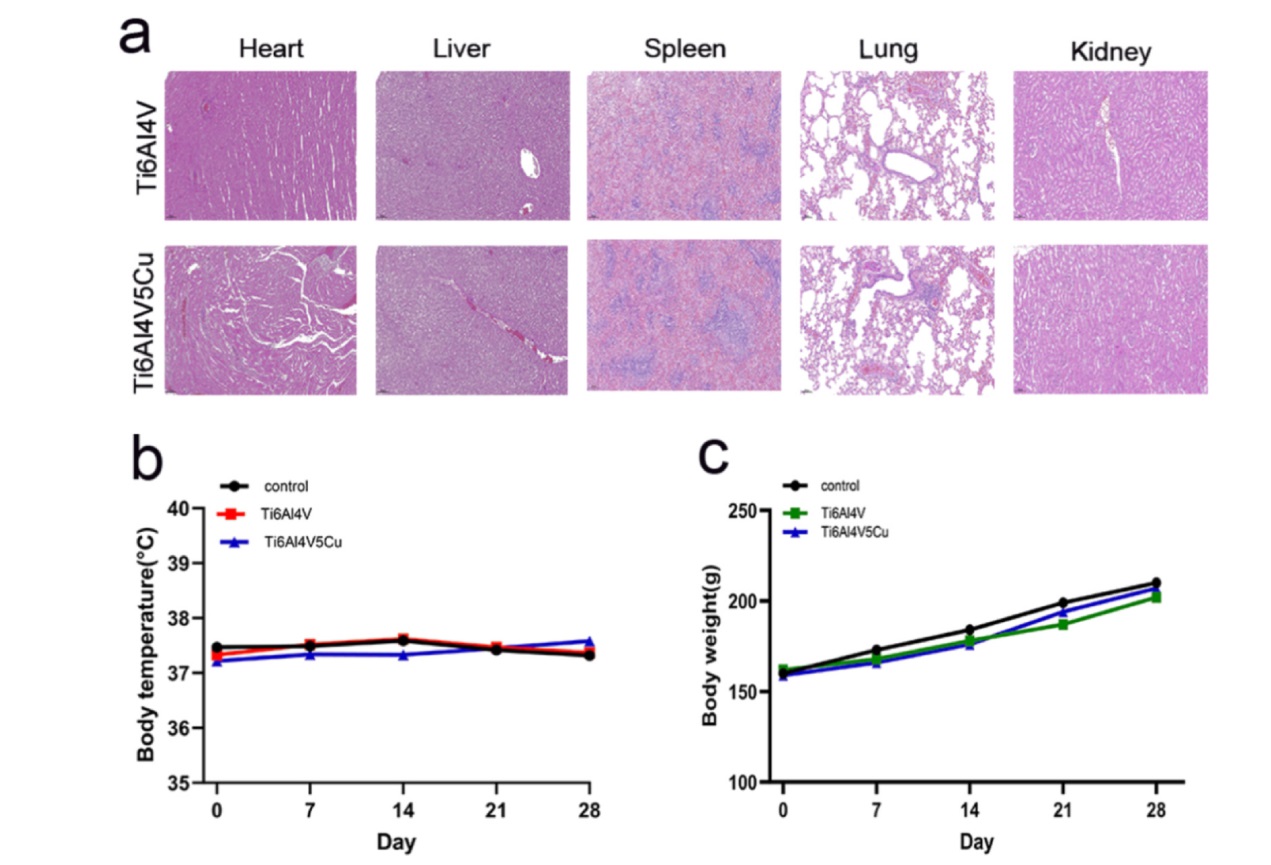
Fig. 8. (a) Evaluation of tissue microstructure of heart, liver, spleen, lung, and kidney of experimental animals using HE staining (100× magnification). (b, c) Body temperature and body weight of experimental animals in Ti6Al4V5Cu and Ti6Al4V groups. Data were expressed as mean±SD; n=3.
| [1] |
M. Kulkarni, A. Mazare, E. Gongadze, Š. Perutkova, V. Kralj Iglič, I. Milošev, P. Schmuki, A. Iglič, M. Mozetič, Nanotechnology 26 (2015) 062002.
DOI URL |
| [2] |
M. Geetha, A.K. Singh, R. Asokamani, A.K. Gogia, Prog. Mater. Sci. 54 (2009) 397-425.
DOI URL |
| [3] |
Y.H. Li, D.Y. Jiang, R. Zhu, C.L. Yang, L.Q. Wang, L.C. Zhang, Int. J. Extrem. Manuf. 7 (2025) 022002.
DOI |
| [4] |
J.X. Li, J.W. Zhang, H.B. Hu, Y. Cai, J.Y. Ling, Z.H. Wu, Y.H. Deng, Cancer Manag. Res. 12 (2020) 3301-3310.
DOI URL |
| [5] | Y.H. Li, Y.X. He, Q. Zhang, C.W. Zhang, L.B. Niu, Y.J. Liu, S.S. Zhu, P. Wang, Acta Metall. Sin.-Engl. Lett. 38 (2025) 1839-1852. |
| [6] |
Y.H. Li, D.Y. Jiang, R. Zhao, X. Wang, L.Q. Wang,L.C Zhang, Metals 14 (2024) 1165.
DOI URL |
| [7] | X.D. Yang, C. Liu, L.C. Xie, Met. Adv. 39 (2026) 95-116. |
| [8] |
L.C. Xie, H.X. Sun, Y. Wen, L. Hua, L.C. Zhang, Prog. Mater. Sci. 153 (2025) 101488.
DOI URL |
| [9] |
C.N. Elias, D.J. Fernandes, F.M. de Souza, E.D.S. Monteiro, R.S. de Biasi, J. Mater. Res. Technol. 8 (2019) 1060-1069.
DOI URL |
| [10] |
M. Kaur, K. Singh, Mater. Sci. Eng. C 102 (2019) 844-862.
DOI URL |
| [11] |
N.D. Tomashov, R.M. Altovsky, G.P. Chernova, J. Electrochem. Soc. 108 (1961) 113-119.
DOI URL |
| [12] |
K. Liu, H.Y. Zhang, X. Maimaiti, A. Yusufu, J. Orthop. Surg. Res. 18 (2023) 140.
DOI |
| [13] |
L. Shen, Q. Wang, J. Chen, Z.H. Jiang, BMC Musculoskelet. Disord. 23 (2022) 1091.
DOI |
| [14] |
A.R. Vosoughi, P. Medhati, E. Hosseini, M. Labidi, A.H. Hoveidaei, Foot Ankle Surg. 29 (2023) 334-340.
DOI PMID |
| [15] |
P.R. Oliveira, M.C. Leonhardt, C.T. Panico, J.B. Silva, V.C. Carvalho, K.E. Kojima, J.S. Silva,A.L.L Lima, Injury 54 (2023) 110821.
DOI URL |
| [16] |
K.K. Boyle, M. Kapadia, D.C. Landy, M.W. Henry, A.O. Miller, G.H. Westrich, J. Arthroplast. 35 (2020) 2210-2216.
DOI URL |
| [17] |
C.R. Arciola, D. Campoccia, L. Montanaro, Nat. Rev. Microbiol. 16 (2018) 397-409.
DOI PMID |
| [18] | M.J. Weaver, U. Khan, S. Puri, S. Lamiha, K. Swanson, I. Rababa, A. Olson, B. Best. Inj. 56 (2025) 112302. |
| [19] |
J.K. Zeng, C.J. Gu, X.W. Geng, K.L. Lin, Y.Z. Xie,X.S Chen, Biomaterials 297 (2023) 122122.
DOI URL |
| [20] |
W. Song, H. Wang, Y. Li, S.Y. Zhang, L. Ren, K. Yang, J. Mater. Sci. Technol. 129 (2022) 240-250.
DOI |
| [21] |
S. Mandal, A.V. Kishore, S. Mandal, B. Bhar, B.B. Mandal, S.K. Nandi, M. Roy, Acta Biomater. 168 (2023) 650-669.
DOI URL |
| [22] |
L. Ling, S. Cai, Y. Zuo, M. Tian, T.F. Meng, H. Tian, X.G. Bao, G.H. Xu, Colloids Surf. B Biointerfaces 219 (2022) 112810.
DOI URL |
| [23] |
E. Moschini, G. Colombo, G. Chirico, G. Capitani, I. Dalle-Donne, P. Mantecca, Sci. Rep. 13 (2023) 2326.
DOI PMID |
| [24] |
J. Yang, H.J. Qin, Y. Chai, P. Zhang, Y.R. Chen, K. Yang, M. Qin, Y.F. Zhang, H. Xia, L. Ren, B. Yu, J. Orthop. Transl. 27 (2021) 77-89.
DOI PMID |
| [25] |
Y. Safarova Yantsen, A. Nessipbekova, A. Syzdykova, F. Olzhayev, B. Umbayev, A. Kassenova, I.V. Fadeeva, S. Askarova, J.V. Rau, J. Funct. Biomater. 15 (2024) 352.
DOI URL |
| [26] |
B. Piotrowski, A.A. Baptista, E. Patoor, P. Bravetti, A. Eberhardt, P. Laheurte, Mater. Sci. Eng. C 38 (2014) 151-160.
DOI URL |
| [27] |
A.H. Foroughi, M.J. Razavi, Acta Biomater. 146 (2022) 317-340.
DOI PMID |
| [28] |
H.J. Jang, M.S. Kang, J. Jang, D. Lim, S.W. Choi, T.G. Jung, H.J. Chun, B. Kim, D. W. Han, Biomater. Sci. 12 (2024) 5491-5503.
DOI URL |
| [29] |
H.Q. Luan, L.T. Wang, W.Y. Ren, Z.W. Chu, Y.F. Huang, C.L. Lu, Y.B. Fan, Sci. China Technol. Sci. 62 (2019) 1160-1168.
DOI |
| [30] |
R. Liu, Z. Ma, S. Kunle Kolawole, L.L. Zeng, Y. Zhao, L. Ren, K. Yang, J. Mater. Sci. Mater. Med. 30 (2019) 75.
DOI |
| [31] |
C. Peng, S.Y. Zhang, Z.Z. Sun, L. Ren, K. Yang, Mater. Sci. Eng. C 93 (2018) 495-504.
DOI URL |
| [32] |
Y.F. Zhuang, L. Ren, S.Y. Zhang, X. Wei, K. Yang, K.R. Dai, Acta Biomater. 119 (2021) 472-484.
DOI PMID |
| [33] |
X.Y. Zhang, H. Liu, L. Li, C.S. Huang, X.B. Meng, J.Z. Liu, X.L. Bai, L. Ren, X. L. Wang, K. Yang, L. Qin, Regen. Biomater. 9 (2022) rbac011.
DOI URL |
| [34] |
P. Li, W.T. Zhang, J.T. Dai, A.B. Xepapadeas, E. Schweizer, D. Alexander, L. Scheideler, C. Zhou, H.J. Zhang, G.J. Wan, J. Geis-Gerstorfer, Mater. Sci. Eng. C 103 (2019) 109826.
DOI URL |
| [35] | D.Z. Li, Y.H. Li, A. Shrestha, S. Wang, Q.Q. Wu, L.J. Li, C. Guan, C. Wang, T.W. Fu, W.Z. Liu, Y.D. Huang, P. Ji, T. Chen, Adv. Healthc. Mater. 8 (2019) e1900002. |
| [36] | Z.Q. Liu, X.L. Liu, S. Ramakrishna, Biotechnol. J. 16 (2021) e2000116. |
| [37] |
C. Hou, J.J. An, D.Y. Zhao, X. Ma, W.L. Zhang, W. Zhao, M. Wu, Z.Y. Zhang, F.S. Yuan, Front. Bioeng. Biotechnol. 10 (2022) 835008.
DOI URL |
| [38] |
G.K. Meenashisundaram, N. Wang, S. Maskomani, S. Lu, S.K. Anantharajan, S.T. Dheen, S.M.L. Nai, J.Y.H. Fuh, J. Wei, Mater. Sci. Eng. C 108 (2020) 110478.
DOI URL |
| [39] |
S. Barui, A.K. Panda, S. Naskar, R. Kuppuraj, S. Basu,B Basu, Biomaterials 213 (2019) 119212.
DOI URL |
| [40] |
A. Palmquist, M. Jolic, E. Hryha, F.A. Shah, Acta Biomater. 156 (2023) 125-145.
DOI URL |
| [41] |
J. Guerrero, E. Maevskaia, C. Ghayor, I. Bhattacharya, F.E. Weber, J. Funct. Biomater. 15 (2024) 174.
DOI URL |
| [42] |
F. Deng, L. Liu, Z. Li, J. Liu, J. Biol. Eng. 15 (2021) 4.
DOI |
| [43] |
J. Liu, F. Li, C. Liu, H. Wang, B. Ren, K. Yang, E. Zhang, Mater. Sci. Eng. C 35 (2014) 392-400.
DOI URL |
| [44] |
L. Ren, X.H. Xu, H. Liu, K. Yang, X. Qi, J. Mater. Sci. Technol. 95 (2021) 237-248.
DOI URL |
| [45] |
S.X. Lu, R.Y. Li, M.Z. Chai, J.M. Wang, W.P. Duan, X.H. Yao, X.Y. Zhang, B. Tang, Colloids Surf. B Biointerfaces 217 (2022) 112695.
DOI URL |
| [46] |
E.L. Zhang, J. Ren, S.Y. Li, L. Yang, G.W. Qin, Biomed. Mater. 11 (2016) 065001.
DOI |
| [47] |
Z. Ma, M. Li, R. Liu, L. Ren, Y. Zhang, H.B. Pan, Y. Zhao, K. Yang, J. Mater. Sci. Mater. Med. 27 (2016) 91.
DOI URL |
| [48] |
Y. Alshammari, F. Yang, L. Bolzoni, J. Mech. Behav. Biomed. Mater. 95 (2019) 232-239.
DOI PMID |
| [49] |
P. Kumar, T. Saha, S. Behera, S. Gupta, S. Das, K. Mukhopadhyay, J. Inorg. Biochem. 222 (2021) 111494.
DOI URL |
| [50] |
Y.H. Si, H.Y. Liu, H.Y. Yu, X.Z. Jiang, D.B. Sun, Colloids Surf. B Biointerfaces 219 (2022) 112840.
DOI URL |
| [51] | C.R. Arciola, D. Campoccia, S. Ravaioli, L. Montanaro, Front. Cell. Infect. Microbiol. 5 (2015) 7. |
| [52] |
S.R. Radoshitzky, P. Iversen, X.H. Lu, J. Zou, S.J.F. Kaptein, K.S. Stuthman, S.A. Van Tongeren, J. Steffens, R.Y. Gong, H. Truong, A.A. Sapre, H.L. Yang, X.D. Xie, J.J. Chia, Z.J.J. Song, S.M. Leventhal, J. Chan, A. Shornikov, X. Zhang, D. Cowfer, H. Yu, T. Warren, T. Cihlar, D.P. Porter, J. Neyts, P.Y. Shi, J. Wells, J.P. Bilello, J.Y. Feng, Sci. Rep. 13 (2023) 3131.
DOI PMID |
| [1] | Pinjing Yao, Qinghuang Huang, Wangyang Li, Bingyuan Ke, Zhibo Yang, Jixi Chen, Huagui Zhang, Dun-Bao Ruan, Xinghui Wang. Thick, asymmetric electrodes enable high-energy-density 3D-printed flexible quasi-solid-state micro-supercapacitors [J]. Metals Advances, 2026, 44(6): 60-69. |
| [2] | Shiqiang Song, Lizhu Tang, Longjian Huang, Yuanli Luo, Huiqing Yang, Chengliang Yang. Advancements in design, surface modification, and spinal applications of biomedical metallic materials for bone repair [J]. Metals Advances, 2026, 42(4): 49-65. |
| [3] | Minquan Xiong, Linghui Zeng, Wenwu Ruan, Yiyan Qiu, Xinliang Ye, Weiwei Zhang, Chong Wang, Min Wang. Recent advances in 3D printing of metallic component-containing bone repairing materials [J]. Metals Advances, 2026, 41(3): 55-71. |
| [4] | Zhihua Cheng, Xiaocheng Men, Zhijie Ma, Yubo Zhang, Jinshu Wang, Wei Yang, Tong Gao, Yan Zhang, Jiahua Wei, Haibin Lu, Dewei Zhao. Personalized biomimetic trabecular porous tantalum dental implants: A study on early osteogenesis and osseointegration [J]. Metals Advances, 2026, 41(3): 85-93. |
| [5] | Xuhui Liu, Zijin Xiao, Yang Yuan, Qihong Huang, Kaiwei Tang, Yilong Dai, Dechuang Zhang, Jia She, Feng Peng, Fugang Qi, Xiaoping Ouyang. Corrosion-resistant and bioactive FeMn-CaP-Col@CS coating on magnesium alloy for orthopedic implants: Fabrication and characterization [J]. Metals Advances, 2026, 39(1): 1-12. |
| [6] | Kunmao Li, Shengfeng Zhou, Jing Liu, Feng Yang, Chengliang Yang. A review on the biomedical Ti-Cu alloys: Design, preparation, microstructure and properties [J]. Metals Advances, 2026, 39(1): 47-67. |
| [7] | Yuntian Lou, Shengyu He, Xudong Chen, Weiwei Chang, Hao Zhang, Jingzhi Yang, Hongchang Qian, Dawei Zhang. Effect of Ultrasonic Shot Peening on the Corrosion Resistance and Antibacterial Properties of 304 Cu-Bearing Stainless Steel [J]. Acta Metallurgica Sinica (English Letters), 2025, 38(8): 1371-1384. |
| [8] | Shuaiwu Peng, Zejun Chen, Runhua Yao, Sen Pei, Ruiqiang Hang, Yonghua Sun, Xiaohong Yao, Ying Lu. Corrosion Behavior, Antioxidation Property, Antibacterial Ability, and Osteogenic Activity of Zn / Chitosan-Catechol Coating Prepared on NiTi Alloy [J]. Acta Metallurgica Sinica (English Letters), 2025, 38(11): 1909-1925. |
| [9] | Jin-Xiu Li, Jun-Xiu Chen, M. A. Siddiqui, S. K. Kolawole, Yang Yang, Ying Shen, Jian-Ping Yang, Jian-Hua Wang, Xu-Ping Su. Enhancing Corrosion Resistance and Antibacterial Properties of ZK60 Magnesium Alloy Using Micro-Arc Oxidation Coating Containing Nano-Zinc Oxide [J]. Acta Metallurgica Sinica (English Letters), 2025, 38(1): 45-58. |
| [10] | J. Sharath Kumar, Rakesh Kumar, Rajeev Verma. Surface Modification Aspects for Improving Biomedical Properties in Implants: A Review [J]. Acta Metallurgica Sinica (English Letters), 2024, 37(2): 213-241. |
| [11] | Ying Shen, Xianfeng Shan, Iniobong P. Etim, Muhammad Ali Siddiqui, Yang Yang, Zewen Shi, Xuping Su, Junxiu Chen. Comparative Study of the Effects of Nano ZnO and CuO on the Biodegradation, Biocompatibility, and Antibacterial Properties of Micro-arc Oxidation Coating of Magnesium Alloy [J]. Acta Metallurgica Sinica (English Letters), 2024, 37(2): 242-254. |
| [12] | Zenglong Yan, Shuyuan Zhang, Ling Ren, Xizhuang Bai, Ke Yang, Xiang Wei. Anodic Etching Surface Treatment and Antibacterial Properties of Ti-Cu [J]. Acta Metallurgica Sinica (English Letters), 2024, 37(10): 1767-1776. |
| [13] | Shuilong Huang, Qingjun Chen, Li Ji, Kan Wang, Guosheng Huang. Microstructure and Internal Friction Behavior of Laser 3D Printed Fe-Based Amorphous Composites [J]. Acta Metallurgica Sinica (English Letters), 2024, 37(1): 196-204. |
| [14] | Wenyu Li, Weiming Yang, Mingze Li, Xiang Zhang, Ping Zhang, Yucheng Zhao, Peijian Chen, Haishun Liu. Energy Absorption by 3D-Printed Mesh Structures with a Negative Poisson’s Ratio [J]. Acta Metallurgica Sinica (English Letters), 2024, 37(1): 205-212. |
| [15] | Minghui Zhou, Hui Sun, Yanming Gan, Cheng Ji, Yan Chen, Yanjin Lu, Jinxin Lin, Qiang Wang. Tuning the Corrosion Resistance, Antibacterial Activity, and Cytocompatibility by Constructing Grooves on the Surface of Ti6Al4V3Cu Alloy [J]. Acta Metallurgica Sinica (English Letters), 2023, 36(12): 1979-1998. |
| Viewed | ||||||
|
Full text |
|
|||||
|
Abstract |
|
|||||
 WeChat
