
Metals Advances ›› 2026, Vol. 39: 47-67.DOI: 10.1016/j.metadv.2025.12.005
• Review Article • Previous Articles Next Articles
Kunmao Lia, Shengfeng Zhoub,*( ), Jing Liua,**(), Feng Yanga, Chengliang Yangc,d,***()
Received:2025-08-16
Revised:2025-09-14
Accepted:2025-09-23
Online:2026-01-10
Published:2026-03-10
Contact:
*Institute of Advanced Wear & Corrosion Resistance and Functional Materials, Jinan University, Guangzhou 510632, Guangdong, China. E-mail addresses: zhousf1228@163.com (S. Zhou),
**408452347@qq.com (J. Liu),
***yangchengliang@ymcn.edu.cn (C. Yang).
Kunmao Li, Shengfeng Zhou, Jing Liu, Feng Yang, Chengliang Yang. A review on the biomedical Ti-Cu alloys: Design, preparation, microstructure and properties[J]. Metals Advances, 2026, 39: 47-67.
Add to citation manager EndNote|Ris|BibTeX
| Material | Density (g/cm3) | Microstructure | Modulus (GPa) | Tensile strength (MPa) | Primary applications |
|---|---|---|---|---|---|
| Bone | ∼1.8 | Viscoelastic composite | 10-40 | 90-140 | - |
| 316L | 8.0 | Austenite | 200 | 540-1000 | Temporary devices (screws, hip nails, fracture plates, et al.) |
| CoCrMo | ∼8.3 | Austenite+hcp | 200-230 | 600-1795 | Load-bearing components, prostheses stems, dentistry castings, etc. |
| CP-Ti | 4.5 | α | 105 | 785 | Dental implants, orthopaedic implants, cardiovascular, etc. |
| Ti6Al4V | 4.4 | α+β | 110 | 960-970 | Large joint replacement, dental implants, etc. |
| Ti35Nb5Ta7Zr | 5.7 | Metastable β | 55 | 590 | A new generation of orthopedic implants (bone plate, bone nail, spine, etc.) |
| NiTi | 6.45 | Martensite | 30-50 | 1355 | Vascular stent, cochlear implant, orthodontic archwires, etc. |
Table 1. Physical parameters and primary applications of metal implant materials [2], [33].
| Material | Density (g/cm3) | Microstructure | Modulus (GPa) | Tensile strength (MPa) | Primary applications |
|---|---|---|---|---|---|
| Bone | ∼1.8 | Viscoelastic composite | 10-40 | 90-140 | - |
| 316L | 8.0 | Austenite | 200 | 540-1000 | Temporary devices (screws, hip nails, fracture plates, et al.) |
| CoCrMo | ∼8.3 | Austenite+hcp | 200-230 | 600-1795 | Load-bearing components, prostheses stems, dentistry castings, etc. |
| CP-Ti | 4.5 | α | 105 | 785 | Dental implants, orthopaedic implants, cardiovascular, etc. |
| Ti6Al4V | 4.4 | α+β | 110 | 960-970 | Large joint replacement, dental implants, etc. |
| Ti35Nb5Ta7Zr | 5.7 | Metastable β | 55 | 590 | A new generation of orthopedic implants (bone plate, bone nail, spine, etc.) |
| NiTi | 6.45 | Martensite | 30-50 | 1355 | Vascular stent, cochlear implant, orthodontic archwires, etc. |

Fig. 1. (a) Schematic diagram of the Burgers orientation relationship of the α↔β phase transition. (b) Crystal structure of α and β phases. (a) (Adapted with permission from Ref. [40], copyright Elsevier 2014)

Fig. 2. Ti-Cu phase diagram. (Adapted with permission from Ref. [62], copyright Elsevier 2022).

Fig. 3. SEM images of the Ti-xCu alloys. (a) Ti-1Cu, (b) Ti-3Cu, (c) Ti-5Cu, (d) Ti-10Cu, (e) Ti-15.3Cu, (f) Ti-25Cu. (Adapted with permission from Refs. [13], [66], [67], [68], copyright Elsevier).

Fig. 4. Crystallography relationship of Ti-Cu alloy during equilibrium phase transformation. (Adapted with permission from Ref. [66], copyright Elsevier 2019).

Fig. 5. (a) Stress-strain curve of Ti6Al4V-Cu alloy. (b-e) Fracture features of (b) Ti6Al4V, (c) 1Cu, (d) 3Cu, and (e) 5Cu. (Adapted with permission from Ref. [23], copyright Elsevier 2023).

Fig. 6. Manufacturing process of Ti-Cu alloys. (Adapted with permission from Refs. [21], [23], [76], [78], [85], [86], [108], copyright Elsevier).

Fig. 7. Schematic illustrations of solid-solid phase transformation pathways and mechanical properties of Ti6Al4V-5Cu alloy. (Adapted with permission from Ref. [23], copyright Elsevier 2023).
| Materials | Process | Microstructure | UTS (MPa) | El. (%) | Hardness (HV) | Ref. |
|---|---|---|---|---|---|---|
| Ti-10Cu | As-cast (annealed at 800 °C) | α + Ti2Cu | 722 | 44 | - | [ |
| Ti-20Cu | 719 | 26 | - | |||
| Ti-30Cu | 616 | 10 | - | |||
| Ti-10Cu | As-cast (annealed at 950 °C) | α + Ti2Cu | 1204 | 5 | - | [ |
| Ti-20Cu | 807 | 22 | - | |||
| Ti-30Cu | 725 | 8 | - | |||
| Ti-3Cu | SPS (850 °C) | α + Ti2Cu | 555 | 16.2 | - | [ |
| Ti-5Cu | 571 | 12.5 | - | |||
| Ti-7Cu | 685 | 10.2 | - | |||
| Ti-3Cu | SPS (1000 °C) | α + Ti2Cu | 594 | 29.2 | - | [ |
| Ti-5Cu | 653 | 17.9 | - | |||
| Ti-7Cu | 820 | 13 | - | |||
| Ti-6Cu | LMD (118 J/mm3) | Equiaxed-α and Widmanstätten-α | 1054 | 10.3 | - | [ |
| LMD (197 J/mm3) | 553 | 19.5 | - | |||
| Ti-1.25Cu | SLM | α + Ti2Cu | 842 | 12 | 258 | [ |
| Ti-2.5Cu | 1002 | 5.3 | 299 | |||
| Ti-5Cu | 1242 | 2.5 | 365 | |||
| Ti-1Cu | WAAM | α + Ti2Cu | 705 | 13.4 | - | [ |
| Ti-4Cu | 992 | 11.6 | - | |||
| Ti-7Cu | 905 | 5.6 | - | |||
| Ti-10Cu | 1102 | 1.9 | - | |||
| Ti-3Cu | DED | α + Ti2Cu | 652 | 21.6 | - | [ |
| Ti-6Cu | 827 | 12.7 | - | |||
| Ti-9Cu | 1110 | 5.0 | - | |||
| Ti6Al4V-1.2Cu | DED | α + β | 991 | 10.7 | - | [ |
| Ti6Al4V-8.5Cu | WAAM | α + β + Ti2Cu | 876 | 4.2 | 340 | [ |
| Ti6Al4V-4Cu | DED | α/α'+ β + Ti2Cu | 1325 | 1.4 | 446 | [ |
| Ti6Al4V-7Cu | 841 | - | 510 | |||
| Ti6Al4V-1Cu | LPBF | α' | 1364 | 6.1 | - | [ |
| Ti6Al4V-3Cu | 1404 | 5.2 | - | |||
| Ti6Al4V-5Cu | 1771 | 2.4 | -- | |||
| Ti6Al4V-1Cu | LPBF + HT (800 °C) | α + α'' | 1106 | 16.9 | - | [ |
| Ti6Al4V-3Cu | 1174 | 15.4 | - | |||
| Ti6Al4V-5Cu | 1263 | 14.9 | - | |||
| Ti35Nb-1Cu | LPBF | β + Ti2Cu+ α | 747 | 21.5 | 259 | [ |
| Ti35Nb-3Cu | 785 | 17.7 | 253 | |||
| Ti35Nb-5Cu | 867 | 11.7 | 289 | |||
| Ti35Nb-7Cu | 681 | 1.2 | 302 | |||
| Ti10Mo-3.5Cu | As-cast | ω + β | 791 | 44 | - | [ |
| TiZr-5.5Cu | Forged (coarse grain) | α + β + (Ti,Zr)2Cu | 707 | 23 | - | [ |
| Forged (fine grain) | 813 | 19.3 | - | |||
| Ti13Nb13Zr-5Cu | SLM (62.5 J/mm3) | β + (Ti,Zr)2Cu | 1001 | 0.39 | 443 | [ |
| SLM (78.1 J/mm3) | 1450 | 2.19 | 457 | |||
| SLM (80 J/mm3) | 871 | 0.39 | 445 |
Table 2. Microstructure and mechanical properties of Ti-Cu alloys.
| Materials | Process | Microstructure | UTS (MPa) | El. (%) | Hardness (HV) | Ref. |
|---|---|---|---|---|---|---|
| Ti-10Cu | As-cast (annealed at 800 °C) | α + Ti2Cu | 722 | 44 | - | [ |
| Ti-20Cu | 719 | 26 | - | |||
| Ti-30Cu | 616 | 10 | - | |||
| Ti-10Cu | As-cast (annealed at 950 °C) | α + Ti2Cu | 1204 | 5 | - | [ |
| Ti-20Cu | 807 | 22 | - | |||
| Ti-30Cu | 725 | 8 | - | |||
| Ti-3Cu | SPS (850 °C) | α + Ti2Cu | 555 | 16.2 | - | [ |
| Ti-5Cu | 571 | 12.5 | - | |||
| Ti-7Cu | 685 | 10.2 | - | |||
| Ti-3Cu | SPS (1000 °C) | α + Ti2Cu | 594 | 29.2 | - | [ |
| Ti-5Cu | 653 | 17.9 | - | |||
| Ti-7Cu | 820 | 13 | - | |||
| Ti-6Cu | LMD (118 J/mm3) | Equiaxed-α and Widmanstätten-α | 1054 | 10.3 | - | [ |
| LMD (197 J/mm3) | 553 | 19.5 | - | |||
| Ti-1.25Cu | SLM | α + Ti2Cu | 842 | 12 | 258 | [ |
| Ti-2.5Cu | 1002 | 5.3 | 299 | |||
| Ti-5Cu | 1242 | 2.5 | 365 | |||
| Ti-1Cu | WAAM | α + Ti2Cu | 705 | 13.4 | - | [ |
| Ti-4Cu | 992 | 11.6 | - | |||
| Ti-7Cu | 905 | 5.6 | - | |||
| Ti-10Cu | 1102 | 1.9 | - | |||
| Ti-3Cu | DED | α + Ti2Cu | 652 | 21.6 | - | [ |
| Ti-6Cu | 827 | 12.7 | - | |||
| Ti-9Cu | 1110 | 5.0 | - | |||
| Ti6Al4V-1.2Cu | DED | α + β | 991 | 10.7 | - | [ |
| Ti6Al4V-8.5Cu | WAAM | α + β + Ti2Cu | 876 | 4.2 | 340 | [ |
| Ti6Al4V-4Cu | DED | α/α'+ β + Ti2Cu | 1325 | 1.4 | 446 | [ |
| Ti6Al4V-7Cu | 841 | - | 510 | |||
| Ti6Al4V-1Cu | LPBF | α' | 1364 | 6.1 | - | [ |
| Ti6Al4V-3Cu | 1404 | 5.2 | - | |||
| Ti6Al4V-5Cu | 1771 | 2.4 | -- | |||
| Ti6Al4V-1Cu | LPBF + HT (800 °C) | α + α'' | 1106 | 16.9 | - | [ |
| Ti6Al4V-3Cu | 1174 | 15.4 | - | |||
| Ti6Al4V-5Cu | 1263 | 14.9 | - | |||
| Ti35Nb-1Cu | LPBF | β + Ti2Cu+ α | 747 | 21.5 | 259 | [ |
| Ti35Nb-3Cu | 785 | 17.7 | 253 | |||
| Ti35Nb-5Cu | 867 | 11.7 | 289 | |||
| Ti35Nb-7Cu | 681 | 1.2 | 302 | |||
| Ti10Mo-3.5Cu | As-cast | ω + β | 791 | 44 | - | [ |
| TiZr-5.5Cu | Forged (coarse grain) | α + β + (Ti,Zr)2Cu | 707 | 23 | - | [ |
| Forged (fine grain) | 813 | 19.3 | - | |||
| Ti13Nb13Zr-5Cu | SLM (62.5 J/mm3) | β + (Ti,Zr)2Cu | 1001 | 0.39 | 443 | [ |
| SLM (78.1 J/mm3) | 1450 | 2.19 | 457 | |||
| SLM (80 J/mm3) | 871 | 0.39 | 445 |

Fig. 8. (a) Vickers hardness, (b) friction coefficient, (c) the 3D-profile morphology of the wear track, (d) the cross-sectional profile of the wear track, and (e) the wear volume of the Ti6Al4V-xCu alloys. (Adapted with permission from Ref. [13], copyright Elsevier 2025).
| Materials | Process | Microstructure | Hardness (HV) | COF | Wear rates (mm3/Nm) | Ref. |
|---|---|---|---|---|---|---|
| Ti | LPBF | α | 223 | 0.84 | 17.9 × 10⁻⁵ | [ |
| Ti-3Cu | α + Ti2Cu | 356 | 0.69 | 9.47 × 10⁻⁵ | ||
| Ti-5Cu | 418 | 0.62 | 7.64 × 10⁻⁵ | |||
| Ti-7Cu | 440 | 0.62 | 7.26 × 10⁻⁵ | |||
| Ti | Powder metallurgy | α | 107 | 0.62 | 9.23 × 10⁻⁴ | [ |
| Ti-5Cu | α + Ti2Cu | 453 | 0.57 | 8.34 × 10⁻⁴ | ||
| Ti-25Cu | 453 | 0.73 | 7.18 × 10⁻⁴ | |||
| Ti-43Cu | As-cast | Cu4Ti | -- | 0.56 | 10.5 × 10⁻⁵ | [ |
| Ti-60Cu | Cu2Ti, Cu4Ti3, CuTi, Ti2Cu3 | -- | 0.45 | 10.3 × 10⁻⁵ | ||
| Ti-69Cu | Cu2Ti, Cu3Ti, CuTi, Ti2Cu3, Cu4Ti3 | -- | 0.48 | 10.1 × 10⁻⁵ | ||
| Ti-74Cu | Cu2Ti, Cu3Ti, Ti2Cu3, Cu4Ti | -- | 0.45 | 9.0 × 10⁻⁵ | ||
| TiTa-0.5Cu | As-cast | α + Ti2Cu | -- | 0.54 | 8.57 × 10⁻⁵ | [ |
| TiTa-0.75Cu | -- | 0.54 | 8.68 × 10⁻⁵ | |||
| TiTa-1.0Cu | -- | 0.54 | 8.41 × 10⁻⁵ | |||
| Ti6Al4V | EBM | α/α′+ β | -- | 0.71 | 7.3 × 10⁻⁷ | [ |
| Ti6Al4V-5Cu | EBM (high energy density) | α/α′+ β + Ti2Cu | -- | 0.68 | 3.7 × 10⁻⁷ | |
| EBM (medium energy density) | α/α′+ β + Ti2Cu | -- | 0.54 | 3.0 × 10⁻⁷ | ||
| EBM (low energy density) | α/α′+ β + Ti2Cu | -- | 0.51 | 2.9 × 10⁻⁷ | ||
| Ti6Al4V-3Cu | LPBF | α + β + Ti2Cu | 520 | 0.51 | 1.8 × 10⁻³ | [ |
| Ti6Al4V-5Cu | 548 | 0.47 | 1.4 × 10⁻³ | |||
| Ti6Al4V-8Cu | 574 | 0.39 | 0.8 × 10⁻³ | |||
| Ti6Al4V-10Cu | 597 | 0.26 | 0.6 × 10⁻³ | |||
| Ti6Al4V | LPBF | α + β | 334 | 0.73 | 6.46 × 10⁻⁴ | [ |
| Ti6Al4V-1Cu | 407 | 0.39 | 3.99 × 10⁻⁴ | |||
| Ti6Al4V | LPBF + HT | α + β | 310 | 0.64 | 3.0 × 10⁻⁴ | [ |
| Ti6Al4V-1Cu | α + β + Ti2Cu | 328 | 0.64 | 2.8 × 10⁻⁴ | ||
| Ti6Al4V-3Cu | 352 | 0.62 | 2.3 × 10⁻⁴ | |||
| Ti6Al4V-5Cu | 375 | 0.59 | 1.8 × 10⁻⁴ |
Table 3. Friction properties of Ti-Cu alloys.
| Materials | Process | Microstructure | Hardness (HV) | COF | Wear rates (mm3/Nm) | Ref. |
|---|---|---|---|---|---|---|
| Ti | LPBF | α | 223 | 0.84 | 17.9 × 10⁻⁵ | [ |
| Ti-3Cu | α + Ti2Cu | 356 | 0.69 | 9.47 × 10⁻⁵ | ||
| Ti-5Cu | 418 | 0.62 | 7.64 × 10⁻⁵ | |||
| Ti-7Cu | 440 | 0.62 | 7.26 × 10⁻⁵ | |||
| Ti | Powder metallurgy | α | 107 | 0.62 | 9.23 × 10⁻⁴ | [ |
| Ti-5Cu | α + Ti2Cu | 453 | 0.57 | 8.34 × 10⁻⁴ | ||
| Ti-25Cu | 453 | 0.73 | 7.18 × 10⁻⁴ | |||
| Ti-43Cu | As-cast | Cu4Ti | -- | 0.56 | 10.5 × 10⁻⁵ | [ |
| Ti-60Cu | Cu2Ti, Cu4Ti3, CuTi, Ti2Cu3 | -- | 0.45 | 10.3 × 10⁻⁵ | ||
| Ti-69Cu | Cu2Ti, Cu3Ti, CuTi, Ti2Cu3, Cu4Ti3 | -- | 0.48 | 10.1 × 10⁻⁵ | ||
| Ti-74Cu | Cu2Ti, Cu3Ti, Ti2Cu3, Cu4Ti | -- | 0.45 | 9.0 × 10⁻⁵ | ||
| TiTa-0.5Cu | As-cast | α + Ti2Cu | -- | 0.54 | 8.57 × 10⁻⁵ | [ |
| TiTa-0.75Cu | -- | 0.54 | 8.68 × 10⁻⁵ | |||
| TiTa-1.0Cu | -- | 0.54 | 8.41 × 10⁻⁵ | |||
| Ti6Al4V | EBM | α/α′+ β | -- | 0.71 | 7.3 × 10⁻⁷ | [ |
| Ti6Al4V-5Cu | EBM (high energy density) | α/α′+ β + Ti2Cu | -- | 0.68 | 3.7 × 10⁻⁷ | |
| EBM (medium energy density) | α/α′+ β + Ti2Cu | -- | 0.54 | 3.0 × 10⁻⁷ | ||
| EBM (low energy density) | α/α′+ β + Ti2Cu | -- | 0.51 | 2.9 × 10⁻⁷ | ||
| Ti6Al4V-3Cu | LPBF | α + β + Ti2Cu | 520 | 0.51 | 1.8 × 10⁻³ | [ |
| Ti6Al4V-5Cu | 548 | 0.47 | 1.4 × 10⁻³ | |||
| Ti6Al4V-8Cu | 574 | 0.39 | 0.8 × 10⁻³ | |||
| Ti6Al4V-10Cu | 597 | 0.26 | 0.6 × 10⁻³ | |||
| Ti6Al4V | LPBF | α + β | 334 | 0.73 | 6.46 × 10⁻⁴ | [ |
| Ti6Al4V-1Cu | 407 | 0.39 | 3.99 × 10⁻⁴ | |||
| Ti6Al4V | LPBF + HT | α + β | 310 | 0.64 | 3.0 × 10⁻⁴ | [ |
| Ti6Al4V-1Cu | α + β + Ti2Cu | 328 | 0.64 | 2.8 × 10⁻⁴ | ||
| Ti6Al4V-3Cu | 352 | 0.62 | 2.3 × 10⁻⁴ | |||
| Ti6Al4V-5Cu | 375 | 0.59 | 1.8 × 10⁻⁴ |

Fig. 9. Microstructure of the cross section of the wear scar of Ti6Al4V-5Cu alloy. (a) Sampling position of the TEM sample; (b) TEM image; (c) cross-sectional microstructure near the worn surface; (d-i) corresponding EDS element maps of the topmost layer. (Adapted with permission from Ref. [13], copyright Elsevier 2025).

Fig. 10. (a) Voltaic potentials of α and Ti2Cu phases. (b) The corrosion mechanism of Ti-Cu alloys. (a) (Adapted with permission from Ref. [13], copyright Elsevier 2025).
| Materials | Process | Solution | Microstructure | Ecorr (mV) | icorr (nA/cm2) | Ref. |
|---|---|---|---|---|---|---|
| Ti-3Cu | As-cast | 0.9%NaCl | α+Ti2Cu | −189 | 0.65 | [ |
| Ti-5Cu | −148 | 1.79 | ||||
| Ti-3Cu | LPBF | Saliva | α+Ti2Cu | −421 | 33.4 | [ |
| Ti-5Cu | −260 | 10.9 | ||||
| Ti-7Cu | −284 | 86.7 | ||||
| Ti6Al4V-1Cu | Powder metallurgy | 0.9%NaCl | α+β+Ti2Cu | −318 | 200 | [ |
| Ti6Al4V-5Cu | −227 | 77.5 | ||||
| Ti6Al4V-10Cu | −295 | 356 | ||||
| Ti6Al4V-1Cu | LPBF+HT | SBF | α+β+Ti2Cu | −310 | 47.9 | [ |
| Ti6Al4V-3Cu | −240 | 56.6 | ||||
| Ti6Al4V-5Cu | −130 | 151 | ||||
| Ti6Al4V-5Cu | EBM (medium energy density) | PBS | α/α′+β+Ti2Cu | −209 | 9.3 | [ |
| EBM (low energy density) | α/α′+β+Ti2Cu | −92 | 12.6 | |||
| Ti25Ta-0.5Cu | As-cast | SBF | α+Ti2Cu | −467 | 92 | [ |
| Ti25Ta-0.75Cu | −419 | 85 | ||||
| Ti25Ta-1.0Cu | −327 | 97 | ||||
| Ti55Ta-1.2Cu | Powder metallurgy | SBF | β+α+Ti2Cu | −280 | 3350 | [ |
| Ti55Ta-3.5Cu | −169 | 3030 | ||||
| Ti55Ta-5.8Cu | −234 | 670 | ||||
| TiNbZr-5Cu | Solution at 950 °C | SBF | β+α″ | −393 | 11.8 | [ |
| Solution+aging (15 min) | β+α″+Ti2Cu | −106 | 383.9 | |||
| Solution+aging (30 min) | −87 | 486.5 | ||||
| Solution+aging (1 h) | −115 | 373.2 | ||||
| Solution+aging (2 h) | −96 | 507.4 | ||||
| TiNbZrMn-0.5Cu | SPS | Ringer's | β+ω+Ti2Cu | −192 | 124 | [ |
| TiNbZrMn-2Cu | −213 | 116 | ||||
| TiNbZrMn-4Cu | −137 | 180 | ||||
| TiNbZrMn-6Cu | −146 | 183 |
Table 4. Corrosion properties of Ti-Cu alloys.
| Materials | Process | Solution | Microstructure | Ecorr (mV) | icorr (nA/cm2) | Ref. |
|---|---|---|---|---|---|---|
| Ti-3Cu | As-cast | 0.9%NaCl | α+Ti2Cu | −189 | 0.65 | [ |
| Ti-5Cu | −148 | 1.79 | ||||
| Ti-3Cu | LPBF | Saliva | α+Ti2Cu | −421 | 33.4 | [ |
| Ti-5Cu | −260 | 10.9 | ||||
| Ti-7Cu | −284 | 86.7 | ||||
| Ti6Al4V-1Cu | Powder metallurgy | 0.9%NaCl | α+β+Ti2Cu | −318 | 200 | [ |
| Ti6Al4V-5Cu | −227 | 77.5 | ||||
| Ti6Al4V-10Cu | −295 | 356 | ||||
| Ti6Al4V-1Cu | LPBF+HT | SBF | α+β+Ti2Cu | −310 | 47.9 | [ |
| Ti6Al4V-3Cu | −240 | 56.6 | ||||
| Ti6Al4V-5Cu | −130 | 151 | ||||
| Ti6Al4V-5Cu | EBM (medium energy density) | PBS | α/α′+β+Ti2Cu | −209 | 9.3 | [ |
| EBM (low energy density) | α/α′+β+Ti2Cu | −92 | 12.6 | |||
| Ti25Ta-0.5Cu | As-cast | SBF | α+Ti2Cu | −467 | 92 | [ |
| Ti25Ta-0.75Cu | −419 | 85 | ||||
| Ti25Ta-1.0Cu | −327 | 97 | ||||
| Ti55Ta-1.2Cu | Powder metallurgy | SBF | β+α+Ti2Cu | −280 | 3350 | [ |
| Ti55Ta-3.5Cu | −169 | 3030 | ||||
| Ti55Ta-5.8Cu | −234 | 670 | ||||
| TiNbZr-5Cu | Solution at 950 °C | SBF | β+α″ | −393 | 11.8 | [ |
| Solution+aging (15 min) | β+α″+Ti2Cu | −106 | 383.9 | |||
| Solution+aging (30 min) | −87 | 486.5 | ||||
| Solution+aging (1 h) | −115 | 373.2 | ||||
| Solution+aging (2 h) | −96 | 507.4 | ||||
| TiNbZrMn-0.5Cu | SPS | Ringer's | β+ω+Ti2Cu | −192 | 124 | [ |
| TiNbZrMn-2Cu | −213 | 116 | ||||
| TiNbZrMn-4Cu | −137 | 180 | ||||
| TiNbZrMn-6Cu | −146 | 183 |
| Materials | Process | Structure | Ti2Cu (vol.%) | Cu2+ | Antibacterial rates | Ref. |
|---|---|---|---|---|---|---|
| Ti-10Cu | As-cast (annealed at 800 °C) | α+Ti2Cu | 12.7 | - | 99.9% (S. aureus) | [ |
| Ti-20Cu | 40 | - | 99.9% (S. aureus) | |||
| Ti-30Cu | 67.3 | - | 99.9% (S. aureus) | |||
| Ti-10Cu | As-cast (annealed at 950 °C) | α+Ti2Cu | 0 | - | 99% (S. aureus) | [ |
| Ti-20Cu | 27.9 | - | 99.9% (S. aureus) | |||
| Ti-30Cu | 60.5 | - | 99.9% (S. aureus) | |||
| Ti-3.5Cu | DED | α+Ti2Cu | 1.63 | 29.5 μg/L | - | [ |
| Ti-6.5Cu | 8.71 | 27 μg/L | - | |||
| Ti-8.5Cu | 13.51 | 24.2 μg/L | 99.7% (S. algae) | |||
| Ti-3Cu | As-cast | α+Ti2Cu | - | 11 μg/L | 76% (S. aureus) | [ |
| Ti-5Cu | - | 26 μg/L | 90% (S. aureus) | |||
| Ti6Al4V-1Cu | LPBF+HT | α+β+Ti2Cu | 0.6 | 19.4 µm/L | 50.1% (S. aureus) | [ |
| Ti6Al4V-3Cu | 2.6 | 39.8 µm/L | 78.2% (S. aureus) | |||
| Ti6Al4V-5Cu | 5.8 | 83.9 µm/L | 91.4% (S. aureus) | |||
| Ti6Al4V-5Cu | EBM | α/α′+β+Ti2Cu | 3 | 0.36 μg/cm2 | 91% (S. aureus) 92% (E. coli) | [ |
| TiNbZr-5Cu | Solution+aging (15 min) | β+α″+Ti2Cu | - | 33 μg/L | 56% (S. aureus) | [ |
| Solution+aging (30 min) | - | 36 μg/L | 61% (S. aureus) | |||
| Solution+aging (1 h) | - | 39 μg/L | 90% (S. aureus) | |||
| Solution+aging (2 h) | - | 44 µm/L | 95% (S. aureus) | |||
| Ti15Mo-3Cu | Powder metallurgy | α+β+Ti2Cu | - | 0.43 mg/L | 55.7% (S. aureus) 62.8% (E. coli) | [ |
| Ti15Mo-7Cu | - | 0.71 mg/L | 81.4% (S. aureus) 91.9% (E. coli) | |||
| Ti15Mo-11Cu | - | 0.81 mg/L | 92.8% (S. aureus) 95.4% (E. coli) | |||
| Ti15Mo-15Cu | - | 1.19 mg/L | 93.8% (S. aureus) 96.5% (E. coli) | |||
| TiTa-0.5Cu | As-cast | α+Ti2Cu | - | - | 75.5% (S. aureus) 83.7% (E. coli) | [ |
| TiTa-0.75Cu | - | - | 80.5% (S. aureus) 97.9% (E. coli) | |||
| TiTa-1.0Cu | - | - | 99.4% (S. aureus) 99.4% (E. coli) |
Table 5. Antibacterial properties of various Ti-Cu alloys.
| Materials | Process | Structure | Ti2Cu (vol.%) | Cu2+ | Antibacterial rates | Ref. |
|---|---|---|---|---|---|---|
| Ti-10Cu | As-cast (annealed at 800 °C) | α+Ti2Cu | 12.7 | - | 99.9% (S. aureus) | [ |
| Ti-20Cu | 40 | - | 99.9% (S. aureus) | |||
| Ti-30Cu | 67.3 | - | 99.9% (S. aureus) | |||
| Ti-10Cu | As-cast (annealed at 950 °C) | α+Ti2Cu | 0 | - | 99% (S. aureus) | [ |
| Ti-20Cu | 27.9 | - | 99.9% (S. aureus) | |||
| Ti-30Cu | 60.5 | - | 99.9% (S. aureus) | |||
| Ti-3.5Cu | DED | α+Ti2Cu | 1.63 | 29.5 μg/L | - | [ |
| Ti-6.5Cu | 8.71 | 27 μg/L | - | |||
| Ti-8.5Cu | 13.51 | 24.2 μg/L | 99.7% (S. algae) | |||
| Ti-3Cu | As-cast | α+Ti2Cu | - | 11 μg/L | 76% (S. aureus) | [ |
| Ti-5Cu | - | 26 μg/L | 90% (S. aureus) | |||
| Ti6Al4V-1Cu | LPBF+HT | α+β+Ti2Cu | 0.6 | 19.4 µm/L | 50.1% (S. aureus) | [ |
| Ti6Al4V-3Cu | 2.6 | 39.8 µm/L | 78.2% (S. aureus) | |||
| Ti6Al4V-5Cu | 5.8 | 83.9 µm/L | 91.4% (S. aureus) | |||
| Ti6Al4V-5Cu | EBM | α/α′+β+Ti2Cu | 3 | 0.36 μg/cm2 | 91% (S. aureus) 92% (E. coli) | [ |
| TiNbZr-5Cu | Solution+aging (15 min) | β+α″+Ti2Cu | - | 33 μg/L | 56% (S. aureus) | [ |
| Solution+aging (30 min) | - | 36 μg/L | 61% (S. aureus) | |||
| Solution+aging (1 h) | - | 39 μg/L | 90% (S. aureus) | |||
| Solution+aging (2 h) | - | 44 µm/L | 95% (S. aureus) | |||
| Ti15Mo-3Cu | Powder metallurgy | α+β+Ti2Cu | - | 0.43 mg/L | 55.7% (S. aureus) 62.8% (E. coli) | [ |
| Ti15Mo-7Cu | - | 0.71 mg/L | 81.4% (S. aureus) 91.9% (E. coli) | |||
| Ti15Mo-11Cu | - | 0.81 mg/L | 92.8% (S. aureus) 95.4% (E. coli) | |||
| Ti15Mo-15Cu | - | 1.19 mg/L | 93.8% (S. aureus) 96.5% (E. coli) | |||
| TiTa-0.5Cu | As-cast | α+Ti2Cu | - | - | 75.5% (S. aureus) 83.7% (E. coli) | [ |
| TiTa-0.75Cu | - | - | 80.5% (S. aureus) 97.9% (E. coli) | |||
| TiTa-1.0Cu | - | - | 99.4% (S. aureus) 99.4% (E. coli) |

Fig. 11. (a) Release of Cu ions. (b-g) Antibacterial rates of S. aureus co-cultured with alloys for 24 h. (Adapted with permission from Ref. [87], copyright Elsevier 2014).
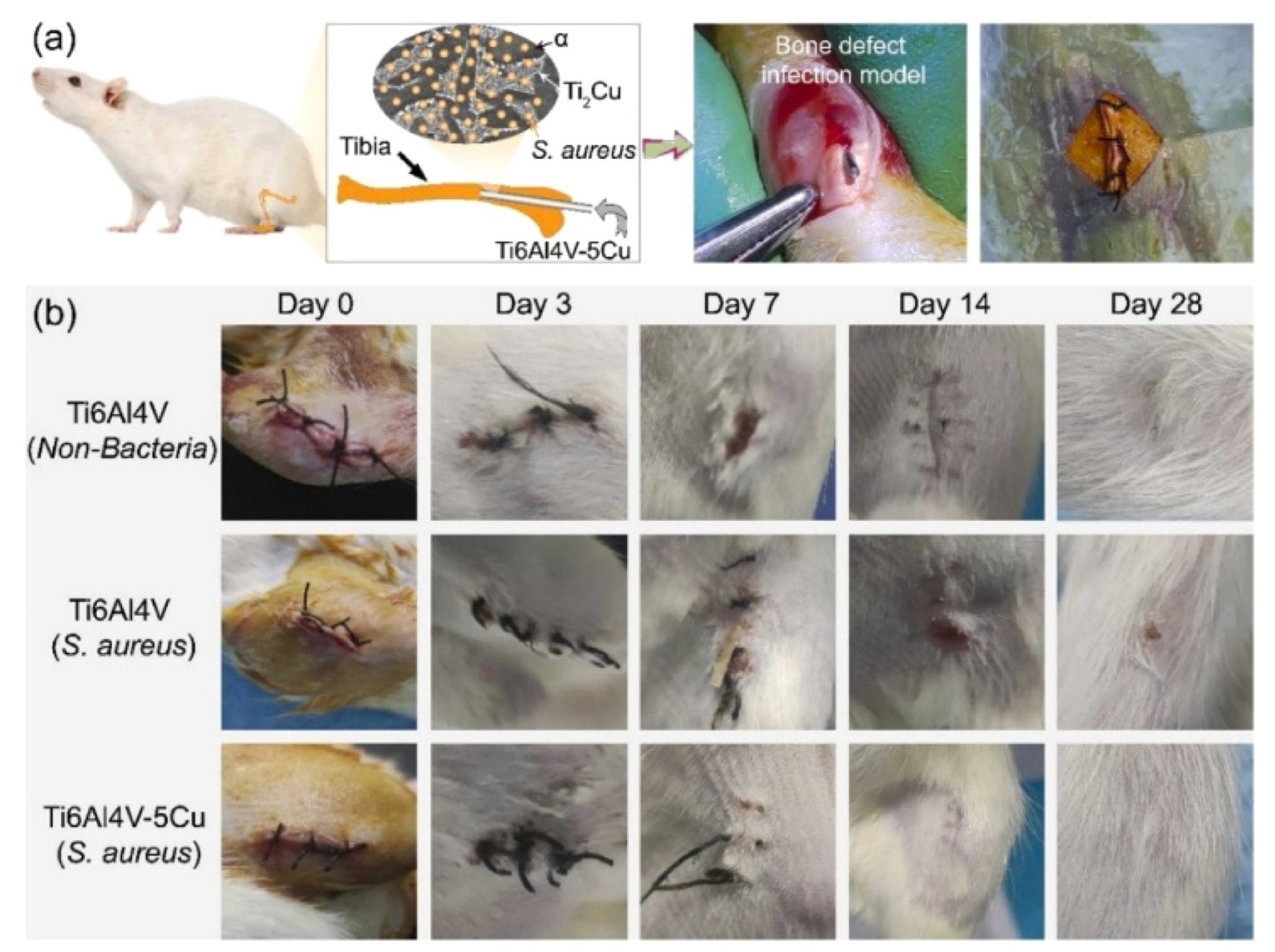
Fig. 12. (a) SD rat infection model, (b) General observation of wound healing at 0-28 days after implantation. (Adapted with permission from Ref. [13], copyright Elsevier 2025).
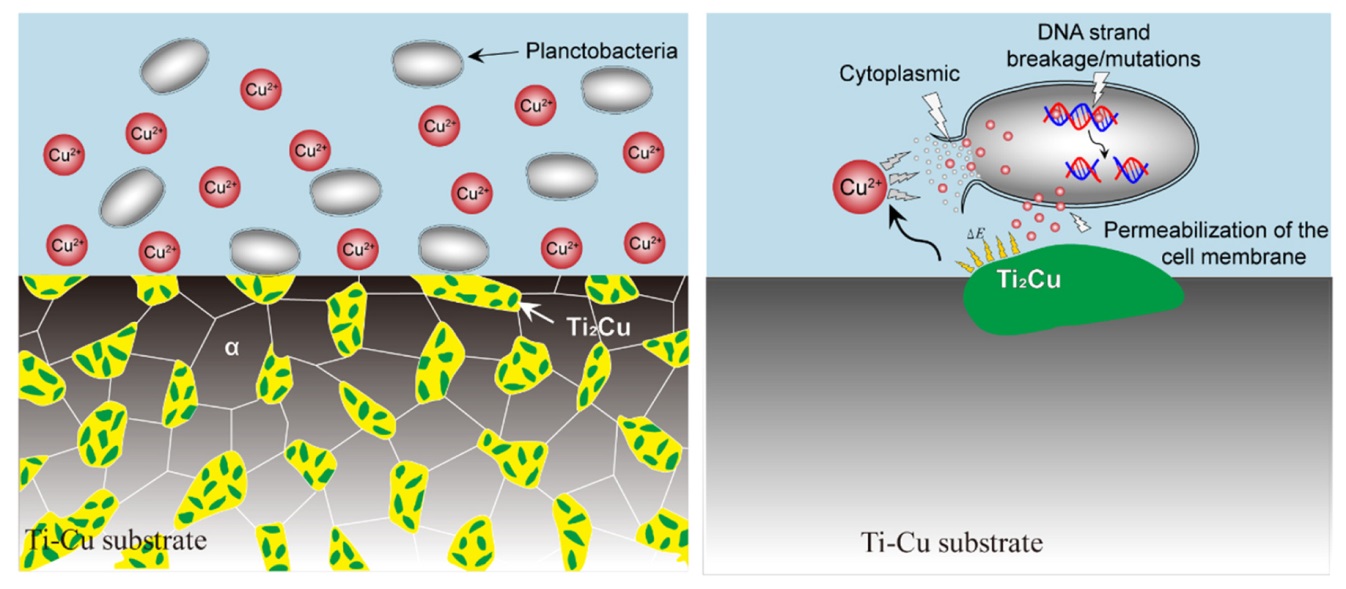
Fig. 13. Antibacterial mechanism of Ti-Cu alloy.

Fig. 14. (a) Fluorescence images of cytoskeletal staining of BMSC, and (b) live and dead cells on Ti6Al4V-xCu alloy after culturing for 1 week. (Adapted with permission from Ref. [13], copyright Elsevier 2025).
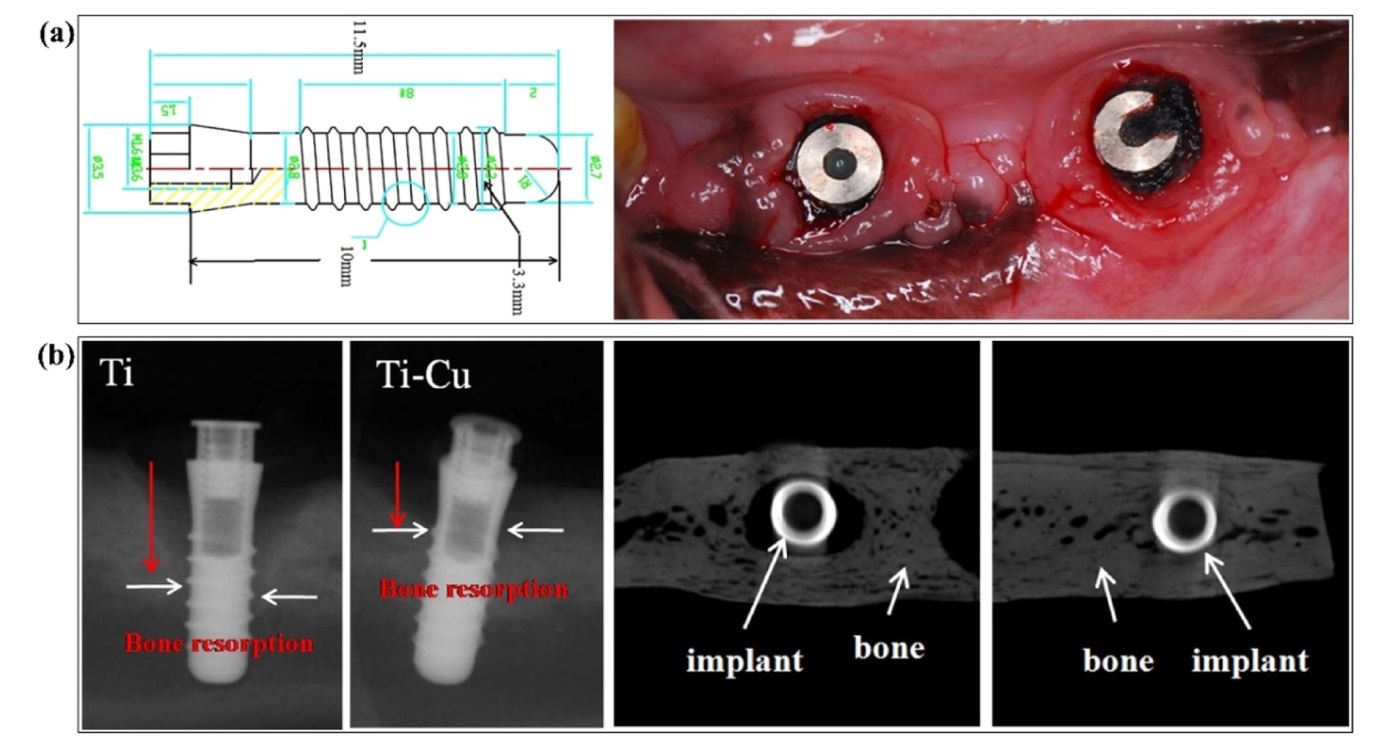
Fig. 15. (a) Experimental design of implantation in dog mandible diagram, (b) X-ray images of implant bone levels at 3 months. (Adapted with permission from Ref. [122], copyright Elsevier 2018).
| [1] |
A. Jacobs, G. Renaudin, C. Forestier, J.M. Nedelec, S. Descamps, Acta Biomater. 117 (2020) 21-39.
DOI URL |
| [2] |
Q. Chen, G.A. Thouas, Mater. Sci. Eng. R 87 (2015) 1-57.
DOI URL |
| [3] |
L. Xie, H. Sun, Y. Wen, L. Hua, L.C. Zhang, Prog. Mater. Sci. 153 (2025) 101488.
DOI URL |
| [4] |
Y. Li, D. Jiang, R. Zhu, C. Yang, L. Wang, L.C. Zhang, Int. J. Extrem. Manuf. 7 (2025) 022002.
DOI |
| [5] |
R.O. Darouiche, N. Engl. J. Med. 350 (2004) 1422-1429.
DOI URL |
| [6] |
W. Zimmerli, A. Trampuz, P.E. Ochsner, N. Engl. J. Med. 351 (2004) 1645-1654.
DOI URL |
| [7] |
C. Otto-Lambertz, A. Yagdiran, F. Wallscheid, P. Eysel, N. Jung, Dtsch. Arztebl. Int. 114 (2017) 347-353.
DOI PMID |
| [8] |
P. Izakovicova, O. Borens, A. Trampuz, EFORT Open Rev. 4 (2019) 482-494.
DOI PMID |
| [9] |
K. Ohyama, Y. Matsumoto, H. Amamizu, H. Uzuka, K. Nishimiya, S. Morosawa, M. Hirano, H. Watabe, Y. Funaki, S. Miyata, J. Takahashi, K. Ito, H. Shimokawa, Arterioscler. Thromb. Vasc. Biol. 37 (2017) 1757-1764.
DOI URL |
| [10] |
K.Y. Lee, D.J. Mooney, Chem. Rev. 101 (2001) 1869-1879.
DOI PMID |
| [11] |
T. Hoare, J. Santamaria, G.F. Goya, S. Irusta, D. Lin, S. Lau, R. Padera, R. Langer, D.S. Kohane, Nano Lett. 9 (2009) 3651-3657.
DOI PMID |
| [12] |
G.B. Hwang, K. Page, A. Patir, S.P. Nair, E. Allan, I.P. Parkin, ACS Nano 12 (2018) 6050-6058.
DOI URL |
| [13] |
K.M. Li, P. Li, J.J. Yang, C. Deng, L.C. Zhang, W. Li, Y. Lu, L. Chen, S.F. Zhou, J. Alloys Compd. 1030 (2025) 180893.
DOI URL |
| [14] |
J. Li, D. Zhang, X. Chen, D. Xu, D. Qiu, F. Wang, M. Easton, J. Mater. Sci. Technol. 166 (2023) 21-33.
DOI URL |
| [15] |
Z. Ma, L. Ren, R. Liu, K. Yang, Y. Zhang, Z. Liao, W. Liu, M. Qi, R.D.K. Misra, J. Mater. Sci. Technol. 31 (2015) 723-732.
DOI URL |
| [16] |
X. Zhang, C. Yang, K. Yang, ACS Appl. Mater. Interfaces 12 (2020) 361-372.
DOI URL |
| [17] |
Z. Yuan, Y. He, C. Lin, P. Liu, K. Cai, J. Mater. Sci. Technol. 78 (2021) 51-67.
DOI URL |
| [18] | S. Wang, J. Tan, H. Zhang, S. Guan, Y. Zeng, X. Nie, H. Zhu, S. Qian, X. Liu, Bioact. Mater. 48 (2025) 458-473. |
| [19] |
Z. Yuan, P. Liu, Y. Hao, Y. Ding, K. Cai, Colloids Surf. B 171 (2018) 597-605.
DOI URL |
| [20] | T. Shirai, H. Tsuchiya, T. Shimizu, K. Ohtani, Y. Zen, K. Tomita, J. Biomed. Mater. Res. B 91 (2009) 373-379. |
| [21] |
Z. Zheng, J. Chen, P. Yu, P. Tian, H. Wang, S. Wu, F. Cheng, Mater. Sci. Eng. A 927 (2025) 147973.
DOI URL |
| [22] |
Z. Lin, K. Song, Z. Zhu, K. Guo, W. Ya, J. Xiao, X. Yu, Mater. Sci. Eng. A 887 (2023) 145750.
DOI URL |
| [23] |
K. Li, J. Yang, Y. Yi, X. Liu, Y. Liu, L.C. Zhang, W. Zhang, W. Li, D. Chen, S. Zhou, Acta Mater. 256 (2023) 119112.
DOI URL |
| [24] |
J. Li, X. Ouyang, D. Li, H. Yu, Y. Mao, Q. Jia, Z. Zhang, M. Zhang, C. Bai, F. Wang, D. Xu, J. Mater. Sci. Technol. 222 (2025) 315-330.
DOI URL |
| [25] |
Q. Wang, K. Zhang, W. Niu, J. Alloys Compd. 885 (2021) 161032.
DOI URL |
| [26] |
J. Jin, H. Yang, Y. Liu, J. Yang, K. Li, Y. Yi, D. Chen, W. Zhang, S. Zhou, Mater. Sci. Eng. A 890 (2024) 145889.
DOI URL |
| [27] |
M. Lu, Z. Zhang, J. Zhang, X. Wang, G. Qin, E. Zhang, Surf. Coat. Technol. 421 (2021) 127478.
DOI URL |
| [28] | J.B. Park, R.S. Lakes, Biomaterials: An Introduction, Third ed., Springer, New York, 2010, pp. 2-13. |
| [29] | Y. Gao, W. Jiang, D. Zeng, X. Liang, C. Ma, W. Xiao, Rev. Mater. Res. 1 (2025) 100011. |
| [30] |
E. Karamian, M.R. Kalantar Motamedi, A. Khandan, P. Soltani, S. Maghsoudi, Prog. Nat. Sci.: Mater. Int. 24 (2014) 150-156.
DOI URL |
| [31] |
K.J. Bundy, M. Marek, R.F. Hochman, J. Biomed. Mater. Res. 17 (1983) 467-487.
DOI URL |
| [32] |
Y.S. Al Jabbari, J. Adv. Prosthodont. 6 (2014) 138-145.
DOI URL |
| [33] |
M. Geetha, A.K. Singh, R. Asokamani, A.K. Gogia, Prog. Mater. Sci. 54 (2009) 397-425.
DOI URL |
| [34] |
D.B. McGregor, R.A. Baan, C. Partensky, J.M. Rice, J.D. Wilbourn, Eur. J. Cancer 36 (2000) 307-313.
PMID |
| [35] |
E.J. Evans, I.T. Thomas, Biomater. 7 (1986) 25-29.
DOI URL |
| [36] |
B.M. Long, H.J. Rack, Biomater. 19 (1998) 1621-1716.
DOI URL |
| [37] |
X. Wang, P. Qin, H. Sun, L.C. Zhang, Adv. Eng. Mater. 26 (2024) 2300526.
DOI URL |
| [38] |
F. Yang, K.M. Li, X.J. Liu, H. Sun, C.P. Wang, Rare Met. 42 (2022) 651-663.
DOI URL |
| [39] |
K.M. Li, Y.J. Liu, X.C. Liu, X. Wu, S.F. Zhou, L.C. Zhang, W. Li, W.C. Zhang, Mater. Des. 215 (2022) 110491.
DOI URL |
| [40] |
H. Beladi, Q. Chao, G.S. Rohrer, Acta Mater. 80 (2014) 478-489.
DOI URL |
| [41] |
R. Ummethala, P.S. Karamched, S. Rathinavelu, N. Singh, A. Aggarwal, K. Sun, E. Ivanov, L. Kollo, I. Okulov, J. Eckert, K.G. Prashanth, Materialia 14 (2020) 100941.
DOI URL |
| [42] |
X. Zhao, M. Niinomi, M. Nakai, J. Hieda, Acta Biomater. 8 (2012) 1990-1997.
DOI URL |
| [43] |
X. Zhao, M. Niinomi, M. Nakai, G. Miyamoto, T. Furuhara, Acta Biomater. 7 (2011) 3230-3236.
DOI URL |
| [44] |
P. Mohan, A.B. Elshalakany, T.A. Osman, V. Amigo, A. Mohamed, J. Alloys Compd. 729 (2017) 1215-1225.
DOI URL |
| [45] |
Y. Zhuang, L. Ren, S. Zhang, X. Wei, K. Yang, K. Dai, Acta Biomater. 119 (2021) 472-484.
DOI PMID |
| [46] | E. Zhang, X. Zhao, J. Hu, R. Wang, S. Fu, G. Qin, Bioact. Mater. 6 (2021) 2569-2612. |
| [47] |
A. Shi, C. Zhu, S. Fu, R. Wang, G. Qin, D. Chen, E. Zhang, Mater. Sci. Eng. C 109 (2020) 110548.
DOI URL |
| [48] | P. Mahmoudi, M.R. Akbarpour, H.B. Lakeh, F. Jing, M.R. Hadidi, B. Akhavan, Mater. Today Bio 17 (2022) 100447. |
| [49] |
X. Tong, Y. Han, R. Zhou, W. Jiang, L. Zhu, Y. Li, S. Huang, J. Ma, C. Wen, J. Lin, Acta Biomater. 155 (2023) 684-702.
DOI URL |
| [50] |
I.F. Scheiber, J.F. Mercer, R. Dringen, Prog. Neurobiol. 116 (2014) 33-57.
DOI PMID |
| [51] |
M. Bost, S. Houdart, M. Oberli, E. Kalonji, J.F. Huneau, I. Margaritis, J. Trace Elem. Med. Biol. 35 (2016) 107-115.
DOI URL |
| [52] | S.M. Burwell, T.J. Vilsack, Health and Health and Human Service Dietary Guidelines for Americans 2015-2020, 2016, https://odphp.health.gov/dietaryguidelines/2015/guidelines/, January 7, 2016. |
| [53] | T. Tsang, C.I. Davis, D.C. Brady, Curr. Biol. 31 (2021) R421-R427. |
| [54] |
I. Burghardt, F. Lüthen, C. Prinz, B. Kreikemeyer, C. Zietz, H.G. Neumann, J. Rychly, Biomaterials 44 (2015) 36-44.
DOI PMID |
| [55] |
F. Heidenau, W. Mittelmeier, R. Detsch, M. Haenle, H. Gollwitzer, J. Mater. Sci.: Mater. Med. 16 (2005) 883-888.
DOI URL |
| [56] |
L. Kun, I.L. Wang, L.M. Tam, K.H. Lo, R. Li, C.W. Chan, V.A.M. Cristino, C.T. Kwok, Mater. Des. 254 (2025) 114110.
DOI URL |
| [57] | M. Bao, Y. Liu, X. Wang, L. Yang, S. Li, J. Ren, G. Qin, E. Zhang, Bioact. Mater. 3 (2018) 28-38. |
| [58] |
L. Ren, K. Memarzadeh, S. Zhang, Z. Sun, C. Yang, G. Ren, R.P. Allaker, K. Yang, Mater. Sci. Eng. C 67 (2016) 461-467.
DOI URL |
| [59] |
E. Zhang, F. Li, H. Wang, J. Liu, C. Wang, M. Li, K. Yang, Mater. Sci. Eng. C 33 (2013) 4280-4287.
DOI URL |
| [60] |
L. Ren, Z. Ma, M. Li, Y. Zhang, W. Liu, Z. Liao, K. Yang, J. Mater. Sci. Technol. 30 (2014) 699-705.
DOI URL |
| [61] |
A. Joukainen, N. Grant, C. Floe, JOM 4 (1952) 766-770.
DOI URL |
| [62] |
M.R. Akbarpour, H.M. Mirabad, A. Hemmati, H.S. Kim, Prog. Mater. Sci. 127 (2022) 100933.
DOI URL |
| [63] | L.C. Zhang, Y.H. Li, High-performance Titanium Alloys and Lattice Structures, Cambridge Scholars Publishing, United Kingdom, 2025, pp. 150-186. |
| [64] | J.L. Murray, Bull. Alloys Phase Diagr. 4 (1983) 81-95. |
| [65] |
H. Mats, Metall. Mater. Trans. B 3 (1972) 2729-2741.
DOI URL |
| [66] |
H. Donthula, B. Vishwanadh, T. Alam, T. Borkar, R.J. Contieri, R. Caram, R. Banerjee, R. Tewari, G.K. Dey, S. Banerjee, Acta Mater. 168 (2019) 63-75.
DOI |
| [67] |
E. Zhang, S. Li, J. Ren, L. Zhang, Y. Han, Mater. Sci. Eng. C 69 (2016) 760-768.
DOI URL |
| [68] |
K.N. Campo, E.S.N. Lopes, C.J. Parrish, R. Caram, Acta Mater. 139 (2017) 86-95.
DOI URL |
| [69] |
C.G. Rhodes, J.C. Williams, Metall. Trans. A 6 (1975) 2103-2114.
DOI URL |
| [70] |
A. Jacobs, G. Renaudin, C. Forestier, J.M. Nedelec, S. Descamps, Acta Biomater. 117 (2020) 21-39.
DOI URL |
| [71] |
Y.W. Cui, L. Wang, L.C. Zhang, Prog. Mater. Sci. 144 (2024) 101277.
DOI URL |
| [72] |
M.R. Akbarpour, F.A. Hesari, Mater. Res. Express 3 (2016) 045004.
DOI URL |
| [73] |
J. Jin, S. Zhou, H. Yang, J. Yang, Z. Zhang, B. Guo, L.C. Zhang, Int. J. Extrem. Manuf. 7 (2025) 065003.
DOI |
| [74] |
H.M. Mirabad, M.R. Akbarpour, F. Gazani, A.A. Chadegani, I. Khezri, A. Mirzamohammad, H. Damghani, O. Elahi, M.N. Khameneh, H.S. Kim, J. Mater. Res. Technol. 37 (2025) 3155-3181.
DOI URL |
| [75] |
L.Y. Chen, P. Qin, L. Zhang, L.C. Zhang, Int. J. Extrem. Manuf. 6 (2024) 052006.
DOI |
| [76] |
K. Sun, Z. Liu, F. Wang, K. Yao, B. Miao, S. Zheng, J. Alloys Compd. 1013 (2025) 178580.
DOI URL |
| [77] |
Y.Y. Wu, J. Zhou, G.L. Han, Y. Wen, Z. Wang, L.Q. Wang, W.J. Lv, L.C. Xie, L. Hua, Rare Met. 43 (2024) 2805-2818.
DOI URL |
| [78] |
Z. Wang, Y. Huo, Y. Qin, R. Guo, J. Zhang, C. Zhang, M. Cheng, L. Zhang, C. Cai, Y. Shi, J. Mater. Res. Technol. 31 (2024) 810-820.
DOI URL |
| [79] |
J.W. Sim, J.H. Kim, C.H. Park, J.K. Hong, J.T. Yeom, S.W. Lee, J. Alloys Compd. 926 (2022) 166823.
DOI URL |
| [80] | M. Zhou, H. Sun, Y. Gan, C. Ji, Y. Chen, Y. Lu, J. Lin, Q. Wang, Acta Metall. Sin.- Engl. Lett.. 36 (2023) 1979-1998. |
| [81] | S.K. Kolawole, L. Ren, M.A. Siddiqui, I. Ullah, H. Wang, S. Zhang, J. Zhang, K. Yang, Acta Metall. Sin.-Engl. Lett. 35 (2022) 304-316. |
| [82] | S.K. Yeshanew, C. Bai, Q. Jia, T. Xi, Z. Zhang, D. Li, Z. Xia, R. Yang, K. Yang, Acta Metall. Sin.-Engl. Lett. 36 (2023) 1261-1280. |
| [83] |
A.O.F. Hayama, P.N. Andrade, A. Cremasco, R.J. Contieri, C.R.M. Afonso, R. Caram, Mater. Des. 55 (2014) 1006-1013.
DOI URL |
| [84] |
C. Peng, Y. Liu, H. Liu, S. Zhang, C. Bai, Y. Wan, L. Ren, K. Yang, J. Mater. Sci. Technol. 35 (2019) 2121-2131.
DOI |
| [85] |
J. Yu, C. Fu, Y. Liu, K. Xia, U. Aydemir, T.C. Chasapis, G.J. Snyder, X. Zhao, T. Zhu, Adv. Energy Mater. 8 (2017) 1701313.
DOI URL |
| [86] |
M. Li, Z. Zhu, S. Xu, S. Pan, F. Zhang, G. Li, K. Ming, J. Cheng, L. Yang, Q. Fan, X. Cheng, J. Alloys Compd. 1026 (2025) 180467.
DOI URL |
| [87] |
J. Liu, F. Li, C. Liu, H. Wang, B. Ren, K. Yang, E. Zhang, Mater. Sci. Eng. C 35 (2014) 392-400.
DOI URL |
| [88] |
M.R. Akbarpour, S.M. Javadhesari, JOM 72 (2020) 3262-3268.
DOI |
| [89] |
R. Suárez-Martínez, J. Pérez-Alvarez, D. Bravo-Barcenas, O. Jimenez, M. A. Gonzalez, D. Carrillo-Nieves, R. Garcia-Varela, J. Chavez, J. Mater. Res. Technol. 31 (2024) 1655-1664.
DOI URL |
| [90] |
S. Ma, X. Hu, C. Liu, S. Qiu, M. Song, J. Alloys Compd. 970 (2024) 172568.
DOI URL |
| [91] |
T.W. Kim, D.H. Kim, Y.T. Cho, C.M. Lee, J. Mater. Res. Technol. 28 (2024) 1810-1823.
DOI URL |
| [92] |
E. Zhang, J. Ren, S. Li, L. Yang, G. Qin, Biomed. Mater. 11 (2016) 065001.
DOI URL |
| [93] |
C. Liu, H. Wang, J. Zhou, Y. Wen, L. Xie, L. Wang, L. Hua, Virtual Phys. Prototyp. 20 (2025) e2449174.
DOI URL |
| [94] |
H. Liu, X. Zhang, L. Shi, Y. Hong, H. Yao, L. Ren, K. Yang, J. Mater. Res. Technol. 30 (2024) 8992-8998.
DOI URL |
| [95] |
H. Wang, C. Yu, S. Wang, Z. Tian, J. Xu, J. Chen, H. Lu, B. Xu, Z. Yu, J. Chen, Mater. Sci. Eng. A 901 (2024) 146532.
DOI URL |
| [96] |
J. Han, G. Zhang, X. Chen, Y. Cai, Z. Luo, X. Zhang, Y. Su, Y. Tian, J. Mater. Process. Technol. 310 (2022) 117759.
DOI URL |
| [97] |
I. Polozov, V. Nefyodova, A. Zolotarev, V. Sokolova, A. Gracheva, A. Popovich, J. Alloys Compd. 1035 (2025) 181587.
DOI URL |
| [98] |
J. Li, S. Liu, B. Ma, D. Chen, X. Lei, R. Li, Y. Qin, D. Li, Mater. Des. 243 (2024) 113088.
DOI URL |
| [99] |
J.F. Archard, J. Appl. Phys. 24 (1953) 981-988.
DOI URL |
| [100] |
X.D. Liang, X.G. Zhang, W.Q. Wang, J.W. Liang, X.H. Zhao, M.Q. Liu, S.Y. Du, Z.H. Zhang, J. Mater. Res. Technol. 35 (2025) 5242-5259.
DOI URL |
| [101] |
H. Yu, W. Bin, Z. Jiang, T. Sun, Y. Yang, M. Song, B. Guo, W. Li, Z. Yu, J. Alloys Compd. 1036 (2025) 181716.
DOI URL |
| [102] |
F. Yu, H. Wang, G. Yuan, X. Shu, Appl. Phys. A 123 (2017) 278.
DOI URL |
| [103] |
R. Dong, W. Zhu, C. Zhao, Y. Zhang, F. Ren, Metall. Mater. Trans. A 49 (2018) 6147-6160.
DOI |
| [104] |
J. Ju, R. Zan, Z. Shen, C. Wang, P. Peng, J. Wang, B. Sun, B. Xiao, Q. Li, S. Liu, T. Yang, Chem. Eng. J. 471 (2023) 144656.
DOI URL |
| [105] |
Q. Gu, Z. Zhang, H. Zhou, D. Wang, Y. Gu, B. Zhao, L. Yan, T. Chen, L. Chen, Mater. Des. 254 (2025) 114093.
DOI URL |
| [106] |
H. Yu, W. Liang, Q. Miao, M. Yin, H. Chen, W. Yao, Y. Sun, K. Zang, X. Gao, Y. Song, Wear 523 (2023) 204789.
DOI URL |
| [107] |
H. Gong, C. Yu, L. Zhang, G. Xie, D. Guo, J. Luo, Compos. Part B 202 (2020) 108450.
DOI URL |
| [108] | L. Liu, Y. Li, F.H. Wang, Acta Metall. Sin. 50 (2014) 212-218. |
| [109] |
J. Xing, Z. Xia, J. Hu, Y. Zhang, L. Zhong, Corros. Sci. 75 (2013) 212-219.
DOI URL |
| [110] |
X. Wang, P. Qin, L.Y. Chen, H. Sun, L.C. Zhang, Corros. Sci. 221 (2023) 111336.
DOI URL |
| [111] |
J. Wang, S. Zhang, Z. Sun, H. Wang, L. Ren, K. Yang, J. Mater. Sci. Technol. 35 (2019) 2336-2344.
DOI URL |
| [112] |
H. Li, Z. Cai, X. An, J. Zhang, B. Chen, W. Yao, Q. Wang, Q. Kong, Mater. Chem. Phys. 344 (2025) 131165.
DOI URL |
| [113] |
Z. Wang, J. Xu, S. Yu, G. Xu, C. Tang, J. Alloys Compd. 1009 (2024) 176981.
DOI URL |
| [114] |
S.F. Jawed, C.D. Rabadia, Y.J. Liu, L.Q. Wang, P. Qin, Y.H. Li, X.H. Zhang, L. C. Zhang, Mater. Sci. Eng. C 110 (2020) 110728.
DOI URL |
| [115] |
X. Liu, S. Chen, J. Zhang, G. Yang, Y. Zhang, T. Wang, J. Lei, Corros. Sci. 221 (2023) 111343.
DOI URL |
| [116] |
P. Qin, L.Y. Chen, C.H. Zhao, Y.J. Liu, C.D. Cao, H. Sun, L.C. Zhang, Corros. Sci. 189 (2021) 109609.
DOI URL |
| [117] |
A. Shi, D. Cai, J. Hu, X. Zhao, G. Qin, Y. Han, E. Zhang, Mater. Sci. Eng. C 126 (2021) 112116.
DOI URL |
| [118] |
R.D. Luo, Y.X. Yuan, J.K. Ren, F. Li, Y.J. Yang, Z.Y. He, Y.H. Jiang, J. Alloys Compd. 945 (2023) 169323.
DOI URL |
| [119] |
W.L. Du, S.S. Niu, Y.L. Xu, Z.R. Xu, C.L. Fan, Carbohydr. Polym. 75 (2009) 385-389.
DOI URL |
| [120] |
E. Zhang, L. Zheng, J. Liu, B. Bai, C. Liu, Mater. Sci. Eng. C 46 (2015) 148-157.
DOI URL |
| [121] |
X. Wang, H. Dong, J. Liu, G. Qin, D. Chen, E. Zhang, Mater. Sci. Eng. C 100 (2019) 38-47.
DOI URL |
| [122] |
R. Liu, Y. Tang, L. Zeng, Y. Zhao, Z. Ma, Z. Sun, L. Xiang, L. Ren, K. Yang, Dent. Mater. 34 (2018) 1112-1126.
DOI URL |
| [123] | H. Liu, Y. Tang, S. Zhang, H. Liu, Z. Wang, Y. Li, X. Wang, L. Ren, K. Yang, L. Qin, Bioact. Mater. 8 (2022) 381-395. |
| [124] |
M. Godoy-Gallardo, U. Eckhard, L.M. Delgado, Y.J.D. de Roo Puente, M. Hoyos- Nogues, F.J. Gil, R.A. Perez, Bioact. Mater. 6 (2021) 4470-4490.
DOI PMID |
| [125] |
W. Abd-Elaziem, M.A. Darwish, A. Hamada, W.M. Daoush, Mater. Des. 241 (2024) 112850.
DOI URL |
| [126] |
E. Zhang, X. Wang, M. Chen, B. Hou, Mater. Sci. Eng. C 69 (2016) 1210-1221.
DOI URL |
| [1] | Shang Zhao, Zhaolin Wang, Mingliang Wang, Zeyu Ding, Yiping Lu. A critical review of advances and application prospects of soft magnetic high entropy alloys [J]. Metals Advances, 2026, 40(2): 1-7. |
| [2] | Wei-Peng Chen, Jia-Qi Pei, Hua Hou, Yu-Hong Zhao. Phase-field simulation of α-Mg dendrite growth in magnesium alloys: A review [J]. Metals Advances, 2026, 40(2): 48-61. |
| [3] | Peng Han, Wen Wang, Jun Cai, Jia Lin, Hubin Yang, Qianzhi Ma, Feng Gao, Ke Qiao, Fengming Qiang, Kuaishe Wang. Excellent superplasticity for lamellar microstructure in nugget of a double-sided friction stir welded Ti-4.5Al-3V-2Mo-2Fe alloy joint [J]. Metals Advances, 2026, 40(2): 110-123. |
| [4] | Lei Qin, Shengfeng Zhou, Jianbo Jin, Huan Yang, Kunmao Li, Cheng Deng, Yujie Yuan, Seyed Reza Elmi Hosseini, Lai-Chang Zhang. Effect of molybdenum content on the microstructure and tribological properties of Ti-Nb-Cu alloys produced by LPBF additive manufacturing [J]. Metals Advances, 2026, 39(1): 13-25. |
| [5] | X.L. Wang, J.Y. Li, Q.S. Mei. Recent progress in Zn matrix composites for biomedical applications [J]. Metals Advances, 2026, 39(1): 26-37. |
| [6] | B. M. Shi, Y. T. Pang, B. H. Shan, B. B. Wang, Y. Liu, P. Xue, J. F. Zhang, Y. N. Zan, Q. Z. Wang, B. L. Xiao, Z. Y. Ma. Microstructure Evolution and Fracture Behavior of (B4C+Al2O3)/Al Friction Stir Welded Joints [J]. Acta Metallurgica Sinica (English Letters), 2025, 38(9): 1513-1526. |
| [7] | H. Q. Dai, N. Li, L. H. Wu, J. Wang, P. Xue, F. C. Liu, D. R. Ni, B. L. Xiao, Z. Y. Ma. Low-Temperature Superplastic Deformation Behavior of Bimodal Microstructure of Friction Stir Processed Ti-6Al-4V Alloy [J]. Acta Metallurgica Sinica (English Letters), 2025, 38(9): 1559-1569. |
| [8] | Shuyi Ren, Jiao Li, Kai Wu, Xiaoge Li, Yaqiang Wang, Jinyu Zhang, Gang Liu, Jun Sun. Thermal Stability and Mechanical Properties of Nanotwinned Ni-W Alloyed Films [J]. Acta Metallurgica Sinica (English Letters), 2025, 38(9): 1570-1582. |
| [9] | Biao Zhang, Yuntian Du, Huishuang Jia, Yuanyi Zhou, Liguang Wang, Minghe Zhang, Yunli Feng, Weimin Gao, Ning Xu. Hot Deformation Behavior of CoNiV Medium-Entropy Alloy: Constitutive Model, Convolutional Neural Network, Hot Processing Map, and Microstructure Evolution [J]. Acta Metallurgica Sinica (English Letters), 2025, 38(8): 1275-1292. |
| [10] | F. S. Li, L. H. Wu, Y. Kan, H. B. Zhao, D. R. Ni, P. Xue, B. L. Xiao, Z. Y. Ma. Microstructure Evolution and Fracture Mechanisms in Electron Beam Welded Joint of Ti-6Al-4V ELI Alloy Ultra-thick Plates [J]. Acta Metallurgica Sinica (English Letters), 2025, 38(8): 1317-1330. |
| [11] | Haoran Pang, Liwei Lu, Gongji Yang, Xiaojun Wang, Wen Wang, Hua Zhang, Yujuan Wu. Amelioration of Mechanical Properties of Rolled Mg-4.5Al-2.5Zn Alloy by Cryogenic Cycling Treatment [J]. Acta Metallurgica Sinica (English Letters), 2025, 38(8): 1436-1452. |
| [12] | Qi Zhou, Yufeng Xia, Yu Duan, Baihao Zhang, Yuqiu Ye, Peitao Guo, Lu Li. Microstructure and Mechanical Properties of Yb-Containing AZ80 Cast Alloys [J]. Acta Metallurgica Sinica (English Letters), 2025, 38(7): 1095-1108. |
| [13] | Xu Yue, Zhiyong Chen, Wei Chen, Qingjiang Wang. Hot Deformation Behavior and Processing Map of a Novel Ti750s High-Temperature Titanium Alloy [J]. Acta Metallurgica Sinica (English Letters), 2025, 38(7): 1174-1194. |
| [14] | Mengjun Chen, Tingping Hou, Shi Cheng, Feng Hu, Tao Yu, Xianming Pan, Yuanyuan Li, Kaiming Wu. A Comprehensive Exploration of the Relationship between Microstructure Optimization and Strength Enhancement in Low-Density 5Al-5Mn Steel [J]. Acta Metallurgica Sinica (English Letters), 2025, 38(7): 1219-1236. |
| [15] | Wangjian Yu, Rui Hu, Guoqiang Shang, Xian Luo, Hong Wang. Correlation Mechanism Between Microstructure and Fatigue Crack Propagation Behavior of Ti-Mo-Cr-V-Nb-Al Titanium Alloys [J]. Acta Metallurgica Sinica (English Letters), 2025, 38(6): 981-1002. |
| Viewed | ||||||
|
Full text |
|
|||||
|
Abstract |
|
|||||
 WeChat
