
Metals Advances ›› 2026, Vol. 46: 34-49.DOI: 10.1016/j.metadv.2026.02.027
• Research Article • Previous Articles Next Articles
Zeyu Zhaoa, Zhibin Chenb, Hailong Shia,*( ), Jinhua Caoc, Xuejian Lia, Xiaoshi Huc, Xiaojun Wanga,*(), Weimin Gand, Xinghong Zhange
Received:2025-09-09
Revised:2025-12-05
Accepted:2026-01-13
Online:2026-08-10
Published:2026-03-03
Contact:
*E-mail addresses: hailongshi@hit.edu.cn (H. Shi),xjwang@hit.edu.cn (X. Wang).
Zeyu Zhao, Zhibin Chen, Hailong Shi, Jinhua Cao, Xuejian Li, Xiaoshi Hu, Xiaojun Wang, Weimin Gan, Xinghong Zhang. Synergistic enhancement of strength and ductility in Mg-Gd-Y-Zn-Zr alloys through LPSO phases with multiple morphologies[J]. Metals Advances, 2026, 46: 34-49.
Add to citation manager EndNote|Ris|BibTeX

Fig. 1. Schematic diagram of the homogenization and rolling process.

Fig. 2. Schematic diagrams of the tensile specimens: (a) mechanical property testing specimen, (b) in situ tensile testing specimen.

Fig. 3. Calculated phase diagrams under thermodynamic equilibrium conditions for the three alloy compositions: (a) Mg-3.1Gd-0.9Y-1.4Zn-0.3Zr, (b) Mg-5.1Gd-1.5Y-2.3Zn-0.3Zr, and (c) Mg-7.1Gd-2.1Y-3.2Zn-0.3Zr (wt%).

Fig. 4. Distribution of secondary phases in the initial microstructures of the three alloys: (a-d) 7%-LPSO alloy in as-cast and as-homogenized conditions; (e-h) 13%-LPSO alloy in as-cast and as-homogenized conditions; (i-l) 18%-LPSO alloy in as-cast and as-homogenized conditions.

Fig. 5. EDS elemental distribution of the 13%-LPSO alloy in as-cast and solution-treated states.

Fig. 6. Morphologies of secondary phases in the as-rolled alloys: (a) 7%-LPSO alloy, (b) 13%-LPSO alloy, (c) 18%-LPSO alloy, (d) W-phase present in the 7%-LPSO alloy, (e) bulk LPSO phase (B-LPSO) present in the 13%-LPSO and 18%-LPSO alloys, (f) intragranular LPSO phase (I-LPSO) and lamellar LPSO phase (L-LPSO) present in the 13%-LPSO alloy.

Fig. 7. Elemental composition in characteristic regions of the three as-rolled alloys: (a) 7%-LPSO alloy, (b) 13%-LPSO alloy, (c) 18%-LPSO alloy.

Fig. 8. EBSD results of the as-rolled 7%-LPSO, 13%-LPSO, and 18%-LPSO alloys on the ND×RD plane: (a–c) morphologies of secondary phases in the EBSD observation areas; (d–f) IPF maps of the three as-rolled alloys; (g–i) grain size distribution graphs of the three as-rolled alloys; (j–l) (0001) and ($10 \overline{1} 0$) pole figures of the three as-rolled alloys.

Fig. 9. (a-c) Grain boundary distribution maps and (d-f) twin boundary distribution maps of as-rolled 7%-, 13%-, and 18%-LPSO alloys.

Fig. 10. Tensile stress-strain curves of the three as-rolled alloys.

Fig. 11. Fracture surface morphologies after tensile testing of the as-rolled alloys: (a, d) 7%-LPSO, (b, e) 13%-LPSO, (c, f) 18%-LPSO.

Fig. 12. (a-h) Microstructures and (i-l) elemental distribution of the 13%-LPSO alloy sheets under different reductions during rolling: (a, e, i) as-rolled with 25% reduction; (b, f, j) annealed with 25% reduction; (c, g, k) as-rolled with 50% reduction; (d, h, l) annealed with 50% reduction.

Fig. 13. TEM images of a typical W-phase particle embedded within the α-Mg matrix after rolling: (a) dark-field TEM image; (b) high-resolution TEM image; (c) selected area electron diffraction figure of area A; (d) fast Fourier transform figure of area B; (e-i) energy-dispersive X-ray spectroscopy elemental mapping.

Fig. 14. TEM images of the residual W-phase and the newly formed LPSO phase along with their interface: (a) dark-field TEM image; (b) high-resolution TEM image; (c, d) EDS line scan profile across the interface.
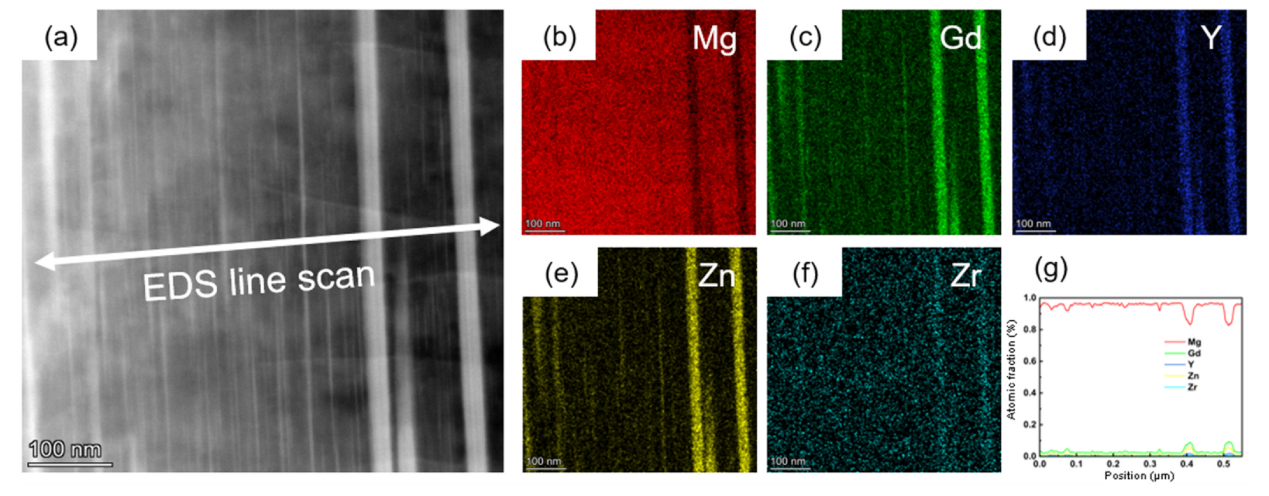
Fig. 15. TEM images of the lamellar LPSO phases: (a) dark-field TEM image; (b-g) energy-dispersive X-ray spectroscopy elemental mapping.

Fig. 16. Schematic diagrams of the secondary phase transformation process during (a) the early, (b) the middle, (c) the late stages of rolling.
| Item | Bulk LPSO phase (B-LPSO) | Intragranular lamellar LPSO phase (I-LPSO) | Lamellar LPSO phase (L-LPSO) |
|---|---|---|---|
| BSE morphology | High contrast, dense bulk, elongated along the RD | Low contrast, coarse lamellar | Relatively low contrast, dispersed elliptical lamellae |
| EDS composition | Alloying element content significantly higher than the Mg matrix; RE: Zn ≈ 2:1 (at.%) | Alloying element content slightly higher than the Mg matrix; RE:Zn ≈ 2:1 (at.%) | Alloying element content close to the Mg matrix due to the small size of the phases (statistical average) |
| Distribution | At grain boundaries, near undissolved particulate W-phase | Inside coarse deformed grains, interleaved with the Mg matrix | Dispersed at the grain boundaries of recrystallized grains |
| Formation process | Deformation-induced dissolution of the W-phase enriches alloying elements, leading to precipitation near grain boundaries; subsequent rolling elongates the phase along the RD. | Stacking faults generated during deformation act as sites for elemental segregation from the supersaturated solid solution, followed by coarsening. | Fragmentation and partial dissolution of coarse lamellar LPSO phases during deformation and recrystallization, followed by reprecipitation as fine lamellar phases. |
Table 1. Features of the LPSO phases with different morphology.
| Item | Bulk LPSO phase (B-LPSO) | Intragranular lamellar LPSO phase (I-LPSO) | Lamellar LPSO phase (L-LPSO) |
|---|---|---|---|
| BSE morphology | High contrast, dense bulk, elongated along the RD | Low contrast, coarse lamellar | Relatively low contrast, dispersed elliptical lamellae |
| EDS composition | Alloying element content significantly higher than the Mg matrix; RE: Zn ≈ 2:1 (at.%) | Alloying element content slightly higher than the Mg matrix; RE:Zn ≈ 2:1 (at.%) | Alloying element content close to the Mg matrix due to the small size of the phases (statistical average) |
| Distribution | At grain boundaries, near undissolved particulate W-phase | Inside coarse deformed grains, interleaved with the Mg matrix | Dispersed at the grain boundaries of recrystallized grains |
| Formation process | Deformation-induced dissolution of the W-phase enriches alloying elements, leading to precipitation near grain boundaries; subsequent rolling elongates the phase along the RD. | Stacking faults generated during deformation act as sites for elemental segregation from the supersaturated solid solution, followed by coarsening. | Fragmentation and partial dissolution of coarse lamellar LPSO phases during deformation and recrystallization, followed by reprecipitation as fine lamellar phases. |

Fig. 17. EBSD analysis of the as-rolled 7%-, 13%-, and 18%-LPSO alloys on the ND×RD plane: (a-c) KAM maps; (d-f) Schmid factor distributions for basal slip {0001} <11̅2̅0> along the RD direction; (g-i) Schmid factor distributions for prismatic slip {10̅1̅0} <11̅2̅0> along the RD direction.

Fig. 18. Initial microstructure and in-situ DIC-based local strain distribution of the as-rolled 13%-LPSO alloy under different tensile strains: (a) SEM image before tensile testing; (b) IPF map before tensile testing; (c) normal strain (εxx) distribution in the early deformation stage; (d) overall average strain and the local average strain values within the tested regions; (e, f) normal strain (εxx) distribution in the middle and late deformation stages.

Fig. 19. Surface morphologies of the sample under different deformation levels during in-situ tensile testing: (a) IPF map of the observed area; (b-f) surface morphologies at different deformation stages.

Fig. 20. Surface morphologies near the fracture area of the sample after in-situ tensile testing: (a) macroscopic morphology near the fracture zone; (b, c) local views of the fracture surface; (d-f) local regions containing LPSO phases with multiple morphologies near the fracture zone.
| [1] | S. Wei, X. Wang, X. Li, H. Shi, X. Hu, C. Xu, J. Magnes. Alloy. 13 (2025) 1536-1548. |
| [2] | Z. Zhu, I. Ayoub, J. He, J. Yang, H. Zhang, Z. Zhu, Q. Hao, Z. Cai, O. Ola, S.K. Tiwari, J. Magnes. Alloy. 13 (2025) 3524-3563. |
| [3] | X. Zhang, X. Wang, N. Turakhodjaevr, X. Li, H. Shi, Y. Zhang, X. Hu, C. Xu, J. Magnes. Alloy. (2024), https://doi.org/10.1016/j.jma.2024.10.010. |
| [4] |
H. Ovri, J. Markmann, J. Barthel, M. Kruth, H. Dieringa, E.T. Lilleodden, Acta Mater. 244 (2023) 118550.
DOI URL |
| [5] | X. Feng, X. Wang, C. Xu, X. Hu, H. Shi, X. Li, Z. Lu, J. Magnes. Alloy. 13 (2025) 5882-5896. |
| [6] |
Y. Kawamura, K. Hayashi, A. Inoue, T. Masumoto, Mater. Trans. 42 (2001) 1172-1176.
DOI URL |
| [7] |
S. Harjo, W. Gong, K. Aizawa, T. Kawasaki, M. Yamasaki, Acta Mater. 255 (2023) 119029.
DOI URL |
| [8] |
J. Zhou, H. Yang, B. Jiang, C. He, Z. Dong, L. Liu, X. Luo, Y. Liu, D. Huang, J. Xu, G. Huang, D. Zhang, F. Pan, Mater. Sci. Eng. A 866 (2023) 144638.
DOI URL |
| [9] |
K. Hagihara, Z. Li, M. Yamasaki, Y. Kawamura, T. Nakano, Acta Mater. 163 (2019) 226-239.
DOI |
| [10] |
S. Yamasaki, T. Tokuzumi, W. Li, M. Mitsuhara, K. Hagihara, T. Fujii, H. Nakashima, Acta Mater. 195 (2020) 25-34.
DOI |
| [11] |
T. Tokuzumi, M. Mitsuhara, S. Yamasaki, T. Inamura, T. Fujii, H. Nakashima, Acta Mater. 248 (2023) 118785.
DOI URL |
| [12] |
K. Li, Y. Zhuang, L. Zhao, D. Zhao, H. Zheng, S. Jia, Y. Zhang, P. Zhao, J. Gui, J. Wang, Scr. Mater. 210 (2022) 114392.
DOI URL |
| [13] |
K. Hagihara, T. Mayama, M. Yamasaki, S. Harjo, T. Tokunaga, K. Yamamoto, M. Sugita, K. Aoyama, W. Gong, S. Nishimoto, Int. J. Plast. 173 (2024) 103865.
DOI URL |
| [14] |
T. Mayama, S.R. Agnew, K. Hagihara, K. Kamura, K. Shiraishi, M. Yamasaki, Y. Kawamura, Int. J. Plast. 154 (2022) 103294.
DOI URL |
| [15] |
Y. Bai, B. Ye, J. Guo, L. Wang, X. Kong, W. Ding, Mater. Charact. 164 (2020) 110301.
DOI URL |
| [16] | X. Li, H. Shi, X. Li, W. Gan, C. Xu, C. Ding, S. Tursunbaev, N. Turakhodjaev, X. Hu, X. Wang, J. Magnes. Alloy. (2025), https://doi.org/10.1016/j.jma.2025.06.029. |
| [17] |
N. Ding, W. Du, X. Li, F. Lou, X. Du, S. Li, Z. Wang, J. Alloys Compd. 992 (2024) 174524.
DOI URL |
| [18] |
S. Yuan, J. Wang, L. Zhang, P. Jin, Mater. Sci. Eng. A 856 (2022) 144016.
DOI URL |
| [19] |
J.K. Kim, S. Sandlöbes, D. Raabe, Acta Mater. 82 (2015) 414-423.
DOI URL |
| [20] | R. Guo, X. Zhao, B. Hu, X. Tian, Q. Wang, Z. Zhang, Acta Metall. Sin. -Engl. Lett. 36 (2023) 1680-1698. |
| [21] | X. Wang, M. Li, Y. Huang, Y. Liu, C. Huang, J. Mater. Res. Technol. 26 (2023) 6121-6134. |
| [22] |
D. Kuriki, F. Briffod, T. Shiraiwa, M. Enoki, Acta Mater. 281 (2024) 120398.
DOI URL |
| [23] |
Q. Li, L. Jin, F. Wang, S. Dong, J. Zeng, F. Wang, J. Dong, Int. J. Plast. 190 (2025) 104367.
DOI URL |
| [24] | J. Zuo, T. Nakata, C. Xu, L. Geng, S. Kamado, Fundam. Res. (2024), https://doi.org/10.1016/j.fmre.2024.08.001. |
| [25] |
M. Matsuda, S. Ando, M. Nishida, Mater. Trans. 46 (2005) 361-364.
DOI URL |
| [26] |
J.K. Kim, S. Sandlöbes, D. Raabe, Acta Mater. 82 (2015) 414-423.
DOI URL |
| [27] |
Z. Nie, F. Wang, J. Li, C. Liu, C. Zhao, S. Sanandiya, M. Calvat, D. Anjaria, J. Zeng, S. Dong, F. Wang, L. Jin, J. Dong, J.C. Stinville, Int. J. Plast. 193 (2025) 104423.
DOI URL |
| [28] | Z. Peng, X. Shao, Z. Liang, D. Wang, L. Wang, X. Ma, J. Magnes. Alloy. 11 (2023) 1754-1768. |
| [29] |
K. Hagihara, T. Okamoto, H. Izuno, M. Yamasaki, M. Matsushita, T. Nakano, Y. Kawamura, Acta Mater. 109 (2016) 90-102.
DOI URL |
| [30] |
Y. Chen, J. Wang, W. Zheng, Q. Li, M. Yu, T. Ying, X. Zeng, Acta Mater. 263 (2024) 119521.
DOI URL |
| [31] | H. Liu, H. Huang, J. Sun, C. Wang, J. Bai, A. Ma, X. Chen, Acta Metall. Sin. -Engl. Lett. 32 (2019) 269-285. |
| [32] | H. Liao, J. Kim, T. Lee, J. Song, J. Peng, B. Jiang, F. Pan, J. Magnes. Alloy. 8 (2020) 1120-1127. |
| [33] |
Y. Jono, M. Yamasaki, Y. Kawamura, Acta Mater. 82 (2015) 198-211.
DOI URL |
| [34] | Q. Ren, J. Mi, J. Wang, S. Liang, Y. Feng, J. Magnes. Alloy. 11 (2023) 1754-1768. |
| [35] |
M. Chen, X. Tao, L. Wang, K. Ma, D. Zhang, Y. Li, S. Wei, Z. Zhang, Z. Zhao, P. Bai, J. Alloys Compd. 1005 (2024) 176176.
DOI URL |
| [36] |
C. Liu, Y. Yue, S. Ma, X. Gan, H. Chen, J. Nie, Acta Mater. 284 (2025) 120583.
DOI URL |
| [37] | X. Gu, T. Furuhara, L. Chen, P. Yang, Acta Metall. Sin. -Engl. Lett. 32 (2019) 187-193. |
| [38] |
Y. Zhu, M. Weyland, A.J. Morton, K. Oh-ishi, K. Hono, J. Nie, Scr. Mater. 60 (2009) 980-983.
DOI URL |
| [39] | B. Li, J. Wu, B. Teng, Acta Metall. Sin. -Engl. Lett. 34 (2021) 1051-1064. |
| [40] | S. Lee, Y. Park, J. Go, Y.M. Kim, S.S. Sohn, J. Li, P.P. Choi, J. Magnes. Alloy. 11 (2023) 2801-2810. |
| [41] | R. Guo, X. Zhao, B. Hu, X. Tian, Q. Wang, Z. Zhang, Acta Metall. Sin. -Engl. Lett. 36 (2023) 1680-1698. |
| [42] | Z. Yu, X. Xu, B. Du, K. Shi, K. Liu, S. Li, X. Han, T. Xiao, W. Du, Acta Metall. Sin. - Engl. Lett. 35 (2022) 596-608. |
| [43] |
Y. He, R. Guo, X. Zhao, Z. Zhang, J. Rare Earths 42 (2024) 2217-2230.
DOI URL |
| [44] |
Y. Han, Z. Chen, H. Chen, J. Huang, C. Liu, Metall. Mater. Trans. A 54 (2023) 4806-4824.
DOI |
| [1] | Jing-Xiang Zhao, Kun-Kun Deng, Yi-Jia Li, Cui-Ju Wang, Kai-Bo Nie, Yang Yu, Yan Bai. Effect of thermo-mechanical coupling on the microstructure and mechanical properties of as-rolled Mg-Zn-Gd-Y-Mn alloy [J]. Metals Advances, 2026, 45(7): 77-91. |
| [2] | Yutao Wang, Liming Fu, Shuo Ma, Wei Wang, Aidang Shan. A 2.6 GPa Ultra-Strong Steel with Ultrafine Lamellar Structure Produced by Heavy Warm Rolling [J]. Acta Metallurgica Sinica (English Letters), 2025, 38(9): 1613-1627. |
| [3] | Sen Ge, Ben Niu, Zhen-Hua Wang, Qian-Fu Pan, Chao-Hong Liu, Qing Wang. Recrystallization Behavior and Mechanical Property of a Medium-Si 12%Cr Reduced Activation Ferritic/Martensitic Steel Cladding Tube During the Manufacture [J]. Acta Metallurgica Sinica (English Letters), 2025, 38(8): 1385-1396. |
| [4] | Huimin Yang, Kun Yang, Guobing Wei, Rongguang Li. Optimization of Surface Layer Properties of Mg-9Li-1Zn Alloy by Ultrasonic Surface Rolling Process and its Impact on Corrosion Behavior [J]. Acta Metallurgica Sinica (English Letters), 2025, 38(8): 1421-1435. |
| [5] | Xu Yue, Zhiyong Chen, Wei Chen, Qingjiang Wang. Hot Deformation Behavior and Processing Map of a Novel Ti750s High-Temperature Titanium Alloy [J]. Acta Metallurgica Sinica (English Letters), 2025, 38(7): 1174-1194. |
| [6] | Dongfang Lou, Mingda Zhang, Yuping Ren, Hongxiao Li, Gaowu Qin. Fabrication of Zn-0.5Mn-0.05 Mg Micro-Tube with Suitable Strength and Ductility for Vascular Stent Application [J]. Acta Metallurgica Sinica (English Letters), 2025, 38(2): 327-337. |
| [7] | Qi-Mei Tian, Fu Xiao, Ya Yang, Yuan-Biao Tan, Song Xiang, Xuan-Ming Ji, Fei Zhao, Hui Yang. Achieving an Extraordinary Strength-Ductility Synchronization in TA15 Titanium Alloy via Tailoring a Tri-modal Microstructure [J]. Acta Metallurgica Sinica (English Letters), 2025, 38(12): 2228-2242. |
| [8] | Ming-Rong Fan, Tian-Yu Wang, Jing-Gang Suo, Ming-Kun Wang, Ying-Ying Feng, Zong-An Luo. Effect of Heat Treatment on Microstructure Evolution and Fracture Mechanism of 30CrMo/316L Multilayered Composites Fabricated by Vacuum Electron Beam Welding and Accumulative Hot Roll Bonding [J]. Acta Metallurgica Sinica (English Letters), 2025, 38(12): 2265-2278. |
| [9] | Yu Liu, Jinglian Du, Jianwei Xiao, Haotian Xue, Kexing Song, Feng Liu. Insights into Temperature and Strain Rate Dependent Deformation Behaviors of BCC Fe from Discrete Dislocation Dynamics Simulations [J]. Acta Metallurgica Sinica (English Letters), 2025, 38(12): 2279-2288. |
| [10] | Long Liu, Zijian Zhou, Jie Yu, Xinguang Wang, Chuanyong Cui, Rui Zhang, Yizhou Zhou, Xiaofeng Sun. Hot Deformation Behavior and Workability of a New Ni-W-Cr Superalloy for Molten Salt Reactors [J]. Acta Metallurgica Sinica (English Letters), 2024, 37(8): 1453-1466. |
| [11] | Chuan Rong, Jieren Yang, Xiaoliang Zhao, Ke Huang, Ying Liu, Xiaohong Wang, Dongdong Zhu, Ruirun Chen. Microstructure Recrystallization and Mechanical Properties of a Cold-Rolled TiNbZrTaHf Refractory High-Entropy Alloy [J]. Acta Metallurgica Sinica (English Letters), 2024, 37(4): 633-647. |
| [12] | Zhenghong Liu, Zhigang Wu, Ying Han, Xiaolei Song, Guoqing Zu, Weiwei Zhu, Xu Ran. Combination of High Yield Strength and Improved Ductility of 21Cr Lean Duplex Stainless Steel by Tailoring Cold Deformation and Low-Temperature Short-Term Aging [J]. Acta Metallurgica Sinica (English Letters), 2024, 37(4): 695-702. |
| [13] | Hengrui Hu, Jiayu Qin, Yunpeng Zhu, Jinhui Wang, Xiaoqiang Li, Peipeng Jin. Hot Deformation Behavior and Microstructures Evolution of GNP-Reinforced Fine-Grained Mg Composites [J]. Acta Metallurgica Sinica (English Letters), 2024, 37(3): 407-424. |
| [14] | Yang Feng, Wenhuan Chen, Zheng Xu, Weijun He, Bin Jiang, Fusheng Pan. Fabrication of AZ31/Mg3Y Composites with Excellent Strength and Plasticity via Accumulated Rolling Bonding and Diffusion Annealing [J]. Acta Metallurgica Sinica (English Letters), 2024, 37(2): 339-352. |
| [15] | Zhibin Liu, Guangya Zhu, Wenkai Li, Di Mei, Peihua Du, Yufeng Sun, Shijie Zhu, Shaokang Guan. Effect of Rolling Temperature on the Mechanical Properties and Corrosion Behavior of Mg-Zn-Y-Nd Alloy Thin Sheets [J]. Acta Metallurgica Sinica (English Letters), 2024, 37(10): 1721-1734. |
| Viewed | ||||||
|
Full text |
|
|||||
|
Abstract |
|
|||||
 WeChat
