Search for articles:
Jiancheng Li , Shixue Dou
Corresponding authors:
Received: 2019-10-24
Revised: 2019-12-14
Online: 2020-04-10
Copyright: 2020 Editorial board of Acta Metallurgica Sinica(English Letters) Copyright reserved, Editorial board of Acta Metallurgica Sinica(English Letters)
More
Abstract
For the high transition temperature (Tc) and low cost taking both raw materials and fabrication process into account, MgB2 has been a competitive candidate to replace the conventional NiTi superconductor for high-temperature application in fault current limiters, transformers, motors, magnetic resonance imaging, adiabatic demagnetization refrigerators, generators, etc. The carbon-containing materials addition induced high critical current density (Jc) is reviewed based on their influences on the upper critical field (Hc2), flux pinning force, and connectivity. The doping effects were compared in the overview focusing on SiC, organic dopants, and graphene-related dopants. SiC doping is featured for the high-field critical current density, which is caused by the increased Hc2 attributed to the substitution of carbon on boron site and the strong flux pinning force offered by the nanosized secondary phases in the MgB2 matrix. Organic dopants have the advantage over SiC dopant for their relatively homogeneous distribution in the MgB2 matrix based on wet mixing of the organics and the raw boron powders. Low doping level of two-dimensional materials can improve the superconducting properties in all measured fields because of the combined advantages of carbon substitution effect and grain connectivity. MgB2 fabricated with carbon-encapsulated boron also introduces strong flux pinning centers in MgB2, which show weak destruction of the connectivity of the MgB2 grains as reflected by the low-magnetic-supercurrent behavior. High-pressure treatment and diffusion method can fabricate high-density MgB2 superconductors with better connectivity and increase the Jc compared with the in situ and ex situ methods.
Keywords:
The higher superconducting transition temperature (Tc) of 39 K found in MgB2 [1] makes it possible to be used at around 20 K with the aid of cryogenic refrigerator. MgB2 can replace conventional NbTi superconductors to make liquid helium free devices, such as magnetic resonance imaging (MRI) coil, working at higher temperature. In addition, MgB2 possesses the advantages of long coherence length [2] and the absence of weak-link effect [3]. While the application of MgB2 is hindered by its poor connectivity, lower upper critical field (Hc2) and weak flux pinning force. The impurities introduced by chemical doping in MgB2 matrix can enhance the Hc2 due to the impurity scattering [4]. Metals or metal compounds [5,6,7,8], amorphous carbon [9], diamond [10], and carbon nanotube [11] have been introduced into MgB2 matrix on Mg or B sites or as impurities, which can induce lattice distortion and disorder to increase the impurity scattering. Only a few metal elements can substitute on Mg site with low substitution level, just like Al. High doping level will import impurities and destroy the connectivity of superconducting phase. The Hc2 and Jc(H) increments by metals of metal compounds doping are very limited due to the low substitution level of metals on Mg site and agglomeration of dopants [12].
Carbon-containing materials doping effects on Hc2, flux pinning force, and connectivity are reviewed in part 2, including SiC [13,14,15,16,17,18,19,20,21,22,23,24], organics [25,26,27,28,29,30,31,32], graphene, and graphene oxide [33,34,35,36,37,38] as well as preparing MgB2 using carbon-encapsulated boron [39,40,41,42,43,44,45,46,47]. It has been proved that carbon has the tendency to substitute on boron site in the lattice rather than to form solid solution with MgB2 [48]. Carbon is effective dopant to enhance impurity scattering and Hc2, which cause the high in-field Jc performance. Carbon dopants can also introduce nanoparticles and defects in MgB2 matrix, which serve as normal pinning centers (pins) to enhance the flux pinning force and increase the Jc(H). Homogeneous distribution of the dopants, less impurity oxides in the raw Mg, B powders, and low dopants concentration lead to better connectivity. Agglomeration of the dopants, MgO, and BOx [49, 50] in MgB2, destroys the connectivity and suppresses the Jc(H) increment of MgB2. To avoid the volume-decreasing problem during Mg-B reaction, high-pressure fabrication process [51,52,53,54,55,56,57] and preparing MgB2 through diffusion method [33, 58,59,60,61], as reviewed in part 3, have been applied to fabricate MgB2 with better connectivity. The efforts to increase the Jc(H) of MgB2 are summarized in this paper in an attempt to have a better understanding on the flux pinning mechanism and connectivity of MgB2 and get some insights into bringing MgB2 to practical application.
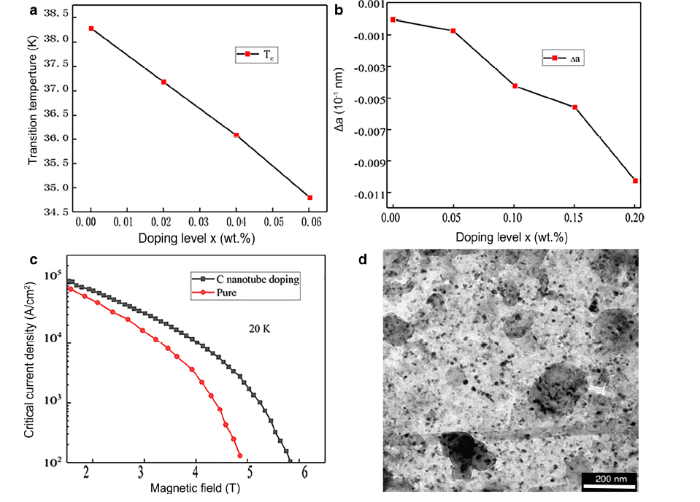
Neutron irradiation [62], Al [63] doping, Sn doping [50], TiB2 [6] doping, carbon nanotube doping [64], and elemental carbon doping [9,10,11, 65,66,67,68,69], etc., have been adopted to increase the Hc2 and Jc(H) of MgB2. Carbon can substitute on boron sites [48] in MgB2 and enhance the impurity scattering. Various elemental carbon in MgB2 increases Hc2 and form lots of nanoparticles as flux pinning centers to improve the high-field Jc. Dou et al. [11] have fabricated carbon nanotube-doped MgB2. The Jc is more than 10,000 A/cm2 at 20 K and 5 K in the field of 4 T and 8.5 T, respectively, with a-axis reduced caused by the effect of carbon substitution, for C-B bound is shorter than B-B bound, as shown in Fig. 1b, c. Figure 1a shows that depressed Tc is caused by the volume decrease and impurity phases in elemental carbon-doped MgB2. The Tc depression is acceptable considering the enhancement of the Jc(H) and the potential usage temperature of 20 K. Carbon-containing materials doping including SiC doping, organic doping, graphene or graphene oxide doping, and pre-coating boron powders with thin carbon layer have increased Jc(H) of MgB2 far beyond that of the elemental carbon doping. Their doping effects on Tc, Hc2, flux pinning, and Jc(H) to date are presented.
Fig. 1 a Transition temperature versus doping level ©2001 The American Physical Society; b lattice parameter a for various carbon doping levels © 2006 IOP Publishing Ltd Printed in the UK; c the critical current density as a function of magnetic field at 20 K (Pure © 2006 IOP Publishing Ltd Printed in the UK, C nanotube doping © 2003 American Institute of Physics), d TEM image of elemental carbon-doped MgB2 © 2006 IOP Publishing Ltd Printed in the UK [
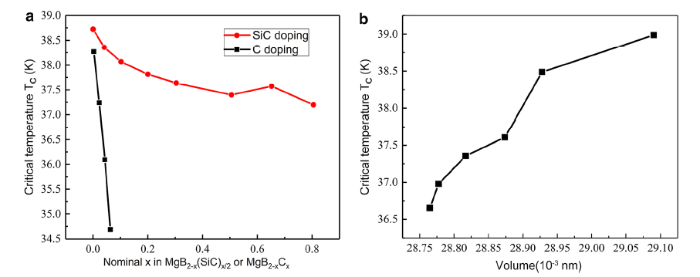
SiC doping can enhance the Hc2 and high-field Jc of MgB2 with weaker field dependence compared to elemental C or Si doping [17]. A series of MgB2-x(SiC)x samples with x (nominal) changing from 0 to 1 have been prepared to investigate the influences of SiC doping on lattice parameters, transition temperature (Fig. 2a), and Jc(H) [23]. The a-axis decreases with the content of SiC doping, until the substitution reaches a saturation level around x = 0.6. The Tc is volume dependent (Fig. 2b) and is higher than that of elemental carbon-doped MgB2. It is proposed that the C and Si co-doping has a counterbalance effect to slow down the volume decrease and depresses the Tc drop [24]. The optimal Jc is achieved in doping level of 0.1 < x < 0.3. The amount of non-superconducting phase would increase and damage the superconductivity while over doping. The very low doping level (x < 0.1) damages the superconductivity, which is anticipated to be too small doping level without sufficient substitution but distorting supercurrent path.
Fig. 2 a Critical temperature versus doping level of the SiC dopant and C dopant; b critical temperature versus crystal lattice unit cell volume [
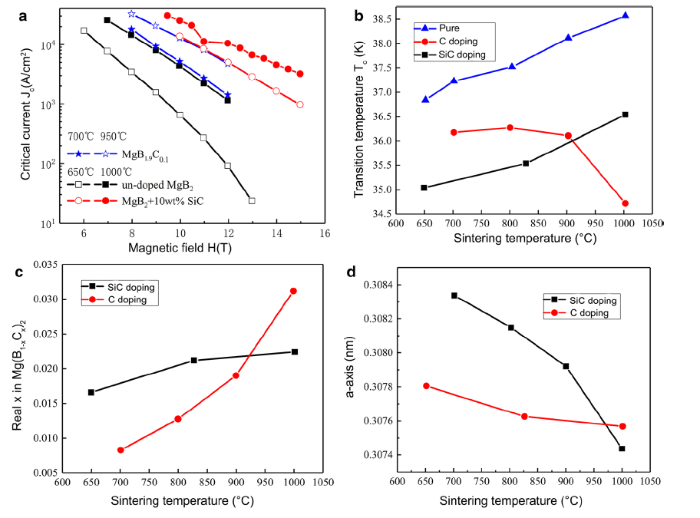
SiC doping and nanocarbon doping have been compared over a sintering temperature range from 600 °C to 1000 °C [18], as shown in Fig. 3. The level of C substitution on B sites can be estimated through a-axis degradation [70]. Nano-SiC-doped MgB2 sintered at a lower sintering temperature achieves the same substitution level and Jc(H) increment as that of higher-temperature-sintered nanocarbon-doped MgB2 (Fig. 3a, c). The best Jc(H) is got by the low temperature (650 °C)-sintered SiC-doped sample, up to 10,000 A cm-2 at 4.2 K and 12 T. Lower sintering temperature ensures refined grains and lots of defects in MgB2 matrix, which act as flux pinning centers. SiC doping combines the advantages of substitution effect and stronger flux pinning force. High sintering temperature decreases the Jc(H) due to the larger grain size with weaker flux pinning force though the crystallinity and the improved substitution level.
Fig. 3 a Critical current density (Jc) at 4.2 K versus magnetic field for the SiC-doped and pure MgB2 sintered at 650 and 1000 °C, and C doped sintered at 700 and 950 °C; b the critical temperature (Tc) versus sintering temperature; c the actual C substitution level, x, in Mg(B1-xCx)2 versus sintering temperature; d the a-axis lattice parameter versus sintering temperature[
The dual reaction model demonstrates the mechanism for the effectiveness of SiC doping to increase Jc(H). Nano-SiC is highly reactive, and at a low temperature, 600 °C, can react with Mg to release C [20]. Defects, nanoscale by-products are involved into the matrix as flux pinning centers, which is described by the following formula:
$${\text{SiC}} + 2{\text{Mg}} = {\text{Mg}}_{ 2} {\text{Si}} + {\text{C}} .$$
The released carbon can substitute into the MgB2 lattice when the boron reacts with magnesium. The substitution and MgB2 formation take place as follows:
$${\text{Mg}} + \left( {2 - x} \right){\text{B }} + x{\text{C}} = {\text{MgB}}_{2 - x} {\text{C}}_{x} .$$
Dual reaction of SiC doping leads to increased Hc2 and releases uniformly dispersed flux pins to increase the Jc(H) of MgB2. The Jc(H) of 10 wt% ex situ SiC-doped MgB2 [14] is impacted by worsened connectivity caused by agglomeration of dopants at grain boundaries. Although uniform dispersed nanoparticles in MgB2 matrix like nanoimpurities in the in situ nanoSi-doped MgB2 [15, 22] serve as effective pins, the Jc(H) and pinning performance are not as good as those of the in situ SiC-doped samples.
Two sets of MgB2 doped with SiC and with (C + Si), respectively, have been sintered using in situ reaction method at 650 and 850 °C [13] to analyze the effects of intra-grain defects in enhancing Hc2, pinning force, and Jc(H). Owing to the dual reaction model, SiC doping induces higher density of defects at both sintering temperatures and higher carbon substitution level at 650 °C. The higher C substitution level sintered at 850 °C is owing to higher free carbon content in the process of (C + Si) doping [71]. The 850 °C-sintered SiC-doped sample shows the best Hc2 and Jc(H) performance due to the combined effects of higher C substitution level and higher density of defects. Besides, SiC-doped samples have better connectivity compared to (Si + C)-doped sample. The calculated active cross-sectional area (AF) at 650 °C were 0.085, 0.056 and 0.027 for pure, SiC, and (C + Si)-doped samples, respectively. Increasing sintering temperature from 650 to 850 °C leads to an obvious AF increase for the pure sample from 0.085 to 0.107, but no noticeable AF changing for both the doped sample. Improvement in the connectivity with increasing temperature is hindered by the impurity phases as a result of the reaction between the additives, magnesium and boron.
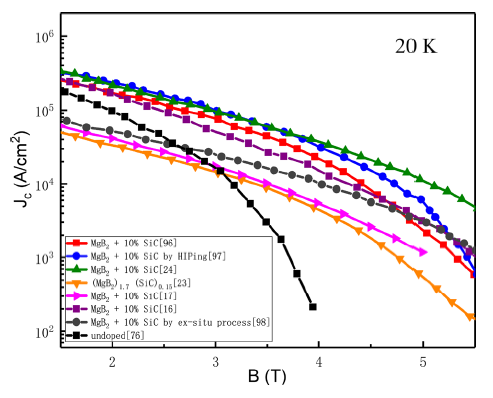
Figure 4 compares the Jc dependence on applied magnetic field at 20 K. Compared with the undoped MgB2, the SiC-doped samples have a better Jc performance and are quite similar over the whole field range. Dou et al. [23, 24, 72] fabricated SiC-doped MgB2 by an in situ reaction method, which has a Jc value of 18,000 A/cm2 at 4 T (20 K) [72] and 105 A/cm2 at 3 T [24], respectively. Wang et al. [73] used the hot-isostatic pressing (HIP) method to increase the density of SiC-doped MgB2. An enhanced Jc and superior Jc field dependence were successfully obtained via this method. Thermal strain was induced to enhance the properties of SiC-doped MgB2 by Zeng et al. [16], which resulted in an improved in-field Jc and a lack of degradation in the self-field Jc. Li et al. [74] reported nano-SiC-doped MgB2/Fe wires fabricated via ex situ process, which achieved high-quality MgB2 wires at a lower sintering temperature.
Fig. 4 Critical current density (Jc) at 20 K versus magnetic field with different SiC-doped and pure MgB2[
Organic doping has the benefits of both homogeneity and low cost in contrast with nanocarbon and nano-SiC doping. Organics, such as malic acid, sugar have a decomposition temperature lower than the formation temperature of MgB2. Homogeneous fresh carbon is released before the Mg-B reaction takes place, contributing to sufficient carbon substitution on boron sites and lots of defects in MgB2 matrix. The Jc(H) increment at high fields induced by organic doping matches or even exceeds the optimal of SiC doping with an extra advantage in low field region.
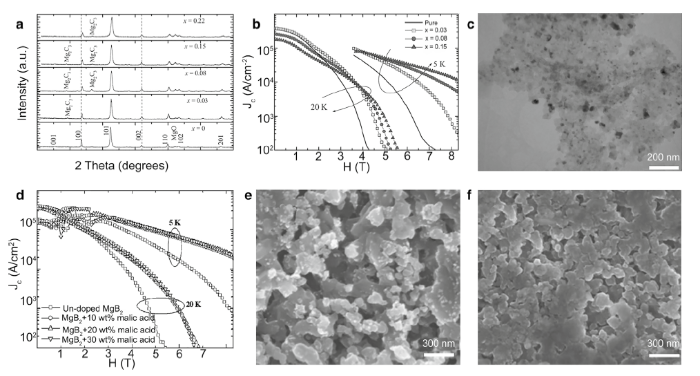
Zhou et al. [30] and Shcherbakova et al. [28] have adopted sugar as the organic dopant to rise the superconducting properties of the MgB2 (Fig. 5a-c). The prepared MgB2 mainly consists of MgB2 phase, with MgO and sometimes Mg2C3 depending on the doping level as the impurity phases, which is related to the competition among C, O, B and H2O to react with Mg as discussed by Zhou et al. [30]. Mg predominantly reacts with B to form MgB2. With the amount of oxygen increases in the reaction materials, the content of MgO increases. Less Mg is left to react with C to form Mg2C3. Unlike nanocarbon or SiC doping, the Jc of the organic-doped sample does not undergo obvious degradation at a relatively low doping level, which is attributed to the homogeneous wet mixing process. Kim et al. [32] pre-treated boron powder with malic acid solution before mixing with Mg, followed by sintering at 900 °C to prepare MgB2. Compared with the undoped sample, the Hc2, Hirr and Jc(H) of the doped MgB2 increase over the entire measured fields, especially the Jc increment by a factor of 21 at 5 K and 8 T as shown in Fig. 5d. Figure 5e and f shows undoped MgB2 and malic acid-doped MgB2, respectively. It can be seen that a smaller grains and denser morphology was gained in malic acid-doped MgB2 compared to the undoped one. Gao et al. [31] have fabricated malic acid-doped MgB2 at 800 °C, which achieved a significant enhancement of Jc, Hirr caused by the increase in Hc2 and the grain size refinement by malic acid. Organic doping improves the Jc(H) of MgB2 through increased Hc2, enhanced flux pinning force offered by defects, and relatively better connectivity compared to nanoparticle doping.
Fig. 5 XRD patterns a, critical current density b, TEM image c of the sugar-doped MgB2, respectively © 2007 WILEY-VCH Verlag GmbH & Co. KGaA; critical current density d, SEM images of the pure e, the malic acid-doped f MgB2, respectively © 2006 American Institute of Physics[
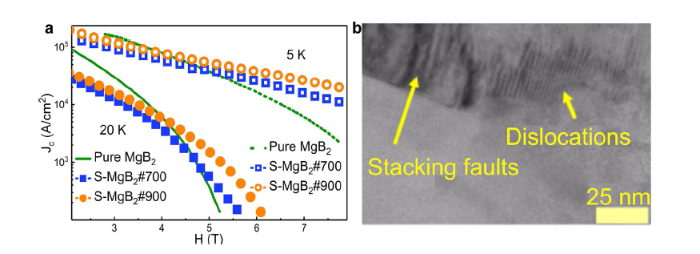
Shcherbakova et al. [28] have investigated the microstructure and flux pinning mechanism of sugar-doped MgB2. The flux pins mainly consist of surface pins including grain boundaries, crystal lattice defects like dislocations and stacking faults based on analysis through the Dew-Hughes model [75]. Point pins provided by nanoinclusions are not important. Transmission electron microscopy (TEM) investigation confirms lots of lattice defects (Fig. 6b) within MgB2 matrix as flux pins. Taking into account analysis of the Dew-Hughes model and microstructures, the flux pinning performance in sugar-doped sample is enhanced by the surface type lattice defects. Nanoinclusions in the matrix can boost the “secondary” lattice defects. Shcherbakov et al. [76] fabricated sugar-doped MgB2 with a high-temperature sintering (950 °C), which also got an enhancement of Jc and critical filed (Hc) caused lattice defects. Bao et al. [77] carbonized the sugar-coated B powders before mixing with Mg powders, and the pre-carbonization treatment successfully suppresses the formation of impurity to achieve an improved Jc at low fields.
Fig. 6 a Critical current density for pure and sugar-doped MgB2; b crystal lattice defects in organic-doped MgB2, respectively[
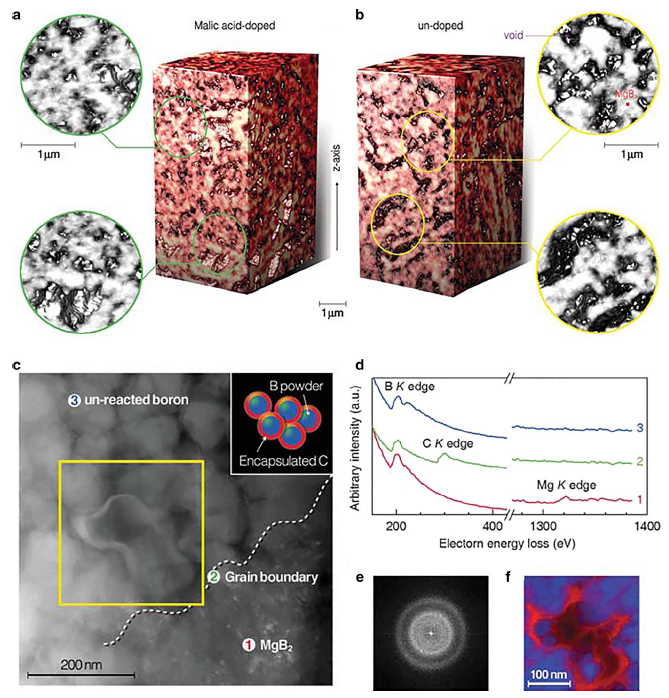
Kim et al. [26] have studied the microstructure of the malic acid-doped MgB2 by the three-dimensional X-ray tomography (Fig. 7a, b), high-resolution transmission electron microscopy (Fig. 7c), and electron energy loss spectroscopy (Fig. 7d). Compared to the undoped sample, the total voids fraction of the doped sample is reduced from 50 to 40% with doubled voids number, but more than four times reduced average size, which increases the packing density and improves the connectivity between grains. The crystallite size is reduced from 44 to 40 nm with doubled lattice distortion in malic acid-doped MgB2. The lattice defects and the refined grains enhance the flux pinning and increase the Hc2. A detailed investigation on the interface between the MgB2 phase and the impurities indicates that thick carbon layer (~ 10 nm) remains in the material even after high-temperature sintering. The carbon layer from the malic acid suppresses the agglomeration of boron, leading to refined grains and the denser packing. The thick carbon encapsulation of boron generates boron deficiency and lattice defects including boron vacancies and stacking faults. Amorphous boron, ~ 100 nm, in the matrix can damage the connectivity and hinder the improvements of Jc(H).
Fig. 7 X-ray tomogram restruction of the malic acid-doped MgB2a, undoped MgB2b, respectively; scanning transmission electron microscope image of MgB2c, electron energy loss spectrum (EELS) d, fast Fourier transform (FFT) pattern e for the impurity phase, color map of electron energy loss f of boron K (blue color) and carbon K (red color) in a selected area of a (marked with yellow box), respectively[
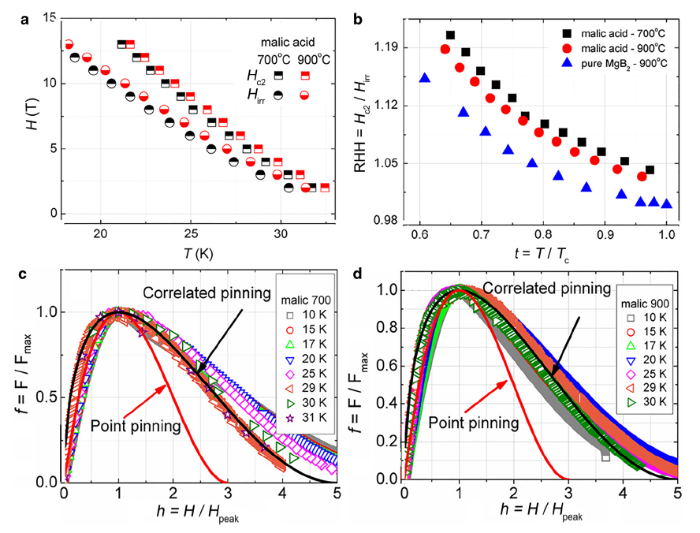
Wang et al. [78] have proposed an approach to estimate whether effective pins were introduced into MgB2. The RHH, the ratio of the Hirr and Hc2, is as close to 1 as possible in the presence of effective pins. If the value of RHH is larger than 2, the flux pinning is not enhanced. Motaman et al. [79] have calculated the RHH of MgB2 treated by malic acid following sintered at 700 and 900 °C (Fig. 8a, b). The value of RHH for samples prepared at 900 °C is closer to 1 than those of the samples prepared at 700 °C, which indicates that pinning efficiency becomes lower for samples prepared at 700 °C. The flux pinning and Jc(H) could be further enhanced by optimizing sintering temperature. Motaman et al. have analyzed the flux pinning mechanism of MgB2 treated by malic acid. δl and δTc pinning mechanisms are dominant mechanisms at low and high temperatures, respectively. At low magnetic field, the dominant mechanism is point pinning, while correlated pinning becomes dominant at higher magnetic fields (Fig. 8c, d).
Fig. 8 aHc2 and Hirr versus operating temperature for the malic acid-treated MgB2 sintered at 700 and 900 oC; b RHH ratio versus reduced operating temperature for the undoped and malic acid-treated MgB2 sintered at 700 and 900 ° C; c, d the reduced pinning force f(h) versus the field dependence in the temperature range of 10-30 K[
Compared with the SiC-doped MgB2, boron vacancies, dislocations, stacking faults, and refined grains in organic-doped MgB2 benefit the flux pinning, while oxygen in the organics results in higher MgO content and poor connectivity between grains in MgB2. And the low-field performance does not decrease with the increment of high-field performance by the organics doping. Aromatic hydrocarbons distinguished for high carbon content and low oxygen content have been adopted in MgB2 for homogeneous and sufficient carbon doping. Kim et al. [29] and Maeda et al. [27] have fabricated pyrene-doped MgB2. Ye et al. [25] have doped MgB2 with coronene. In fact, most of the poly-aromatic hydrocarbons with melting points lower than the decomposition temperatures and decomposition temperatures lower than the practical sintering temperature of the MgB2 are promising organic candidates for improving the in-field superconducting performance of MgB2.
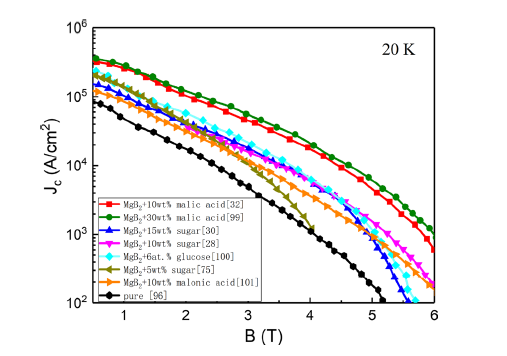
The Jc of a group of different organic-doped samples and undoped MgB2 were compared in Fig. 9. Kim et al. [32, 80] fabricated different contents of malic acid-doped MgB2 samples by in situ reaction process, which achieved nanodoped materials using a C4H6O5 + C7H8 solution and solved the agglomeration problem. Zhou et al. [30] and Shcherbakova et al. [28] used sugar as the carbon resource to dope in MgB2 through an in situ reaction process. They used sugar to mix with boron powders with the help of distilled water, following the drying processes in a vacuum chamber to obtain the sugar-coated boron powders. Ning et al. [77] found that the pre-carbonization treatment can effectively suppress the increase of impurity and thus the final obtained sugar-doped MgB2 samples show a significant enhancement of Jc compared with pure MgB2. Parakkandy et al. [81] reported the glucose-doped MgB2 superconductor fabricated by dry mixing using planetary ball milling. The MgB2 samples with 6 at.% glucose-doped showed the highest Jc$\approx$ 2 $\times$ 104 A/cm2 for 20 K at 3 T. Li et al. [82] have studied the structure of malonic acid-doped MgB2. Compared to the undoped sample, a grain refined MgB2 was gained with a moderate amount of malonic acid addition and the highest Jc value was obtained with 10 wt% malonic acid addition. The enhancement of Jc is achieved in all organic-doped samples and does not degrade in the self-field for organic-doped MgB2 samples, as indicated in Fig. 9. The self-field performance is quite competitive with results of SiC-doped samples [23, 24].
Fig. 9 Critical current densities (Jc) at 20 K versus magnetic field with organic-doped and pure MgB2[
Two-dimensional nanostructures such as graphene, graphene oxide (GO) and reduced graphene oxide (rGO) are distinguished for their high doping efficiency in MgB2, which significantly increase the Jc(H), Hc2 and Hirr at a lower doping level, with connectivity between grains unaffected or even been improved.
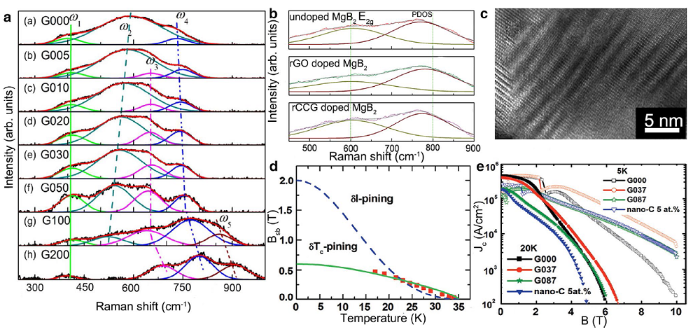
Xu et al. [37] and Li et al. [35] have investigated the effect of graphene doping on the properties of MgB2. The substituted effect of carbon on boron sites is not obvious in these cases due to the strong carbon bound in graphene. Graphene sheets serve as micro-substrates to induce tensile strain in the doped sample evidenced by the softened E2g mode (ω2) as shown in Fig. 10a-c. Tensile strain and less carbon substitution on boron sites suppress the Tc drop in graphene or graphene oxide-doped MgB2. The Jc(H) at all fields of the sample with optimal doping level are higher than those with undoped, indicated that enhanced flux pinning force with excellent connectivity. Over-doped samples have lower low-field Jc due to deteriorated connectivity caused by agglomeration of impurities. Still, the Jc of the over-doped MgB2 drops slower in magnetic field than those with undoped, indicating strong pins are induced by graphene doping. Xu et al. [37] have investigated the flux pinning mechanism in graphene-doped samples. Same to MgB2 in polycrystalline [83], thin film [84], and single crystalline [85], δTc pinning is the dominant pinning mechanism in graphene-doped samples (Fig. 10d). The local strain-induced defects, lattice distortion, and amorphous phases, which are favorable for the δTc pinning are the effective pins in graphene-doped samples. While most forms of carbon-containing material-doped samples have the δl pinning related to strong scattering and the shortening of the mean free path as the dominant pinning mechanism [86].
Fig. 10 a Raman spectra of graphene-doped MgB2 © 2012 IEEE 1051-8223; b Raman spectra with Gaussian fitted E2g mode and PDOS distortion of the pure, rGO and rCCG-doped MgB2 © The Royal Society of Chemistry 2012; c TEM images of graphene-doped MgB2 © 2012 IEEE 1051-8223; d, e the crossover field Bsb as a function of temperature and critical current density of graphene-doped MgB2 © 2010 IOP Publishing Ltd Printed in the UK & the USA[
GO doping has been adopted in MgB2 by Silva et al. [36], Sudesh et al. [34] and Yeoh et al. [33] with advantage of low cost compared to graphene doping. Similar with graphene doping, GO doping has high doping efficiency, much smaller lattice decreases compared to that of SiC or organic doping and small impact on Tc. Jc(H) increases over entire field in MgB2 with proper content of GO doping. Sudesh et al. have investigated the doping effect of GO on MgB2 with a wider wt% range (0, 1, 2, 3, 5, 7, and 10 wt%). The amount of MgO increases with the GO doping level increased due to higher oxygen contents in raw materials, which is different with graphene doping. Contrary to SiC or organic doping, optimal GO doping decreases the resistivity of MgB2 with a counteracting effect of improved connectivity and roman spectra evidenced increased disorder.
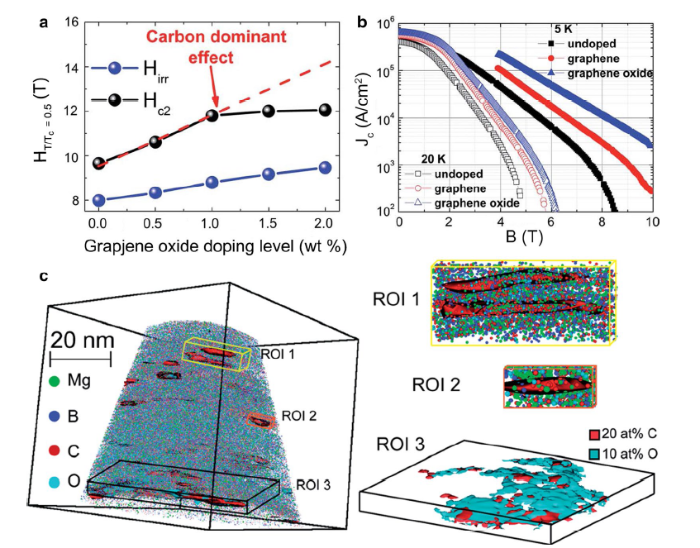
Yeoh et al. [33] have investigated the influence of GO doping in microscopy scale with the help of atom probe microscopy (APM) and density functional theory (DFT) (Fig. 11). The Hirr increases gradually with increasing GO doping level while the Hc2 remains unchanged when doping level exceeds 1 wt%, which suggests the weak carbon substitution effect as shown in Fig. 11a. The GO platelets in MgB2 uniformly disperse in the same orientation with carbon and oxygen segregating toward the grain boundary. Inter-connected GO plates in the matrix texture the MgB2 grains by refining the grains, constrain the growth of MgB2 to a specific orientation. MgB2 grains can suppress the percolation effect and facilitate long-range current pathways, with the help of high fraction of low-angle grain boundaries. Oxygen decomposition on the surface of GO can be introduced into MgB2 to form a solid solution Mg (B, O)2, which is surrounded with ~ 7 nm MgO particles through a spinodal-like phase separation. This is different from other oxides doping and yields intra-grain pins in MgB2. Inter- and intra-granular flux pinning provided by both grain texturing and the oxygen incorporation enhance the Hirr and Jc(H) of GO-doped MgB2.
Fig. 11 a Temperature dependence of normalized Hirr and Hc2, b critical current density; c 3D atom probe tomography reconstruction of GO-doped MgB2[
Kim et al. [46] believed that high Jc(H) performance MgB2 fabricated by thin carbon-coated boron can be attributed to two reasons: homogeneous carbon doping and refined grains. Homogeneous carbon doping assures sufficient carbon substitution on boron sites and less impurities, which enhances the impurity scattering, Hc2, while leaving the connectivity as good as the pure sample. Refined grains provided by carbon layer suppressing grain growth result in high grain boundary density and enhance grain boundary pinning.
Kim et al. [46] have reported high-performance MgB2 wires fabricated using radiofrequency argon plasma method synthesized thin carbon-coated boron [47]. Methane(CH4) is injected to the reaction gas to form a mixture of boron trichloride(BCl3), hydrogen(H2) and methane(CH4) to prepare carbon-coated boron. The prepared boron particles have a uniformly carbon coating, 1-2 nm, with average size of about 65 nm. Amorphous boron is reactive and easy to react with magnesium [45], while high temperature and long reaction time are usually required for crystalline boron which mainly has β-rhombohedral structure to fully react with magnesium to form MgB2 [87]. The very fine plasma synthesized crystalline boron powder in this case enables the lower reaction temperature and small MgB2 grain size.
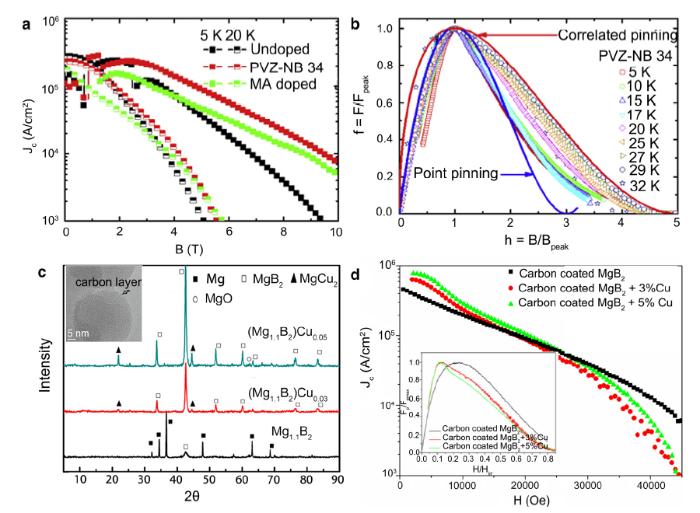
The residual BCl3 on the boron powders in plasma method synthesized carbon-encapsulated boron has a detrimental effect on the superconducting properties of MgB2, to avoid which Barua et al. [44] have fabricated carbon-coated boron through pyrolysis of B2H6 mixed with hydrocarbon under inert atmosphere(Fig. 12a, b). The resulting boron powder is uniform spherical shape encapsulated by thin carbon layer. This kind of carbon-encapsulated boron powders is commercially available, produced by PAVEZYUM, Advanced Chemicals, Turkey. Liu et al. [43] have combined this carbon-coated boron with the Cu-activated low-temperature sintering (600 °C) for the Jc(H) improvement (Fig. 12c). Low-temperature sintering (below the melting point of Mg) depresses the volatility of Mg, which not only decreases the loss of Mg but also leads to lower MgO content. Cu have been found to be effective in improving the reactivity of the solid-state reaction [88] to reduce the reaction time [89]. Minor Cu-activated low-temperature sintering and the carbon-coated boron contribute to smaller grains and homogenous carbon doping, which lead to enhanced flux pinning and the improved Jc(H) in MgB2. Peng et al. [42] have synthesized minor Cu-doped MgB2 at 850 °C with the same boron powders coated by carbon. The self-field Jc and low-field Jc of the Cu-doped sample are increased by the improved crystallinity and connectivity (Fig. 12d). The high field Jc is decreased in Cu-doped sample because of the larger grain size and weaker flux pinning force. Impurities such as MgCu2 and MgB4 caused by Cu addition impress the connectivity between grains and is not good at higher Jc(H).
Fig. 12 Critical current density a and normalized pinning force density b of MgB2, respectively © 2015 Acta Materialia Inc. Published by Elsevier Ltd. All rights reserved; c XRD patterns of the Cu-doped MgB2 prepared with carbon-coated boron. The inset is TEM image of carbon-coated nanosize amorphous boron particles prepared by the pyrolysis technique and © 2015 IOP Publishing Ltd Printed in the UK; d critical current density of Cu-doped MgB2 prepared with carbon-coated boron. The inset is the corresponding normalized pinning force Fp/Fpmax as a function of reduced magnetic field h. ©2016 Elsevier B.V. All rights reserved
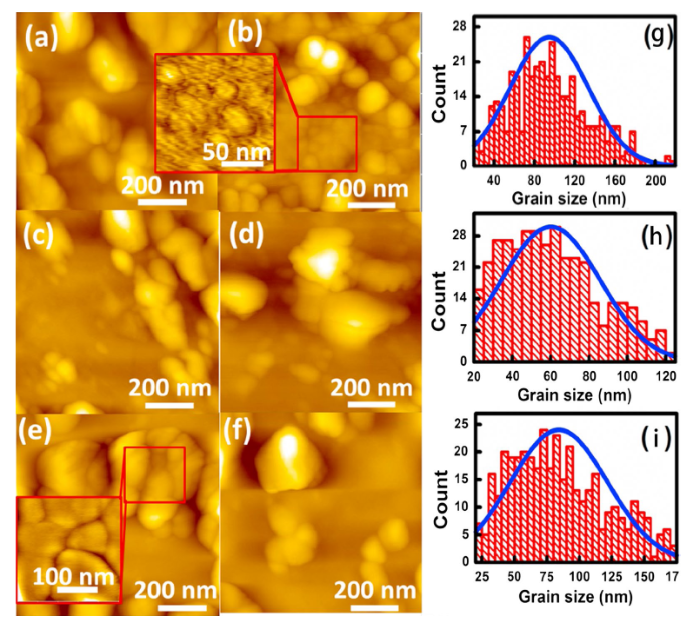
Muralidhar et al. [40] have investigated the effect of carbon content in the carbon-coated boron on the superconducting properties of MgB2 with carbon contents (0, 2.8, 4.5, 7.8, 12 and 16.5 wt%) sintered at 805 °C for 2 h in Ar atmosphere. The best Jc(H) performance was achieved in the 2.8 wt% carbon-coated boron prepared MgB2. AFM study provides direct particle size information of MgB2 prepared with various contents carbon-encapsulated boron [41], as shown in Fig. 13. With 2.8 wt% carbon doping, the average grain size is reduced from 100 to 60 nm. With carbon content further increases to 3.7 wt%, the average grain size increases from 60 to 90 nm. The coherence length of 8-40 nm in the MgB2 matches closely to the average grain size in the sample prepared with 2.8 wt% carbon-doped boron [90]. Proper carbon content results in enough carbon doping, homogeneous microstructure and particle size assisting the flux pinning in MgB2. A further optimal of carbon content or the sintering condition is necessary for further improvements of the superconducting performance.
Fig. 13 AFM images of the MgB2 Prepared with boron powders encapsulated by a 0, b 2.8, c 4.5, d 7.8, e 12, f 16.5 wt% carbon, respectively; Grain size distributions in the samples prepared by boron powders with g 0 wt% and h 2.8 wt% carbon, respectively; i grain size distribution obtained from the samples prepared by boron powders with 4.5, 7.3, 12 and 16.5 wt% carbon[
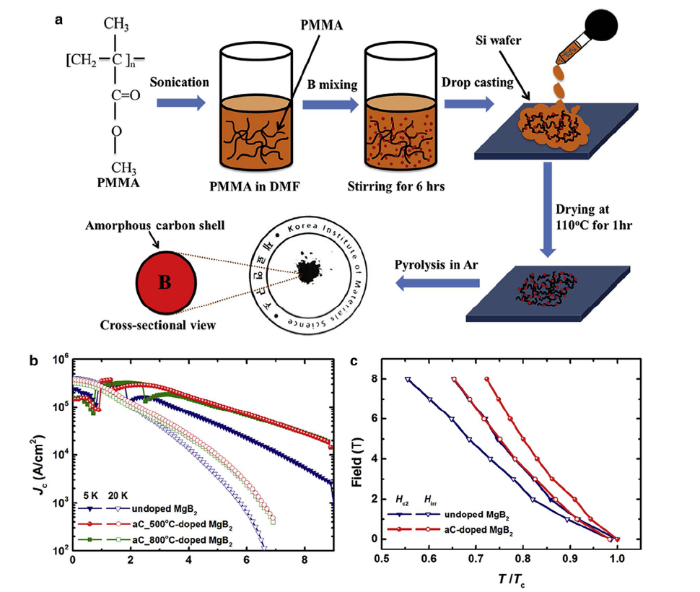
Expensive plasma technique or explosive gaseous carbon sources (CxHy) are adopted in the above-mentioned carbon coating processes. Li et al. [91] fabricated amorphous layer surrounding Nb nanograins by a ball-milling process, which may also be used to get a homogeneous carbon-layer-encapsulated boron. A solution process to prepare 3-4-nm-thin carbon layer encapsulated boron has been proposed by Ranot et al. [39]. Polymethyl methacrylate (PMMA) polymer is first dissolved in N,N-dimethyl formamide (DMF) solution. Then, the boron powder is homogenized in the solution, followed by dropping-cast on Si wafer and drying, high-temperature pyrolysis (Fig. 14). The thin carbon-coated boron derived MgB2 has a comparable connectivity to the pristine MgB2. Besides, the reaction between Mg and oxygen is restricted by the carbon layer. The MgO content in the prepared MgB2 is slightly reduced. Same to graphene or graphene oxide doping, preparing MgB2 using carbon-encapsulated boron also induce two-dimensional flux pins in MgB2 and have shown excellent superconducting performance in both low and high magnetic field. The solution-processed carbon coating method has the advantage of low cost among all carbon coating techniques and has results as good as that achieved by other expensive carbon coating techniques. It is the most practical method to prepare MgB2 applicable to industries.
Fig. 14 a Schematic of the fabricating process of PMMA-derived carbon-coated boron; b the critical current density of MgB2 prepared by PMMA-derived carbon-coated boron; c normalized temperature dependence of Hc2 and Hirr for the MgB2 prepared by PMMA-derived carbon-coated boron[
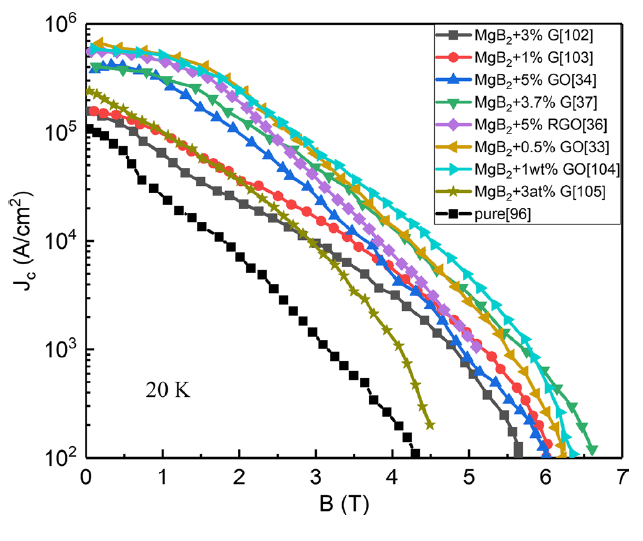
Figure 15 shows the Jc of graphene-related material-doped samples and undoped MgB2. Dou et al. [37] have fabricated the graphene-doped MgB2 by a diffusion process and found that graphene doping has a better efficient than other carbon sources doping for the improvement of Jc. They achieved the best enhancement of Jc with 3.7 at.% graphene doping content. De Silva et al. [92, 93] studied the effects of graphene doping on the superconductivity of MgB2 with different doping contents and sintering temperature via the in situ method. They found that at the doping level of 1 at.% with sintering at 850 °C the sample shows a Jc of 5.6 $\times$ 103 A/cm2 and the flux pinning behavior has been improved due to the graphene doping. Sudesh et al. [34] achieved an enhancement of Jc ~ 0.5 $\times$ 104 A/cm2 at 4 T (20 K) with a GO-doped MgB2. Yeoh et al. [33] successfully reached a higher Jc ~ 1 $\times$ 104 A/cm2 at 4 T (20 K) with a lower GO doping content via the diffusion method. Xiang et al. [94] found that GO-doped MgB2 can improve both low field and high field Jc. GO have a better doping efficiency than graphene for the same doping contents. Silva et al. [36] doped with rGO in MgB2 by a diffusion process at 800 °C for 10 h and the Jc achieved 5.15 $\times$ 105 A/cm2 at zero field (20 K). Compared with SiC doping and organic doping, Graphene-related materials doping have a higher doping efficiency in MgB2, which can achieve a Jc improvement i the whole magnetic field with a lower doping content, meanwhile, avoiding the connectivity damage.
Fig. 15 Critical current density (Jc) at 20 K versus magnetic field with graphene-related material-doped and pure MgB2[
Currently, powder in tube (PIT) technique is the primary method to fabricate MgB2 wires, bulks or other forms. A mixture of the raw materials with specific shape is firstly sealed in a tube before the high-temperature sintering. The sealed container can suppress the loss of volatile Mg at high temperatures [96]. PIT method can be divided into in situ PIT (using Mg and B powders mixture) and ex situ PIT (using MgB2 powder). Hard ceramic nature of MgB2 [97] makes ex situ PIT-fabricated MgB2 with poor connectivity. Chemical or physical treatment [98, 99] to the raw MgB2 powder can improve the connectivity of ex situ MgB2 to some content. The voids caused by volume depressing during the reaction or low packing density of raw materials result in poor connectivity in in situ PIT-fabricated MgB2. In situ PIT-fabricated MgB2 wires have better connectivity in longitude direction compared to bulks [100] due to the rolling procedure. Pressure process and diffusion method have been adopted to increase the density to improve the connectivity of MgB2.
High pressure has been adopted to fabricate MgB2 with high density and better connectivity in the form of rectangular, square blocks as well as in large rings [55, 57, 67, 101]. Kumakura et al. [52, 56] have fabricated MgB2 wires by hot pressing at 630 °C. It has been found that the MgB2 samples fabricated under hot pressure have higher Jc in both bulk and wire form with about three times increase in Jc, which is related to the better connectivity associated with the increase of MgB2 density and better linkage between grains. Hot-pressed MgB2 wire has a certain degree of texturing in Mg inherited from the rolling process compared to bulk form, which is converted into the crystallites during reaction [102] for the Mg-B reaction already starting below the melting point of Mg. Prikhna et al. [55] have manufactured MgB2 blocks by different pressures at 800-1100 °C, who found that higher amount and finer dispersion of inclusion were observed in MgB2 samples with higher critical currents.
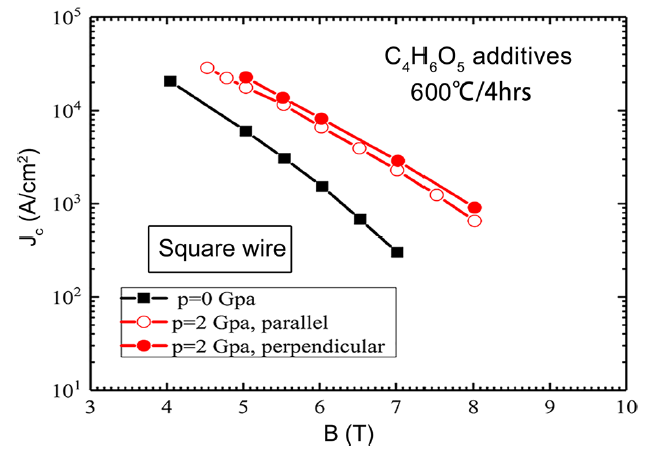
Cold pressure process with the advantage of low temperature and low fabrication cost compared with hot pressure process has been adopted by Flukiger et al. [54] to increase the Jc(H) of MgB2. High-pressure treatment at room temperature is carried out before the high-temperature reaction. The pressure on the wires is applied by means of hard metal anvils in a prototype cell. Nearly 96% of the theoretical mass density of the (B + Mg) mixture was reached after a 6.5 GPa cold pressure step. Cold pressure process improved the connectivity reflected by the decreased electrical resistance in cold-pressure-treated MgB2 wire. The MgB2 wire densified at 1.85 GPa showed an increase of Jc by 300% at 20 K and 5 T compared to that without the application of pressure. At higher magnetic field, 10 T and 4.2 K, a smaller Jc increment of 53% appeared because Jc at high fields has much more to do with flux pinning force than the connectivity. Hossain et al. [53] have combined cold pressure densification and 10 wt% C4H6O5 (malic acid) doping to increase the Jc(H) of MgB2, as shown in Fig. 16. Cold pressure treatment between 1.48 and 2.0 GPa in malic acid-doped MgB2 can fabricate MgB2 with good connectivity and strong flux pinning force. Further higher pressures have been indicated to further enhance the density, but with damaged connectivity due to the presence of microcracks in the matrix. To fabricate long MgB2 wires with high density, a new prototype machine has been constructed by Flukiger et al. [51] with automatic press/release/advance mechanism. The prepared C4H6O5-doped MgB2 wire in longitude of 1 m has almost the same Jc increament as that of the short sample.
Fig. 16 Critical current density of malic acid-doped MgB2 wires fabricated by cold densification at 2 GPa[
The diffusion process, in which Mg-B reaction occurs after the Mg infiltrating into the boron with wanted shape, has also been adopted to improve the connectivity of MgB2. Diffusion method together with chemical doping induced enhanced flux pinning significantly increase Jc(H) of MgB2. Yeoh et al. [33] have combined diffusion method with graphene oxide doping to prepare MgB2 with good connectivity and strong flux pinning force. Giunchi et al. [61] have fabricated MgB2 wire through applied diffusion process. A coaxial internal pure Mg rod and B powder were filled into a Nb tube before the subsequent deformation and heat treatment. The final density of the MgB2 synthesized by diffusion method is mainly determined by the packing density of the raw boron particles. Different tubes have been used to fabricate diffusion method sintered MgB2 wire. Togano et al. [60] have synthesized multi-filamentary wires used a Cu-Ni tube in which each filament comprise an outermost Ta, an intermediate B + SiC powder layer and an Mg core as the center. Their Jc of MgB2 layer reached as high as 99,000 A/cm2 at 4.2 K and 10 T. Nishijima [58] and Shimada et al. [59] have compared the Jc increment of MgB2 wires prepared by diffusion method with that of the MgB2 wire prepared by common PIT method. Jc value of the MgB2 wire fabricated with diffusion method is five times larger than that of PIT method fabricated one at 5 T and four times at 10 T, respectively.
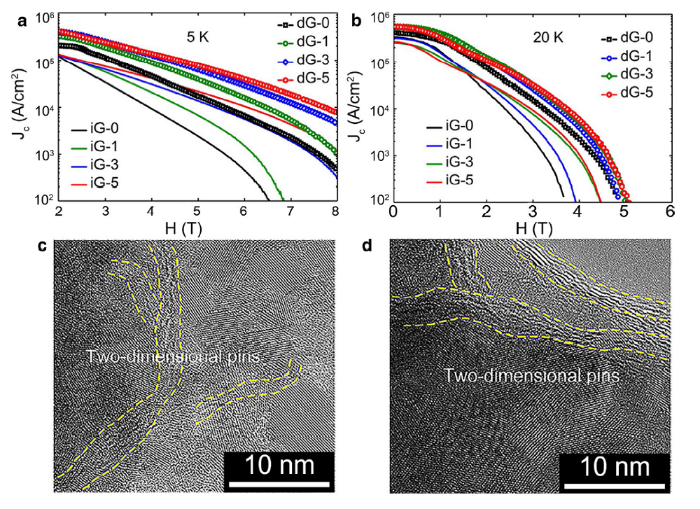
Li et al. [103] have fabricated MgB2 by the boron particles with a graphene coating via in situ method, hydrothermal process, successfully induced 2D flux pinning centers and achieved optimized graphene distribution. And the MgB2 bulks fabricated by the in situ (iG-x) and diffusion (dG-x) methods were compared to study the connectivity and flux pinning effect. The consequence was showed that better Jc(H) was achieved in all diffusion processed samples at 5 and 20 K, respectively, which caused by higher density (Fig. 17a, b). The graphene layer as 2D flux pinning centers with a thickness less than 5 nm was remained after sintering to enhance the connectivity of MgB2 (Fig. 17c, d).
Fig. 17 a, b Magnetic field dependence of Jc for in situ and diffusion method-processed MgB2 at 5 and 20 K, respectively; c, d two-dimensional remnant graphene dispersing within the MgB2 particles and coating on the surface serving as effective flux pinning centers[
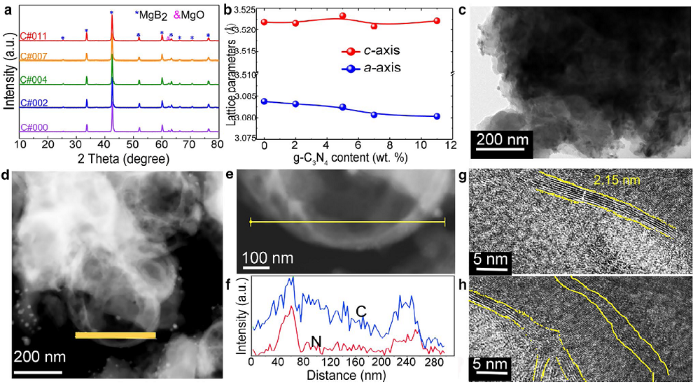
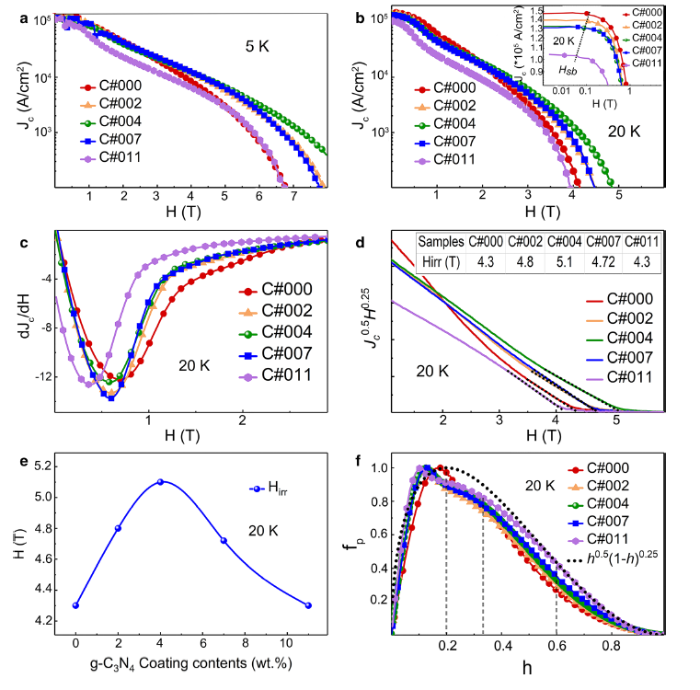
Li et al. [104] employed the g-C3N4 coated boron as precursor, to synthetize MgB2 at 850 °C. The coating layer of g-C3N4 was decomposed to 2D few-carbon layer which demonstrated high flux pinning efficiency as 2D flux pinning centers in MgB2 (Fig. 18). All MgB2 with different g-C3N4 contents (0, 2, 4, 7 and 11 wt%) were compared and best Jc(H) performance was achieved in the 4 wt% at 5 K and 20 K (Fig. 19). The size, distribution, and density of flux pinning centers can affect greatly increasing Jc(H). Homogeneous flux pinning centers without agglomeration was achieved in MgB2 with a 4 wt% g-C3N4 content, which offered strong flux pinning force and did not damage the connectivity of MgB2. A higher g-C3N4 content would induce large impurities and agglomerates in MgB2, which can damage the connectivity and decrease Jc(H). Based on the GO and g-C3N4 coating results, Li et al. [105] have developed a carbon coating technique to tune the thickness of the 2D flux pinning centers from 1 to 5 nm.
Fig. 18 Phase and microstructures of MgB2 samples. a X-ray diffraction (XRD) patterns for MgB2 prepared with B@g-C3N4 with different coating contents. b Lattice parameters of MgB2 with different g-C3N4 coating contents derived from the refinement results. c TEM image for C#004 sample. d-f Liner scans of EDS spectrum for C#004 sample. g, h HRTEM images for C#004 sample[
Fig. 19 Critical current density and the flux pinning performance of the MgB2 samples. a, b Citical current density as a function of magnetic field for all the prepared MgB2 at 5 and 20 K, respectively and the inset shows the double logarithmic Jc(H) curve at 20 K. c Critical current density decreasing rates as a function of magnetic field for all the prepared MgB2. d Linear extrapolation to zero of the low-Jc segment of J0.5c × H0.25 to get the Hirr values and the inset displays the Hirr values. eHirr values of MgB2 with different g-C3N4 contents. f Normalized flux pinning force as a function of the normalized magnetic field (H/Hirr) for all the prepared samples, and the reference curve for two-dimensional flux pinning[
Jc(H) of MgB2 is determined by Hc2, flux pinning and connectivity. Various elemental carbons and carbon-containing materials have been adopted to increase Hc2 and induce flux pinning centers in MgB2. Carbon can increase Hc2 and induce disorder by substitute on boron sites in MgB2. Nanoparticles, stacking faults, and dispersed graphene or GO plates in MgB2 matrix can serve as pining centers to increase Jc(H). SiC doping and organic doping increase the high-field Jc while decrease the low-field Jc due to the presence of large amount of impurity phases. Graphene, GO doping and preparing MgB2 using carbon-encapsulated boron induce two-dimensional pinning centers in MgB2, which enhance the flux pinning force and maintain or even improve the connectivity due to the low doping level and the grain texturing effect. Carbon coating achieves more homogeneous doping compared to graphene or GO doping as far as our knowledge. The solution-processed carbon coating technique is the most scalable and practical method to prepare MgB2 with high Jc(H). Pressure treatment or diffusion method can prepare MgB2 with better connectivity caused by smaller voids fraction in MgB2, of which the diffusion method is the most economic one. A systematical investigation on fabricating MgB2 with solution-processed carbon-encapsulated boron through diffusion method may promote the practical application of MgB2.
This work is financially supported by the National Natural Science Foundation of China (Grant No. 51572166), the Ministry of Science and Support International Cooperation Projects (No. 2015DFA13040), and the Shanghai Key Laboratory of High Temperature Superconductors (No. 14DZ2260700). The authors thank the Analysis and Research Center of Shanghai University for their technical support. W.X. Li acknowledges research support from the Program for Professors with Special Appointments (Eastern Scholar: TP2014041) at Shanghai Institutions of Higher Learning.

 WeChat
/
| 〈 |
|
〉 |